


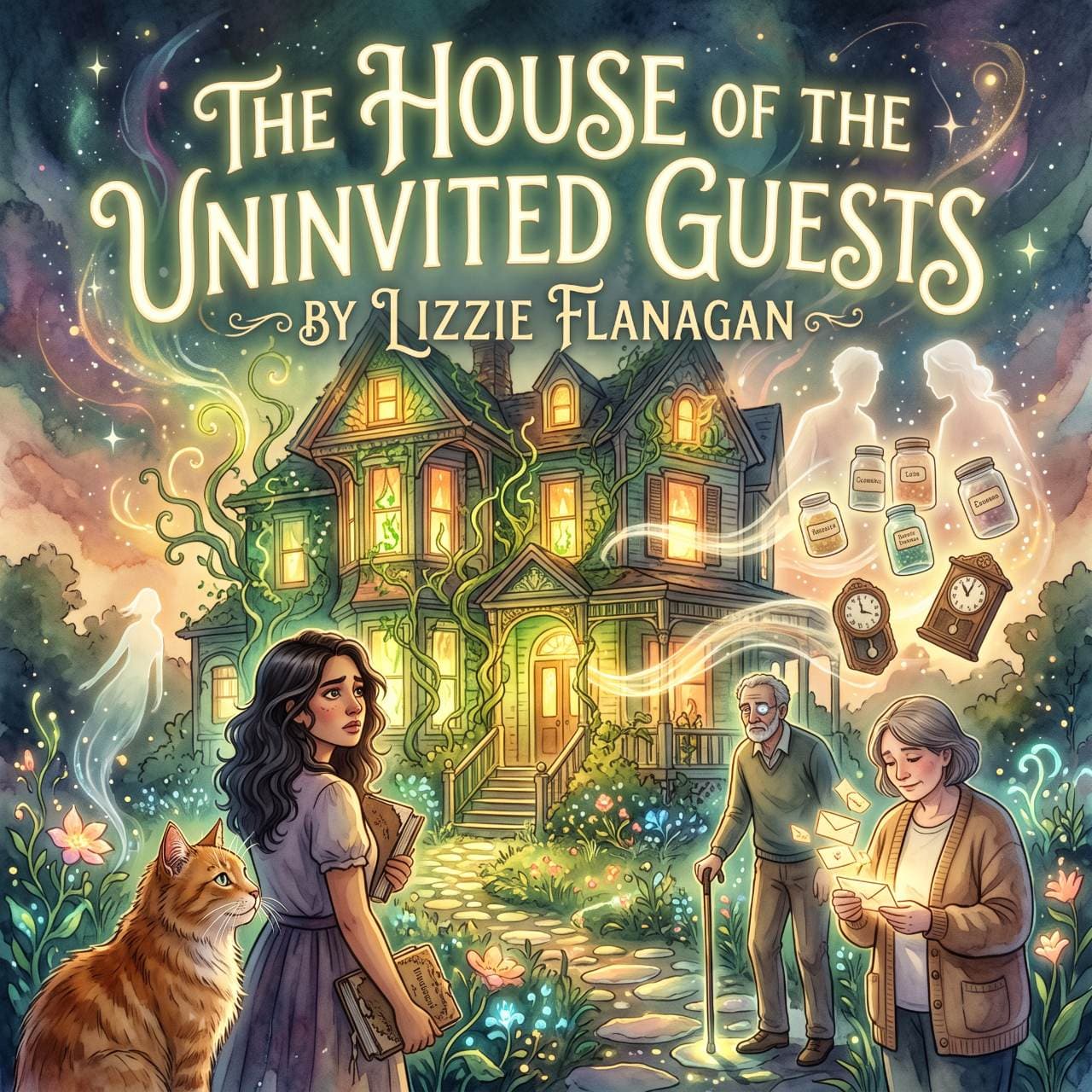

Thirty-four years after Clementine's death, Maria Sanchez sat in the kitchen window seat and watched the rain. Her knees ached with a precision Arthur would have appreciated, barometric pressure dropping, she could feel it in the bone, a personal weather system that predicted storms twelve hours before they arrived. She was seventy-one years old. Her hair had gone the color of the marmalade cat she'd buried in the garden, and her hands had developed the same architectural quality as Arthur's journals, all tendon and memory and deliberate movement.
The house had grown around her like a second skin. She had filled it with the uninvited.
There was the room upstairs where Thistle had lived until his heart failed at fifty-six, suddenly, unfairly, leaving his blackthorn cane by the door where it still stood, gathering dust that Maria refused to disturb. There was the converted library where Zephyr had spent her final weeks, refusing to die in a hospital, teaching Maria the protocols of death midwifery between doses of morphine. There were the guest rooms, constantly rotating: the bipolar teenager whose parents had kicked her out, the veteran with phantom limb pain who'd stayed for three years learning to garden with one hand, the elderly couple who'd fled their assisted living facility to die together in the back bedroom, holding hands, leaving behind a ceramic mug with a chip in exactly the right place.
Maria had become what Arthur was, a node in a network of the displaced, a temporary home for those who had nowhere else that would accommodate their specificity.
But now she was dying, and she knew it with the same certainty she knew the rain was coming. Pancreatic cancer, fast and efficient, diagnosed three months ago. She had declined treatment. She had things to do first. The house needed its next guardian.
The doorbell rang at 4:47 PM, during the particular light that fell at 45 degrees in October, though this was March and the angle was different, the light softer, more forgiving. Maria didn't move from the window seat. She waited.
The knock came. Then another. Then a voice, hesitant, filtered through the door: "Hello? My car broke down. Down the street. I know this is...I wouldn't normally...but my phone is dead and my dog needs water and I saw the lights..."
Maria smiled. The house had called out. It always did.
"Come in," she called, her voice still strong despite the cancer eating her from the inside. "The door is unlocked. It always is."
The young person who entered was twenty-six years old, Maria guessed, though they had the kind of face that age sat on differently, time moved through them in tides rather than lines. They were small, compact, dressed in layers that suggested living out of a backpack, and they moved with the careful deliberation of someone for whom every motion required negotiation with a rebellious nervous system. A service dog stood beside them, a rangy mutt with one ear up and one ear down, wearing a vest that read: *DO NOT PET—MEDICAL ALERT.*
"I'm Zosime," they said. "Zo. I'm sorry. I shouldn't have, I can go. I just needed..."
"Water," Maria said. "For the dog. And for you. Sit down, Zosime. You're exactly on time."
Zo stared at her. Their eyes were different colors, one hazel, one gray, and they had the hypervigilant posture of someone who had learned that safety was temporary and conditional. "On time for what?"
"For me to die properly," Maria said, and laughed at Zo's expression. "Don't look so alarmed. I'm not dying today. Probably not this week. But soon. And I needed to meet you first."
"I don't understand."
"No," Maria agreed. "You don't. Not yet. But you will." She gestured to the chair across from her, the one Thistle had always used, the one that accommodated a bad leg and a good heart. "Tell me why you're on Meridian Street in a broken-down car with a medical alert dog and a backpack that has seen better days."
Zo sat, slowly, the dog settling at their feet with a sigh. "I was driving until I couldn't drive anymore. I have..." they paused, the familiar calculus of disclosure, "...I have fibromyalgia. And autism. And a connective tissue disorder that means my joints dislocate if I sneeze wrong. I was living in my car because my family said I was too much work. Too sensitive. Too broken. I was trying to get to the coast. Someone said the air is easier there. Less pressure."
"And your car broke down."
"Transmission. Three blocks away. I saw this house. I don't know why I knocked. I never knock. I usually just... keep moving."
"Because you're afraid of being uninvited," Maria said. "Of being the guest who stays too long. The burden. The too-much."
Zo's mismatched eyes filled with tears. "How did you know?"
"Because I was you," Maria said. "Forty years ago. Before this house. Before I understood that the uninvited are the only guests that matter." She reached for the wooden box on the table, the same box Zephyr had brought, the one now filled with keys and journals and the accumulated evidence of a life spent witnessing. "My uncle Arthur built this house for people like us. People who feel too much, who don't fit the shapes provided, who need the world to accommodate them rather than the other way around. I've continued his work. And now I need someone to continue it when I'm gone."
Zo shook their head. "You don't even know me. I'm...I can't hold a job. I can't maintain a schedule. I dissociate when I'm stressed. I'm..."
"Specific," Maria said. "You're specific, Zosime. Not broken. Specific. And this house is built for specificity."
She stood, slowly, her body protesting, and led Zo to the basement. The rain collection system was still there, expanded now, feeding a garden that had grown wild and beautiful in its abandon...Arthur's precise pH calculations long forgotten, replaced by thriving chaos. The cistern held three tons of water now. Maria had added a second tank.
"This house has held the dying and the newborn," Maria said. "The divorced and the widowed. The autistic and the addicted. The broken and the strange. It doesn't ask them to change. It just asks them to stay long enough to be seen. I need you to do that when I'm gone."
"But why me?" Zo asked, their voice breaking. "I'm nobody. I'm a drifter. I'm..."
"You're here," Maria said. "That's the only qualification. You arrived, uninvited, at exactly the moment I needed to pass the torch. That's how it works. That's how it has always worked."
Maria spent her final weeks teaching Zo the house's language. Where the floorboards were soft. How the light fell at different times of year. Which cabinet stuck and which one contained Arthur's journals, now numbering in the thousands, a life's work of attention. She introduced them to the neighbors, the ones who understood, who brought casseroles without asking questions, who had learned over decades that 847 Meridian Street was a sanctuary and should be protected as such.
Thistle's cane remained by the door. Zo asked about it once, and Maria said, "Leave it there. It holds the shape of him. The house remembers."
On the day Maria knew would be her last, she asked Zo to help her to the garden. They sat together on the stone bench beside Clementine's grave, which had grown over with the wild hydrangeas Arthur's wife had planted, the ones that bloomed blue in acidic soil, pink in alkaline, unpredictable and beautiful.
"I need to tell you about death," Maria said. Her voice was thin now, a thread of sound. "Not the fear of it. The practice of it. I've been practicing for three months. Learning the layout of the room beyond, as Arthur would say."
"I'm not ready," Zo whispered. The dog pressed against their leg, sensing distress.
"No one ever is," Maria said. "That's not the point. The point is to be present for it anyway. To not look away. That's the final accommodation. We accommodate death by witnessing it. By saying: I see you. You are not an interruption. You are the final guest, and you are welcome."
She took Zo's hand. Their skin was different ages—Maria's paper-thin and spotted, Zo's still elastic, still believing in its own permanence—but the pulse was the same. The same rhythm. The same temporary miracle.
"When I go," Maria said, "don't call the ambulance immediately. Sit with me. Tell me about your mother. Tell me about the car. Tell me about the specific, unrepeatable configuration of neurons and history and love that is you. That's the architecture. That's the inheritance. Not the house, the welcome. The willingness to be present for what the world would rather ignore."
Zo was crying now, silent tears tracking down their face. "I don't know if I can do this. Be this. Hold this space."
"You already are," Maria said. "The moment you stayed, you became the guardian. The house chose you. I chose you. All the uninvited guests who came before, we all choose you. That's how it works. The torch isn't passed. It's grown. Like Arthur said, love doesn't evaporate. It just grows more rooms."
Maria Sanchez died at 3:47 AM, during the hour when the third stair creaked from temperature contraction, just as Arthur had documented decades before. Zo was with her, holding her hand, telling her about their mother, the way she used to sing in the kitchen, off-key, making pancakes, before the diagnosis, before the fear, before the family learned to see Zo's needs as theft rather than texture.
Maria's last breath was like Clementine's had been, not a gasp but a release. A letting go of the tension that had held her together for seventy-one years. Her eyes were open, fixed on the ceiling, and Zo closed them gently, whispering: "I see you. You are not erased. You are transferred."
They sat with her until morning, as Maria had asked. Then they called the death midwife, the one Zephyr had trained, the one who understood that death was not an emergency but a transition. The body was removed with dignity, with slowness, with the care due to something precious.
And then Zo was alone in the house. The uninvited guardian of the uninvited guests.
They walked through the rooms, the ones Thistle had occupied, the ones Zephyr had died in, the ones where the bipolar teenager had painted murals on the walls, the ones where the veteran had learned to garden with one hand. They touched Thistle's cane. They opened Arthur's journals and read: The house will teach you if you let it.
Outside, the rain collection system sang. A storm was coming. Zo could feel it in their joints, the way Maria had taught them, the personal barometer, the specific sensitivity that was not weakness but instrument.
They went to the kitchen and made tea. They sat in the window seat where Maria had sat, where Arthur had sat, where Solene had once stood holding a marmalade cat. They opened the door and left it unlocked. They waited.
The first guest arrived at dusk. A teenager, non-binary, shivering, with track marks on their arms and a backpack full of library books they couldn't bear to return. "My foster home," they said. "I can't...I need..."
"Come in," Zo said, and their voice was steady, strong, the voice of someone who had finally found where they ended and others began, the boundaries clear but permeable, the welcome absolute. "You're exactly on time. The house has been waiting."
The teenager, who said their name was Vesper, who said they were seventeen, who said they didn't have anywhere else, stepped across the threshold. The dog wagged its tail. The rain began to fall, filling the cistern, continuing the cycle.
Zo made tea in a chipped ceramic mug. They sat at the kitchen table, the light falling at whatever angle the afternoon demanded, and they began to write in a blank journal: Today Vesper arrived, uninvited, and I understood at last what Maria meant. The house is not a place. It is a frequency. And we are all tuning to it, broken and strange and too-much and not-enough, finding our way home to each other.
Outside, in the garden, the hydrangeas bloomed wild and unpredictable. The cat door that Clementine had used still swung on its hinges, occasionally stirred by wind, waiting for the next creature who would need it.
The uninvited guests continued to arrive. They would always arrive. And the house, fierce with memory and empathy, would continue to welcome them, to witness them, to say: I see you. You belong. You have always belonged.