


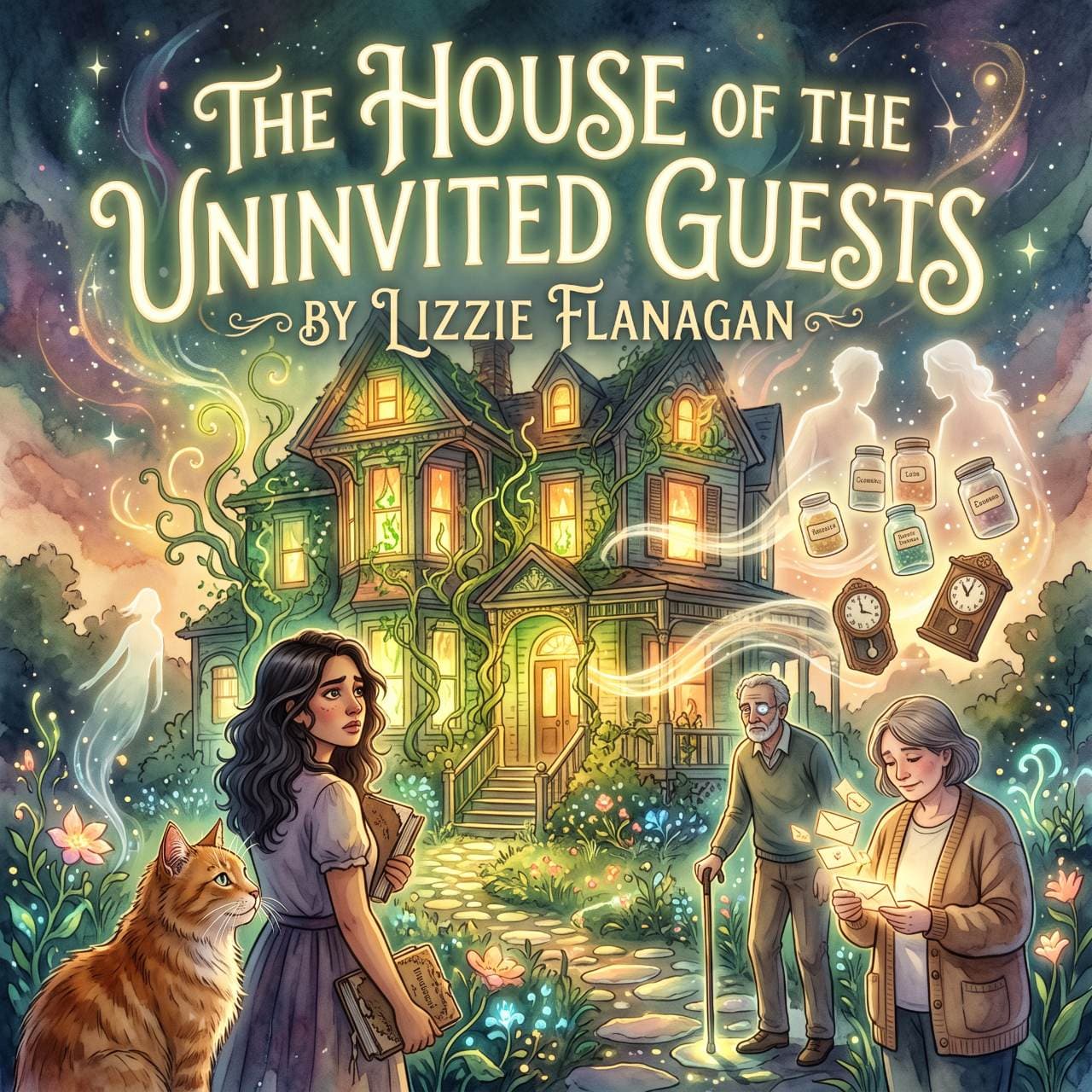

Maria Sanchez stood at the kitchen window, watching Clementine negotiate peace with a scrub jay in the overgrown garden. It had been three weeks since she'd taken her maiden name back, three weeks since she'd stood in a courthouse downtown and reclaimed the syllables her grandmother had carried from Oaxaca, the rhythm her mother had whispered while braiding her hair as a child. Whitmore had never fit her mouth. It had been Luke's name, Luke's lineage, Luke's comfortable Protestant silence. Sanchez had teeth.
The cat had stopped running from her. This was the morning's small victory. Clementine now allowed Maria to sit within arm's reach on the porch steps, though any attempt at actual contact still resulted in ears flattened against that mutilated skull, a warning hiss that sounded like steam escaping from a wound. Trust, Maria was learning, was not a destination but a territory you had to occupy daily, without expectation of treaty.
She poured her tea, Arthur had left behind a cabinet full of herbal concoctions, each jar labeled with dates and locations: Lemon Balm, harvested July 14, 2019, behind the Methodist church, 47 leaves, bee activity high, and opened the first of the journals she'd been avoiding.
The early ones were difficult. Not because the handwriting was poor, Arthur's penmanship was architectural, each letter constructed with the precision of a blueprint, but because the content revealed how thoroughly he'd been alone. Page after page of weather data, yes, but also of conversations that had never happened, social interactions he'd rehearsed and then abandoned:
Practice for asking Mrs. Patterson about her hydrangeas. Script: "Your flowers are the color of twilight." Alternative: "The pH of your soil must be precisely calibrated." Risk assessment: High. She may think I am criticizing her gardening. Likely response: confusion. Optimal choice: silence. Result: walked past without speaking. Hydrangeas noted: 47 blooms, ranging from violet to periwinkle.
Maria recognized something in these entries that made her chest tighten. Not autism, she'd never been diagnosed with anything except "too sensitive" and "overthinking things", but the exhausting calculus of social navigation. She thought of her marriage to Luke, how she'd spent twelve years translating herself into a language he could understand, editing out the sharp edges, the references he wouldn't catch, the anger that came too quickly and burned too hot. She'd made herself digestible, and in doing so, had disappeared so thoroughly that when he finally looked at her and said I don't know who you are anymore, she'd wanted to scream I don't either.
The doorbell rang at 10:47 AM.
Maria startled, tea spilling across the journal page, June 3rd, barometric pressure dropping, finch activity increased, and felt a surge of anger so sudden it made her dizzy. She wasn't ready for visitors. She wasn't ready for anyone to see her in this house, surrounded by her dead uncle's meticulous loneliness, wearing the same sweater for three days, talking to a feral cat like it might answer.
But the doorbell rang again, and then a voice, male, young, strained, called out: "Hello? Mr. Arthur? It's Thistle. From the hardware store? You ordered the copper pipe fittings?"
Maria opened the door to find a young man in his early twenties, heavyset, with the kind of face that suggested he'd been handsome until something broke it. He stood on her porch leaning heavily on a cane carved from gnarled blackthorn, his right leg encased in a brace that disappeared into his work boot. Sweat beaded on his forehead despite the October chill, and his breathing came in shallow, controlled gasps. His hair was the color of wheat before harvest, cropped close to his skull, and his left eye was clouded with a cataract that gave him an otherworldly, oracle-like appearance.
"Mr. Arthur's dead," Maria said, then winced at her own bluntness. "I'm sorry. I'm his niece. Maria. He died in August."
The young man, Thistle, he'd said, nodded, accepting this information with a steadiness that suggested he was familiar with death's logistics. "I know. I mean, I heard. I'm sorry. I just, he ordered these special fittings. Copper, for that rain collection system he was building. They took forever to come in. I kept them at the store because I didn't know if anyone would be here to receive them, but then I saw the lights on, so I thought..." He stopped, breath hitching, pain flashing across his face as he shifted his weight.
"You're hurt," Maria said.
"Old injury. Acts up when I'm stupid enough to walk three miles with copper pipe in my backpack." He tried to smile, revealing a gap where he'd lost a canine tooth. "I was supposed to drive, but my truck's in the shop and I didn't want to wait another week. Mr. Arthur was particular about his projects. I didn't want him to think I'd forgotten."
"He's dead," Maria repeated, gentler this time. "He won't think anything."
Thistle looked at her then, really looked, and she saw something unexpected in his eyes, not pity, not the polite distance she'd grown accustomed to in her years as Luke Whitmore's wife, but recognition. "You don't want to be here," he said. It wasn't a question.
"I don't know where I want to be."
"Yeah." He shifted again, wincing. "Me neither. Most days."
Maria stepped back from the door. "Come in. Please. I'll make you tea, and you can tell me about this rain collection system. And then I'll drive you home, because you look like you're about to fall over."
Thistle Yardley had been Arthur's friend for four years, though he never used that word. He'd been delivering hardware supplies to the house since he was nineteen, first as an employee of Meridian Hardware, then, after the accident that shattered his pelvis and ended his college soccer career, as the store's part-time inventory manager, the job they created when they couldn't legally fire him but couldn't trust him on ladders anymore.
"The rain system," he explained, sitting at Arthur's kitchen table with his leg propped on a chair, "was supposed to collect water from the roof, filter it through charcoal and sand, and store it in a cistern in the basement. He wanted to be self-sufficient. Not in a prepper way, in a..." he searched for the word, "a gentle way. Like he didn't want to take more than he gave back."
Maria poured him chamomile from Arthur's hoard. "He wrote about you. In his journals. Not your name, but 'the young man with the damaged leg who knows the weight of water.'"
Thistle's hand froze around the cup. "He wrote about me?"
"He wrote about everyone. Everything. He was trying to..." Maria stopped, suddenly uncertain how to explain her uncle's project, his attempt to document existence into meaning. "He paid attention. In a world that doesn't."
Thistle was quiet for a long moment. When he spoke, his voice had changed, stripped of the professional cheer he'd arrived with. "I broke my pelvis in three places. Soccer scholarship, Division II, full ride. I was going to be a physical therapist. Help people move again, you know? Then a goalkeeper misjudged his dive, and I was in the wrong place, and suddenly I couldn't walk for eight months."
He tapped his cane against the floor. "The thing they don't tell you about disability is how it makes you uninvited. Not just from places, buildings without ramps, jobs that require standing, but from the futures you imagined. I had this whole life planned. Wife, kids, house with a yard. And then I became someone people have to accommodate, and I watched all those futures close like doors in a hallway."
Maria thought of her own closed doors. The dinner parties she'd stopped attending because Luke's colleagues made jokes she couldn't laugh at. The children they'd postponed until "the right time," which never arrived. The novel she'd stopped writing because Luke said it was "cute" that she had hobbies.
"Why did you come here?" she asked. "Really?"
Thistle looked at his hands, at the scars on his knuckles from the surgeries, the hardware store calluses that had replaced athlete's blisters. "Because Mr. Arthur was the only person who never treated me like a tragedy. He treated me like a delivery problem. 'How much weight can you carry? What angle of approach works best for the steps?' Practical. Like my limitations were just data, not destiny." He looked up, his good eye bright. "He was building that rain system because he said water has memory. That every drop had been somewhere else before, clouds, oceans, dinosaur blood, and would go somewhere after. He wanted to be part of that cycle. Not erased. Just... transferred."
Maria felt something crack in her chest, a fault line she'd been ignoring since the divorce. She'd been thinking of her marriage as a failure, a waste of twelve years, something to be ashamed of. But what if it was just water? What if she and Luke had been clouds that briefly held the same shape, then dispersed, each drop continuing its own trajectory, not erased but transferred?
"I'll drive you home," she said. "But first, do you know how to build a rain collection system?"
They worked on it through October, through the first frost, through the morning Maria woke to find Clementine sleeping at the foot of her bed, having apparently decided that indoor territory was negotiable after all. Thistle came three times a week, bringing his technical knowledge and his blackthorn cane and his particular silence that required no translation.
The system took shape: gutters installed along the roofline, copper pipes soldered with careful precision, filtration tanks in the basement that rang like bells when you tapped them. Maria learned the weight of water, eight pounds per gallon, Thistle told her, which meant the cistern when full would hold nearly two tons of liquid memory. She learned the language of disability, too, not as tragedy but as architecture: how Thistle planned his movements like Arthur had planned his social scripts, calculating energy expenditure, mapping accessible routes, building a life within the parameters of a body that refused to perform as expected.
"You accommodate," Thistle said one afternoon, fitting a gasket with hands that still remembered how to be precise. "Not because you're broken, but because you're specific. Everyone's specific. Most people just never have to admit it."
Maria thought of Luke, who had never accommodated, who had expected her to bend and compress and edit until she fit the shape of his need. She thought of Arthur, who had stopped trying to fit and instead built a world that fit him, this house, these routines, these journals that were both fortress and bridge.
"Why did he never marry?" she asked.
Thistle paused. "He did. Once. In his thirties. She died."
Maria stared at him. "He never told me."
"He didn't tell most people. It was... " Thistle set down his wrench, searching for words that wouldn't wound. "It was complicated. She had cystic fibrosis. They knew she would die young. He married her anyway, built his whole life around her care, and when she died, he kept building. He told me once that grief was just love with nowhere to go. So he gave it somewhere. The house. The projects. The people who showed up needing something he could provide."
Maria walked to the window. Clementine was in the garden, stalking something invisible in the tall grass, her one ear rotating like a radar dish. The cat had been Arthur's, she realized now. Not a stray he'd taken in, but a companion he'd chosen, another creature living at the edges of acceptable society, surviving on terms the world didn't understand.
"She's dying," Maria said, not knowing she knew this until the words emerged.
"What?"
"Clementine. She's old. She's been old since I got here. She's just..." Maria pressed her hand to the glass, feeling the cold transfer through. "She's waiting for something. Permission, maybe. To stop fighting."
Thistle came to stand beside her, close enough that she could smell the cedar of his cane, the metallic tang of the copper they'd been working with. "Mr. Arthur used to say that death was the ultimate uninvited guest. The one you couldn't refuse, couldn't accommodate, couldn't negotiate with. But also, the one that made everything else matter. Without it, he said, we'd be like water that never evaporates. Just sitting there, going nowhere, becoming stagnant."
Maria thought of her marriage again, the way it had felt in the last years, stagnant, yes, but also preserved, suspended, neither living nor properly ended. Luke had done them both a favor, she was beginning to understand. He'd released the water. Let it find new forms.
"I need to tell you something," she said, and was surprised to find her voice steady. "I'm not just here because I inherited this house. I'm here because I had nowhere else to go. My husband, my ex-husband, he was kind. He is kind. But he looked at me one morning over breakfast and said he didn't recognize me anymore. And I realized I'd spent twelve years becoming someone he could love, and in the process, I'd stopped being someone I could stand."
Thistle didn't say anything. He just listened, his clouded eye and his clear eye both fixed on her face, and Maria felt something she'd forgotten existed, the relief of being witnessed without being fixed, without being advised, without being told it would all be okay.
"Arthur left me his empathy," she continued. "His too-much feeling. And I don't know what to do with it. I don't know how to live in a world that feels like it's constantly shouting and I'm the only one without earplugs."
"You start small," Thistle said. "You build your own rain system. You collect what falls on you, filter it, store it up until you have enough to sustain something. A garden. A cat. A friendship." He smiled, the gap in his teeth making him look suddenly young. "You let yourself be specific."
That night, Maria wrote in one of Arthur's blank journals for the first time. Not weather data or bird counts, but a single sentence: Today I met a man named Thistle who understands that water remembers everything, and I think I am beginning to remember myself.