


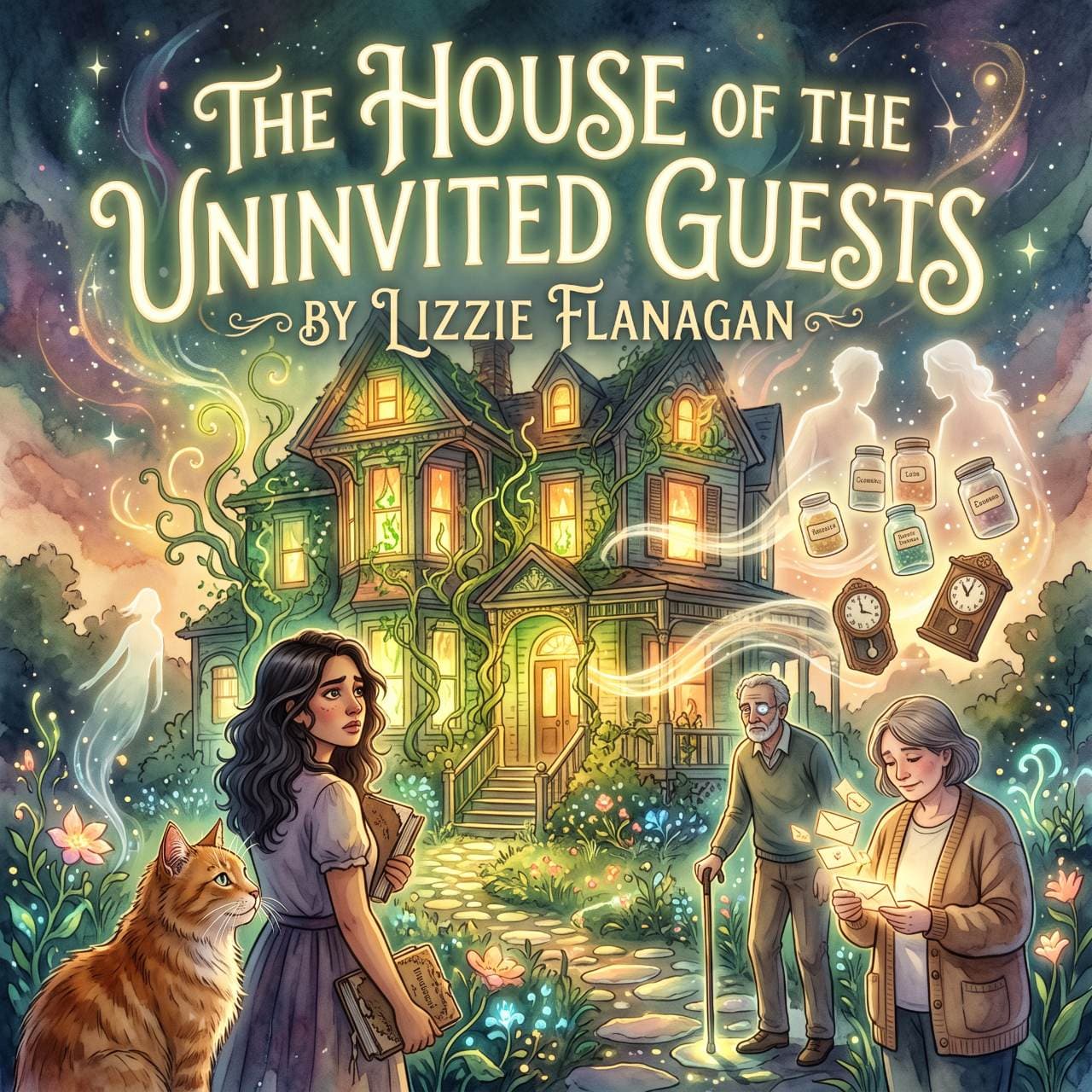

The house at 847 Meridian Street had been empty for eleven months when Maria Sanchez inherited it from her uncle. Not empty in the way of real estate listings, *cozy fixer-upper, needs TLC*, but truly empty, in the way that houses become when they've been left alone too long. The silence had weight. The dust had settled into patterns that suggested permanence.
Maria stood on the porch that first morning, keys biting into her palm, feeling the peculiar vertigo of a life interrupted. Thirty-seven years old, recently divorced (the papers finalized on Tuesday, the ink still drying in her memory), and now the owner of a Victorian monstrosity with peeling sage-green paint and a front door that stuck in humid weather.
She had not wanted this house.
She had not wanted the divorce either, not at first, though Luke Whitmore had been gentle about it. "We've become ghosts to each other, Maria," and in the three months since he'd moved out, she'd begun to understand what he'd meant. Their marriage had been a language she'd learned to speak fluently but never natively. Now, standing in her uncle's house, she was discovering that silence could be its own dialect.
Maria pushed the door open. It groaned like something waking from a long dream.
The first uninvited guest arrived three days later.
Maria had spent seventy-two hours sorting through her uncle's life, his collection of antique clocks, all stopped at different hours; his books organized by the color of their spines rather than subject; his kitchen full of identical ceramic mugs, each with a chip in the same location, as if he'd been trying to achieve some perfect imperfection. She'd found comfort in the eccentricity of it. Her uncle Arthur had been what her mother called "touched," what the world had once called "simple," and what Maria now understood as autistic, a diagnosis that had arrived too late in his sixty-two years to change anything except the vocabulary of his solitude.
She was carrying a box of his journals\, hundreds of them, filled with meticulous observations about weather patterns, bird migrations, the exact number of steps between his house and the mailbox, when she heard the sound.
It was not a polite sound. It was desperate, guttural, coming from somewhere beneath the wraparound porch. Maria set down the box and followed it, crouching at the lattice-work skirting that hid the crawlspace beneath the house.
The cat was orange. Not the soft apricot of fancy breeds or the tiger-stripes of barn cats, but a violent, marmalade orange, like something left too long in the sun. It was also enormous, filthy, and missing its left ear, which had healed into a ragged cauliflower shape. When it saw her, it didn't run. It hissed, showing teeth that belonged to something wilder than a house cat, something that had forgotten or never learned the rules of domestication.
"Shoo," Maria said, feeling foolish. "Go on. Shoo."
The cat stared at her with amber eyes that held no trust whatsoever. It had the look of something that had been fighting for survival long enough to forget that survival wasn't supposed to be a fight.
Maria left a bowl of milk on the porch that night. In the morning, the bowl was empty and the cat was gone. She told herself this was a victory.
The second uninvited guest arrived two weeks later, though this one came with a business card.
Dr. Samuel Okonkwo was a neurologist who specialized in "neurodivergent conditions across the lifespan," according to the card he pressed into Maria's hand when she opened the door to find him standing on her porch with a file folder and an expression of professional concern.
"Your uncle was my patient," he said. "For fifteen years. I came to pay my respects, and to see if you had any questions."
Maria hadn't known Arthur had a neurologist. She'd thought his peculiarities were simply his nature, not something requiring medical supervision. But Dr. Okonkwo explained, patiently, with the careful cadence of someone accustomed to being misunderstood, that Arthur had been what was once called "low-support needs," that he'd lived independently with check-ins, that he'd been part of a longitudinal study about aging and autism.
"He was remarkable," Dr. Okonkwo said, and something in his voice made Maria invite him in for coffee, though she didn't take coffee herself and had to search three cabinets before finding where Arthur had kept the beans. "He taught me more about the condition than any textbook. The way he experienced time, for instance—non-linear. Episodic. He used to say he lived in 'pockets of intensity.'"
Maria poured water into the chipped ceramic coffeemaker. "That sounds exhausting."
"It was," Dr. Okonkwo agreed. "But also..." he paused, searching for words, his own neurotypical language failing him, "...vivid. He experienced everything at full volume. The texture of a wall. The particular frequency of a refrigerator's hum. Most of us filter ninety percent of sensory input. Arthur filtered nothing. It made ordinary life overwhelming, but it also made him present in a way that very few people achieve."
Maria thought of her marriage, of the years she'd spent filtering Luke out, tuning his voice to background noise, making his presence manageable by making it invisible. She thought of the journals, the obsessive documentation, the way Arthur had tried to capture every moment before it escaped.
"Why are you really here?" she asked.
Dr. Okonkwo set down his coffee cup. It had a chip in exactly the right place. "Because your uncle asked me to be. He left instructions. A letter, to be delivered after his death, to whoever inherited the house." He reached into his folder and withdrew an envelope, yellowed with age, addressed in Arthur's careful, architectural handwriting: To the One Who Comes After.
The letter was twelve pages long, written on the back of utility bills and grocery receipts and one page of a bird-watching guide. Arthur had never been linear in his communication any more than in his experience of time.
Dear inheritor, it began. If you are reading this, I have died, which is a word I don't like because it implies a failure to continue. I prefer to think I have transitioned to a different frequency, like a radio station you can no longer receive but which continues broadcasting elsewhere.
Maria read it sitting on the porch steps, the marmalade cat watching from a safe distance in the overgrown garden. She'd started leaving food out regularly now, though the cat still wouldn't let her closer than six feet.
I am autistic, the letter continued. This is not a confession or an apology. It is a fact, like having brown eyes or preferring winter to summer. But it is a fact that shaped this house, this life, everything you will find here. I built routines like other people build walls, not to keep things out, but to keep myself in. Without them, I dissolve. With them, I am contained enough to be human.
The letter described the house in exhaustive detail, how the third stair creaked in a specific way at 3 AM due to temperature contraction; how the light in the kitchen fell at 45 degrees at 4:30 PM in October; how the bathroom faucet dripped in a rhythm that matched the heartbeat of a resting blue whale, which Arthur had recorded and played back for comparison.
I have left you my journals, he wrote. Not because they have value to anyone but me, but because they are the only proof I have that I existed. I spent my life feeling like a ghost in the machine of the world—present but not accounted for, visible but not seen. The journals are my attempt to prove I was here. That it mattered.
Maria looked up from the page. The cat had crept closer, now only four feet away. Its eyes never left her face.
There is one more thing, Arthur wrote. I have left you my empathy. I know that sounds strange, but it is the truest inheritance. I felt everything too much—other people's discomfort, their unspoken disappointments, the weight of expectations they didn't know they had. It made relationships exhausting. I could never tell where I ended and others began. But in the last years, I learned to use it. To be a witness. To hold space for what people couldn't say. This house has been a place for the uninvited—the broken, the strange, the too-much and the not-enough. If you choose to stay, it will continue to gather them. That is its nature. That is my gift to you, whether you want it or not.
The letter ended without signature, just a sketch of a bird Maria didn't recognize, wings spread as if caught mid-transformation.
That night, Maria dreamed of Luke for the first time since the divorce. Not the Luke she'd married, enthusiastic, slightly desperate to be understood, but the Luke she'd divorced: quiet, careful, always negotiating space between them like a diplomat between hostile nations. In the dream, he was trying to tell her something, but his mouth was full of clocks, each one ticking at a different tempo, and she couldn't understand the words through the noise.
She woke at 3 AM to the sound of the third stair creaking.
Someone was in the house.
Maria lay frozen, listening to footsteps move through the kitchen, the familiar rhythm of someone who knew where the floorboards were soft, where the cabinets stuck. She thought of calling the police, but her phone was in the other room, and anyway, there was something familiar in the movement, something that didn't trigger the animal panic of intrusion.
She crept down the stairs, heart hammering, and found the marmalade cat sitting in the kitchen moonlight, having pushed open the cabinet where she kept the canned tuna. It had managed to pull the ring-tab on one can and was eating with the single-minded focus of something that had been hungry for a very long time.
"You're not supposed to be in here," Maria whispered.
The cat didn't look up. But when it finished eating, it didn't run. It sat, licking its one good ear, and when Maria sat down across from it on the linoleum, it allowed her to extend her hand. For thirty seconds, they stayed like that, human and animal, both uninvited in their own lives, both learning the boundaries of acceptance.
Then the cat butted its head against her palm, once, rough as sandpaper, and walked out the cat door Maria hadn't known existed, installed at the bottom of the kitchen door leading to the porch.
She found its name three days later, carved into the windowsill of the guest bedroom: CLEMENTINE, with the dates 2009— and then nothing, as if Arthur hadn't been able to finish the sentence.
Clementine had been waiting for someone to come home.