


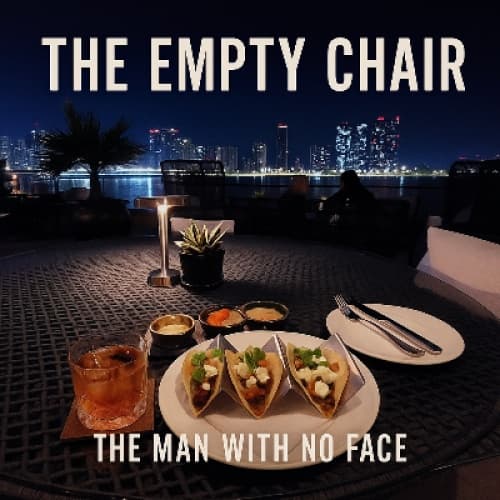

You never see his face.
You've followed him across oceans, along layovers that smell like cinnamon buns and jet fuel, through hotels where the brass doorknobs are polished to a mirror you never dare to look into. But even in the moments when the world thins and becomes honest - like tonight, with the city leaning its shoulder against the water and the moon tucked low - he keeps his face turned at a careful angle. A cap brim, a lifted glass, the pale halo of a table lamp: there is always something between you and the full map of him. It should make him unknowable. Instead, it makes him infinite.
The table is a black lattice, wide as a small country. A single lamp stands in the center like a lighthouse, pushing a soft circle of light across the woven metal. Beyond it, the skyline glitters - skyscrapers like stacked gemstones, a waterfront ribbed by the wake of night ferries. You have learned the city by sound before you learned it by sight; you could recognize the rippling hush of its water taxis, the distant thread of music from rooftop bars two buildings over, the way late traffic sighs instead of snarls.
He orders three tacos and a whiskey, because ritual is a kind of compass, and he loves things that point him home. The tacos arrive in a stainless stand - folds of soft corn, bright with lime, white with crema, a scatter of mint because the chef read once that it helps the night feel cleaner. He breathes in but does not eat. He leans back in the chair, and the chair protests quietly. The sleeve of his shirt rides a fraction higher. You see the tan line his watch has drawn around his wrist like a ring.
He has two families, and he belongs entirely to both and fully to neither. You know this because you are part of the second - his road family, the everywhere family - though he never introduces you, never names what you are. You are the empty chair tucked across from him when he sits down. You are the extra napkin the server places on the table without thinking. You are the way he looks out at the skyline as if it might answer back.
Back home: the first family. A wife who keeps her voice steady on FaceTime and only cries in the shower; children who count his return dates by how many arcade tickets they will save. He sends them gifts that arrive wrapped in tissue and foreign stamps - a scarf woven with the pattern of a city he never had time to understand, a set of carved animals from a market where he drank coffee that tasted like smoke and violets. Sometimes he records himself reading their favorite bedtime stories, his voice rolling low over pirates and dragons. He forgets to smile for the camera every time. You can't see that, but you can hear it - the straight line of his mouth in the straight line of his voice.
Here: the second family. Men and women who survive with him and laugh with him and shoulder more than they carry. A bartender half the world away who always presses an extra cherry into his drink and calls him Major out of habit, even though he's never told her his rank. A driver who leaves the car running because he knows there will be a call; there is always a call. A tailor who keeps his measurements in a book under the counter, and once sewed a pocket inside a jacket where the metal detectors would not notice anything precious.
He lifts the whiskey. The cube clinks against the glass, and the amber flickers like a lighthouse signal. He is not a heavy drinker. He is a ritual drinker. The first sip is a benediction: he made it through another day. The second is a bridge: he will make it through the next.
A few tables away, a couple laughs so hard the woman covers her mouth, embarrassed by happiness. Someone lights a cigar and apologizes for nothing. A server with soft-soled shoes tracks a path of candlelight from table to table. You watch all of it from your side of the invisible line, the line you never cross. You do not touch him. You do not leave. That is the arrangement.
The drink warms his mouth and then the rest of him. He looks at his phone. On the screen is a text from his daughter, six words and a photo of a school project that glows with glue and glitter. He types back slowly, carefully, as if his thumbs are two diplomats negotiating peace. He adds a string of emojis. He deletes and chooses different ones, gentler ones. Sends it. Stares at the delivered message as if it were a small boat he has pushed into a large ocean.
His wedding band catches the light and tilts it, like a mirror held to the sky. The ring perplexes strangers who try to place him: a married man who dines alone, orders two plates, tips like he believes money should move. Once, a young host tucked a menu into the empty place and said, "Will your guest be joining you?" He smiled - no teeth, just the shift of his cheek - and said, "They always do." The host did not understand; you did. You were already there.
He finally lifts a taco. The lime wedges are cut into moons, their juice a green starburst on his fingers. He takes a bite, and for a second his shoulders unlatch; for a second he is a man eating food, not a man between worlds. He chews. Swallows. Consideration returns. He sets the taco down, precise, the way surgeons set instruments between motions.
Sometimes, when he eats alone like this, he talks under his breath. You have learned to listen for it. He narrates the day in verbs and numbers: three meetings, two calls, one promise he shouldn't have made. He never repeats the words he says for the dead, which is how you know there were none today. When there are, he's quieter. When there are, the ice in his drink lasts longer.
A breeze slides across the water and loops around the rooftop, bringing with it a smell like cool iron and rain that has not yet happened. He sits a little straighter. He is alert in a way that looks like relaxation. His phone vibrates against the metal table: a message stamped with a name that always arrives without a country code. He reads; his jaw changes shape; he tucks the phone face-down beneath the edge of the napkin. He does not look at it again.
"This seat taken?" asks a voice at his shoulder.
He doesn't turn. He is good at not turning. He angles his hand toward the empty chair, palm open. A shadow slides into the seat - the kind of man whose haircut is another form of rank. You can tell by the way the new man sits, back to the wall, that he belongs to the same invisible map. They don't say hello; they have said hello too many times. The server appears with another drink that no one orders. This kind of place remembers patterns.
"Package?" the other man says, as if it were small, as if it were wrapped in brown paper with string.
"Delivered," he says, and the word means more than the word suggests. "No fireworks."
"That's a shame," the other says. "City's already lit."
They look together at the skyline. The lights carry on being beautiful and indifferent. The other man eats one of the tacos without asking. He eats the second because hunger overrides etiquette when survival is part of your résumé. He nods toward the third. "You saving that for the ghost?"
He laughs, and the laugh has coins in it. "Always."
"Still keeping a chair?" the other asks.
"Still keeping a promise," he says.
You can feel the promise like a taut wire across the table. You can feel the history wound up inside it: a night in a desert where the wind carved songs out of the tents; a shoulder pressed to the dirt beside a man who wouldn't see morning; a vow muttered into a broken radio that he would always eat for two until everyone he loved was safely fed. Promises are strange creatures - some are soft as cats, some are iron. This one is both.
A couple of servers pass, carrying a sugar-dusted dessert that looks like it would melt if anyone breathed too hard. Somewhere below, a boat horn calls out. The other man leaves as quickly as he arrived, a chair pushed back without a scrape, a bill half-paid by tradition. When he goes, there is a folded piece of paper under the coaster that did not exist before. The mystery man slides it into the inside pocket of his jacket, the pocket that the tailor stitched into the lining so carefully that airport security trusts it without realizing it does.
He finishes the third taco slowly. The mint brightens the night. He closes his eyes, and you imagine his face because you have to - because it is human to put features where there is only shadow. You picture a man with a strong nose and tired eyes, but you know even as you imagine it that you are wrong. His face is not the point. If you ever saw it, the spell would break. The spell is distance; the spell is faith without the comfort of sight.
He pays. The tip is generous enough to disarm guilt and invite rumor. The server thanks him with a warmth usually reserved for old friends; he nods without claiming the intimacy. When he stands, his chair breathes relief. He picks up a black coat that has seen more countries than a passport, and the coat settles on his shoulders like it remembers every shoulder it has been.
Down the stairs, through the lobby swirled with marble and perfume, out into a night that recalibrates to accommodate him. The doorman knows to whistle a car he trusts. The driver knows to pull up music that is all strings and nothing sacred; he learned the hard way that hymns make the mystery man's hands curl. The car glides along the waterfront. The city arrays itself across the water like a necklace he will never be able to give.
At the hotel, he does not go to his room. He goes instead to the lounge with windows as tall as cathedrals. He orders tea this time, black and unforgiving. His phone sits on the low table, glowing occasionally, not demanding attention but declaring its existence. He ignores every message except the one from his son that says: "Dad can you help with my project?" He types: "Call me now." He waits, and the phone rings, and his yes is immediate.
This is the only time you hear the softness that belongs exclusively to the first family. His voice folds; his shoulders notch down a fraction; his hands become quick and useless birds. He helps with fractions and gives advice about gluing foam to cardboard. He says "I'm proud of you" three times in the space of ten minutes. When the call ends, he puts the phone face-down and closes his eyes like a man standing in the doorway of his own house, not yet stepping inside because he wants to memorize the smell.
The lounge pianist presses his fingers into a melody that has traveled across too many weddings to be pure anymore. The song makes him stand. He goes to the elevator and rides alone to the floor where the carpet changes color because someone decided the higher guests deserved a different shade of luxury. His room is a suite, of course. He didn't ask for it. People give him space without realizing why. The bed is slick with the artifice of hospital corners. On the desk, there is a bowl of fruit so shiny it could be made of soap.
He opens the sliding door to the balcony. The night sidles in. He sits on the deck chair that pretends to be a chaise, and he takes from his pocket the folded paper left by the other man. He reads it once. Twice. Three times, as if repetition might alter fate. You have learned not to read over his shoulder; the words always find you anyway. Coordinates, times, names that will vanish by morning. A list of things that must happen so that other things won't.
He burns the paper in the ashtray with a match struck on the book of matches he carries not for cigarettes but for moments like this. He watches the ash collapse, and the moon drips a little lower, weary with the shift. He picks up a pen and writes a note on hotel stationery: **Tell housekeeping to leave the chair by the window.** He signs only his initials. For weeks after he leaves, the chair will sit facing the skyline, an empty seat for an invisible guest.
On the table inside, two room service menus overlap like wings. He circles items without intention: steak, roasted carrots, chocolate torte. He calls and orders all of it for two. When it arrives, he thanks the man in the vest as if the food were the favor, not the company. He sets out two plates. He fills two glasses with still water. He eats his meal and - slowly, reverently - eats the second. It is not wasteful. It is a liturgy.
Between bites, he opens the small wooden box he keeps in his suitcase, the one that used to hold cigars but now houses memory. Inside is a stack of paper squares: the corners of boarding passes, the thin coasters from anonymous bars, a photograph of a soccer field with no players. On the top is a postcard from a coastal town where the seagulls are bold and the winds dunk you in their baptism whether you asked for it or not. The postcard is blank. He never writes on them. He just collects proof that the world is large and that he has been allowed to walk across it.
He will sleep soon, but not yet. He wipes his mouth with the cloth napkin and folds it into a square so tidy it looks like an apology. He goes to the desk, opens his laptop, and enters a stream of numbers that would be meaningless if you didn't know that his body is always tracking three time zones - the one he is in, the one he left, the one where his children are brushing their teeth. He sends a message to a friend who once pulled him out from under an overturned vehicle in a country both of them promised never to name. The message says only: **You good?** The reply arrives quickly: **Good enough.** He smiles that coin-filled smile and closes the screen.
You lean against the doorway of the balcony because that is where you always stand, not in the room but at the edge of it. You watch his outline move: the shrugging off of the jacket, the way he hangs it on the back of a chair like a person; the slow removal of the wedding band, resting it on the nightstand atop a coaster as if it needed a pedestal; the glance he gives the door to the adjoining suite, locked but present, because sometimes his team sleeps on the other side and sometimes a stranger does and sometimes no one at all.
Before he sleeps, he kneels beside his bed in a posture that would look like prayer from a distance. Maybe it is prayer. He says nothing aloud. He is a man who learned early that what he says aloud can be used against him. He remains there long enough for the city to take notice. When he rises, he touches the band on the nightstand with two fingers, as if checking a pulse.
In the morning, he will board another plane. The chauffeur will have already loaded his bag, lifting it with a small sound of surprise because a bag that size should weigh more than it does. He travels light because the world is heavy enough. He will step into first class not because he loves it but because he has paid for it with nights like this, with meals for two eaten by one, with faces unshown and names unspoken. He will look at the safety card because ritual demands it, tuck it back in because courtesy does. He will watch clouds practice their architecture.
You will be there, too - the extra set of eyes at the window, the second cup on the tray, the patience in his breath when the plane queues on the runway. The arrangement is simple: you follow, you witness, you do not ask for more than what the night can bear.
You never see his face, but you see everything else: the way he occupies a room without claiming it, the way he belongs to two families and lets both call him home, the way his luxury has edges, the way loneliness walks beside him without apology. You learn him by his rituals, his angles, his pauses. If another person asked you to describe him, you would say: "He is the man who leaves a chair empty and keeps his promises full." You would say: "He is the man who eats two dinners and calls it survival." You would say: "He is the man who loves like a country - hard to cross, impossible to forget."
On the balcony, the ash cools. Inside, the lamp hums the low, steady tone that good hotels hum when they've learned money needs quiet. He turns off the lights, one by one, until only the city remains. In the dim, his outline is a study in almosts: almost facing you, almost smiling, almost safe. He slides into sleep as if entering water.
You take the empty chair by the window. You watch the city blink. You keep the seat warm for whoever he loves and for whomever he's lost. That is what family does, in whatever language it has to invent: it keeps the chair ready, the lamp lit, the promise alive.
And when the morning opens like a map, you will fold yourself back into the space beside him, unseen, and follow him to the next rooftop, the next city, the next supper for two.