


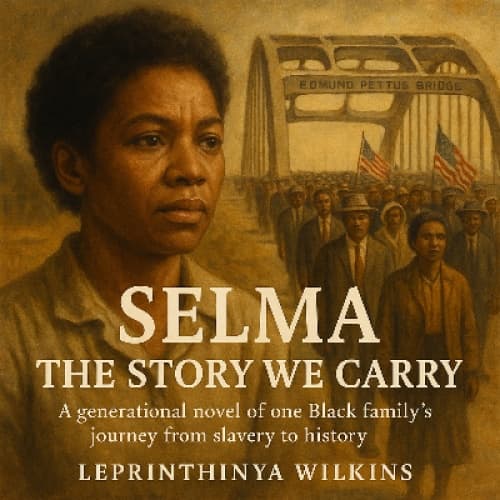

The morning light broke soft and golden over Brown Chapel A.M.E., as if the sky itself was blessing the crowd that had gathered. The church steps overflowed with people - men in their Sunday suits, women in headscarves and sneakers, children holding their parents' hands. Some whispered prayers, others sang low and trembling hymns. Every voice carried that sacred tension between fear and faith.
Sarah stood near the back, clutching her grandmother Ruth's worn Bible. The edges were soft from years of turning pages, and tucked between Psalms 23 and 27 was the same note Ruth had written decades ago:
They want us afraid. But fear is not forever.
The words felt heavier today than ever before.
Inside the church, Reverend Hosea Williams and John Lewis addressed the crowd, their voices steady but charged. The plan was simple - march peacefully from Selma to Montgomery to demand what the Constitution already promised: the right to vote.
"Once we step outside these doors," Hosea said, "we do not raise a hand in anger. We walk. We pray. We stand."
And so they did.
Sarah joined the line, sliding her hand into that of the young boy she had helped through the last march - the one who'd cried when the troopers charged. His name was Matthew. He was twelve. His face was still round with boyhood, but his eyes carried the gravity of a man.
The air was cool, crisp, and deceptively calm as the group began to walk. Feet shuffled over cracked asphalt. Flags waved gently, like they didn't know what was coming. Sarah could hear the Alabama River nearby, whispering in its slow current - a reminder of how much blood had already been spilled on Southern soil.
As they neared the Edmund Pettus Bridge, Sarah's breath caught. The bridge looked both magnificent and menacing in the distance - its white arches curving against a pale sky, its steel ribs gleaming in the sun. But beyond it, she could see them. The troopers.
Rows upon rows of helmets.
Clubs.
Gas masks.
Horses snorting impatiently.
Sheriff Jim Clark stood among them, his badge shining like mockery.
When the marchers reached the base of the bridge, they stopped to pray. The sound of hundreds of knees brushing the road echoed like a single heartbeat. Sarah whispered under her breath:
"Lord, be a fence all around me."
When she rose, her knees left faint prints in the dust.
They began to move again - slow, steady, rhythmic. The sound of their feet was like a drumline of history repeating itself, every step echoing the footsteps of those who came before.
When they reached the crest, the world exploded.
"THIS IS AN UNLAWFUL ASSEMBLY!" a voice boomed through a bullhorn.
"DISPERSE IMMEDIATELY!"
But they had not come this far to turn around.
The next few moments blurred. Sarah saw the flash of movement before she heard the first crack. The horses charged forward. Clubs swung. Tear gas hissed like venom.
She grabbed Matthew and pulled him close as chaos swallowed the line. The air turned white and burned her throat raw. All around her, people screamed - some calling for God, others for their mothers.
A baton struck her shoulder, spinning her sideways. She fell hard, the pavement scraping her palms. Her vision swam. She saw Matthew's hand reaching for hers and reached back through the smoke.
"Hold on!" she coughed. "Don't let go!"
Through the haze, she saw John Lewis crumple under a blow that made her stomach twist. Blood streaked his skull, bright and shocking. The gas bit deeper, tears streaming from her eyes.
Somewhere a woman shouted, "Don't run!"
Another voice cried, "Help him!"
The sound of horses pounding over human bodies filled the air like thunder.
Sarah's lungs screamed for air. She crawled, dragging Matthew with her, searching for the edge of the bridge, for any way out. A man's arm reached down, pulling her to her feet, and she stumbled into the arms of other marchers retreating toward Brown Chapel.
When she finally looked back, the bridge was shrouded in smoke, littered with bodies - not lifeless, but rising. Crawling. Helping each other. Even through agony, they were getting back up.
Sarah pressed a bloodied cloth to her face. Her hands shook. "They can't stop us," she whispered, more to herself than anyone else.
Matthew looked up at her, eyes red and wet. "We didn't make it to Montgomery."
Sarah nodded, her throat raw. "Not today." She looked toward the horizon.
"But we will."
That night, the news traveled faster than anyone could have imagined. Cameras had captured it all - the tear gas, the blood, the cruelty. America had seen Selma. The world had seen Selma.
Sarah lay in her bed, shoulder aching, her lungs still raw from gas. The radio hummed in the next room, voices replaying the horror. She clutched her grandmother's Bible to her chest. The pages smelled faintly of smoke and salt.
Her mother peeked in, eyes red but proud. "You did what you came to do."
Sarah smiled weakly. "We told the truth loud enough to hurt."
She drifted to sleep with that thought, hearing her ancestors' voices in the still air - Josiah, Isaiah, Ruth - whispering through generations:
We are still here. Keep walking.