


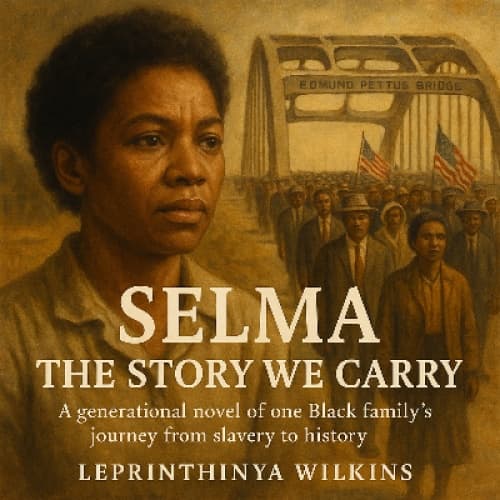

Sarah learned to listen before she learned to speak up.
Listening was how you stayed whole in a town that watched you from behind lace curtains and badge-bright eyes. She listened to the way the Alabama River carried secrets. She listened to the old folks at Ebenezer Baptist trading stories like hand-me-down coats. She listened to her grandmother Ruth's journal pages, read in whispers at the kitchen table after the dishes were dry.
"Read the one about the courthouse again," Sarah would say.
Ruth adjusted her glasses, voice low and steady. "They want us afraid. But fear is not forever."
Sarah would close her eyes and feel the words catch like flint.
By nineteen, she'd memorized the route from the church basement to Brown Chapel A.M.E. by the sound of footsteps alone. That was where the SNCC students set up folding chairs and chalkboards and made room for ordinary folks to become something else: organized. The first time Sarah stepped inside, she saw a hand-lettered sign: NONVIOLENCE ISN'T WEAKNESS. IT'S STRATEGY.
"Name?" asked the young man at the table, pencil poised.
"Sarah Duncan." She lifted her chin. "I can type. I can read. I can walk."
"Good," he said, smiling like a brother she hadn't met yet. "We need all three."
Training started with role-play. A field secretary - a woman with a voice like a steel string - stood nose-to-nose with volunteers, cussing them out in the same tired poison the deputies used. The assignment: don't flinch.
"What do you do when they spit in your face?" the trainer said.
Sarah swallowed. "I keep my hands down."
"What do you do when they call you every name that's not your own?"
"I remember the names I carry," Sarah answered, thinking of Josiah, Isaiah, Ruth. "I remember why I'm here."
At home, her mother examined the bruises that appeared without warning - sore spots from "practice" falls, from hours of kneeling on the wooden floor to simulate jail cells, from bodies learning how not to break.
"You sure you got to go down there so much?" her mother asked, wiping liniment across Sarah's shins. "Your grandma kept records so you could keep living."
"Her records are why I have to go," Sarah said. "Somebody has to carry them across the bridge into daylight."
Word rippled through Selma that winter: Sheriff Jim Clark was itching for a fight; registrar offices were turning away Black citizens by the dozens; teachers in Sunday shoes had walked to the courthouse together and been shoved back down the steps like sinners. Every day after work, Sarah and the others visited kitchens and porches, knocking softly, talking quiet.
"We're going again Tuesday," Sarah would say, balancing on a cinderblock step while an elder folded laundry. "We'll line up at the Dallas County courthouse.
We'll sing. We'll pray. We'll try to register."
"What good's trying?" came the tired reply.
Sarah held the elder's gaze. "Because every attempt becomes part of the count. They count on us quitting."
Sometimes the answer was a nod. Sometimes a sigh. Sometimes a hand that trembled as it reached for Sarah's flyer like a lifeline.
On a cold morning, she watched Reverend Reeb - white, thin, earnest - walk beside old Deacon Henry as if the two men had always known each other.
"They lock us up," Deacon Henry said, smiling with teeth worn down by sorrow, "and we treat it as a meeting the devil paid for." Sarah laughed, because the man could turn pain into a proverb.
In the evenings, she typed names onto sign-up sheets - Mrs. Thelma Avery (attempt #5), Mr. James Polk (attempt #2) - each entry a tally against erasure.
In her pocket, she carried one page from Ruth's journal. On it, the words that had become a vow: Fear is not forever.
The first time Sarah was arrested, the cell smelled of old rain and iron. A girl no older than twelve clutched her skirt and whispered, "I'm not s'posed to be brave without my grandma."
"You ain't without her," Sarah murmured, stroking the girl's hair. "All our grandmas are in this room." She started a hymn, soft at first - "Wade in the water…" - and the walls answered with hums and sniffles until the whole cell was a choir.
When she got out, a reporter asked, "Was it worth it?" Sarah looked at his pencil, hovering like it could cut her story down to a headline.
"You ask me that after the vote," she said, and walked away.
Then Jimmy Lee Jackson was shot in Marion - an unarmed Black deacon protecting his mother - his blood darkening hospital sheets while the town pretended not to see. Grief clamped down across the county like a trap, and rage burned bright enough to light the road.
"We march," someone said. "We march to Montgomery so they hear us breathing."
The plan felt impossible and necessary in the same breath. Fifty-four miles of open road and open season. Sarah pulled on her scuffed shoes, tied them tight, and kissed her mother's forehead. "If I don't walk," she whispered, "who will?"
Her mother pressed a folded handkerchief into her palm. "You come back," she said. "If your legs give out, you crawl back. But you come back."
They met at Brown Chapel, the air electric with fear braided into faith. John Lewis was there, quiet and resolute, his skull already holding a map of what he'd chosen. The line formed like a river finds its banks - fluid, inevitable. Sarah felt a small boy's hand slip into hers; she squeezed, felt how small his bones were, how large his courage.
They crossed Broad Street toward the Edmund Pettus Bridge, steel ribs arcing over the Alabama like a beast's skeleton. The sky was high-boned and pitiless.
Sarah's breath stuttered when she saw the troopers waiting across the span - helmets, gas masks hanging at their throats like threats made of rubber and glass, horses stamping.
"Keep your line," someone called. "Keep your eyes on God."
Halfway up the rise, the world narrowed to the slap of feet and the thump of her heart. The river flashed below like a hard, bright truth. For a moment, Sarah could hear only the song in her head - old, older than any bridge:
God's gonna trouble the water.
They crested the arch and saw the wall of men. Sheriff Clark's deputies lined three deep. An officer lifted a bullhorn, his voice thin but cutting. "This is an unlawful assembly. Disperse and go home."
Home? The word lodged like a thorn. Home was the place that turned them away at the courthouse door. Home was the field where their grandparents bled. Home was a church with busted windows and a choir that kept singing. Home was what they were marching to claim.
Sarah tightened her grip on the boy's hand. "Hold on," she said.
The troopers moved first.
Tear gas bloomed like a white flower torn open by wind. Clubs rose and fell with a meat sound you don't forget. Horses charged. A woman in front of Sarah folded, arms flung like a dropped bird. The boy jerked in her grasp, screaming. The world tilted - river, sky, iron, blood - and then the bridge came up to meet her.
Pain broke over her in a wave, hot and bright. The gas clawed her lungs; her eyes became fire. She heard a skull crack - maybe her own, maybe a stranger's - and a scream that might have been a hymn bent out of shape.
"Get up!" someone shouted, voice far away.
She thought of Josiah's hands, torn by cotton thorns. She saw Isaiah counting beans he refused to count. She saw Ruth, bent over a journal that could have burned the world down if anyone had let it.
Sarah dragged a breath through the fire in her throat. She planted her palms on the filthy pavement, knelt like a woman praying, and pushed. The boy's hand was gone; terror sliced her clean through. She blinked hard until shapes returned - boots, hooves, the blur of a blue dress. She reached for the boy and found his sleeve. "I got you," she coughed. "I got you."
When the line broke, the song did not. It ran ragged under the screams, a thread that refused to snap. Wade in the water… Men stumbled; women shielded strangers with their bodies; elders stood with arms out as if they could hold back horses.
And then, as violence always does, it paused to admire itself. The troopers stood panting, batons sticky with proof. The bridge lay littered with bodies and courage. Cameras blinked like stunned eyes. Somewhere, a reporter's pencil shook. Somewhere else, a television set in a living room that had never thought of Selma suddenly flickered with it.
Hands lifted Sarah from the ground. Blood slid warm along her temple. The boy pressed his face into her skirt and sobbed until he hiccuped. She touched her forehead and felt the split edge of skin, the drum of her pulse still insisting on its job.
"Did we lose?" the boy asked, hiccups tapping his ribs.
Sarah looked down the bridge, across the river, past the barricade where the law had announced itself as lawless. She saw the cameras, the priests, the students, the aunties with their pocketbooks like armor. She thought of a nation that looked away until blood forced it to stare.
"No," she said, tasting iron. "We didn't lose. We told the truth loud enough to hurt."
That night, Selma carried its wounded like a congregation bears a casket - tender, furious, faithful. Brown Chapel became a triage of bodies and psalms. The air smelled of vinegar, sweat, and resolve. Sarah lay on a pew while a nurse dabbed at her cut with a steady hand.
"You gonna walk again?" the nurse asked.
"As long as it takes," Sarah said.
Two weeks later, she did. When thousands came - clergy in collars and students in denim, northerners with sunburned noses and southerners with eyes like flint - Sarah laced her shoes and stepped into the river of feet.
The road to Montgomery felt different: still dangerous, but wider somehow, like history had been forced to make room. They walked past fields that remembered whips, past houses that remembered secrets, past men who watched from porches with unreadable faces. In the dark, they sang. In the daylight, they stood silent as if silence, too, could be a weapon.
On the last day, when they reached the capitol steps and the speeches rose like doves startled into flight, Sarah closed her eyes and felt three hands on her back - one rough with cotton scars, one ink-stained, one calloused from factory steel. She never believed in ghosts, but she believed in this: the living company of the dead.
Months later, the Voting Rights Act became law. A pen scratched across paper in Washington, D.C., and the words were tall enough to cast shade over a bridge in Alabama. Sarah stood in line at the courthouse with a clean dress and a stubborn smile. The registrar from her childhood - older, smaller than she remembered - did not reach for a jar of beans. He reached for a form.
"Name?" he asked, mouth tight.
"Sarah Duncan," she answered, her voice clear. "I can read. I can write. And I can vote."
When she stepped back into the sunlight with her registration card warm in her palm, she thought of what her grandmother wrote: Fear is not forever. She thought of what her father wrote in the margin of that page: Still carrying it, Mama. The story ain't finished yet.
Sarah looked toward the bridge, ribs of iron now etched into the country's conscience. Somewhere out there - now or later, near or far - a president would try to cut pages from the book, to say the blood wasn't real, that the pain had been exaggerated, that the march was a misunderstanding. But paper burns easy. Soil does not.
She tucked the card into her pocket, pressed her palm to her chest where that bell of purpose still rang, and whispered to those who had come before:
"I'm still walking. I'm still carrying it. And I am not done."