


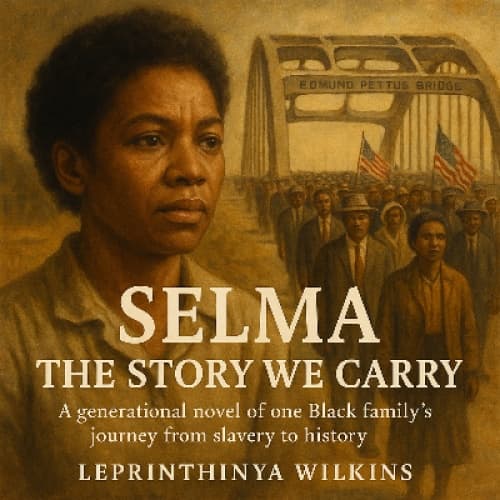

The train groaned like an old animal as it rolled north. Isaiah Jr. pressed his forehead against the window and watched Alabama fade behind him - pine trees shrinking into specks, red dirt giving way to gray tracks that led toward something called freedom.
He had left before dawn, a cardboard suitcase in one hand and his mother Ruth's Bible in the other. Inside that Bible, folded tight, was one of her journal pages. It read:
Carry our story wherever you go. Don't let the North make you forget the South.
He was nineteen. Strong. Restless. Tired of the fields that never forgave, the ledgers that never balanced, and the "Yes, sirs" that felt like chains around his tongue. The newspapers had called it "The Great Migration," though for him, it felt more like running from a storm that never stopped.
The whistle wailed, and the car rocked as the train crossed into Tennessee. A woman with a baby on her lap hummed a gospel tune. An old man in a work cap told stories of Chicago - where a man could earn a week's wage in a single day, where no one called you "boy." Isaiah listened like a man starving for possibility.
When he arrived in Chicago, winter slapped him in the face. The air was sharp, cold, unfamiliar. But the city pulsed with movement: streetcars, jazz, laughter, and smoke curling from factory chimneys. The buildings rose tall and indifferent, as if they didn't care where you came from, only whether you could keep up.
He found work at a steel plant, the kind that paid cash on Fridays and pain on Saturdays. The machines were loud, the heat unbearable, but it was honest work. At night, he and the other men - southern transplants like himself - shared a room above a bakery and talked about home.
"Up here they don't spit on you," one said, "but they don't see you neither."
Isaiah nodded. In the South, they told him he was less than a man. In the North, they acted like he was invisible.
On Sundays he dressed in his cleanest shirt and went to the little Baptist church on 47th Street. The choir sang the same songs his grandmother had hummed, and sometimes, when the light caught the stained glass just right, he could almost smell Alabama again.
He started sending letters home every two weeks.
Mama, he wrote,
I found a job that don't pay much but it's mine. I saw snow fall for the first time - looked like cotton, only colder. I met a woman named Delores. She reads just like you taught me. She says she wants to be a teacher.
Ruth wrote back in her steady hand, reminding him to pray, to write, to remember who he was.
Don't let the noise of the city drown your roots, she said. Freedom is not forgetting. It's remembering and surviving anyway.
He married Delores in the spring of 1941, just before the world went to war.
They lived in a small apartment that smelled like iron and bread, with a radio that never quite tuned right. Delores taught at a segregated school on the South Side, and every night she'd tell Isaiah about the children who couldn't afford shoes but still recited Langston Hughes by heart.
When their daughter Sarah was born, Isaiah held her up to the window, showing her the snow. "Your blood," he whispered, "comes from heat and dust and prayer. Never forget that."
The war changed everything. Men left for Europe. Women filled the factories.
The South bled into the North as train after train delivered new faces, new hopes, and old ghosts. Isaiah worked long shifts and sent money back to Alabama whenever he could.
But freedom had a way of shifting shape. The landlords raised the rent. White workers grumbled when colored men got promoted. One night, Isaiah came home to find COLOREDS GO HOME scrawled across their building in chalk.
Delores wiped the words away before Sarah could see. "It's the same devil," she said softly, "he just moved neighborhoods."
Isaiah sat at the table that night, the city's hum pressing through the walls. He unfolded his mother's journal page and read it again by lamplight: Carry our story wherever you go.
He picked up a pen and wrote in the margin:
Still carrying it, Mama. The story ain't finished yet.
When his father Isaiah Sr. died, he returned to Selma for the funeral. The red soil clung to his shoes as if trying to keep him there. His mother was older now, frail but proud. She handed him her worn journal, its pages thick with years of ink and truth.
"This belongs to Sarah now," she said. "She's got Josiah's eyes."
He kissed her forehead. "I'll make sure she knows what they mean."
When he left again, Sarah was three. She waved from the porch, holding her grandmother's hand, her curls bright in the sun.
The train pulled away, and Isaiah looked back one last time. He could almost see Josiah in the field, Isaiah Sr. by the river, Ruth with her journal pressed to her chest. They were all there, stitched into the soil.
The whistle blew long and low, and he whispered to the window,
"We're still moving, Papa. Still wading in that water."