


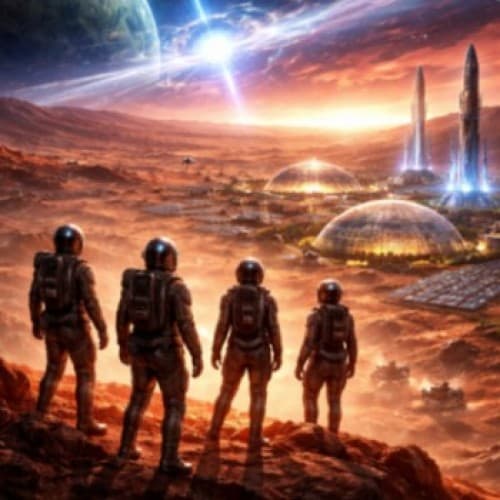

The domes were quiet, save for the hum of life-support systems and the distant creak of the terraforming units. Outside, Mars stretched endlessly under a pale orange sky. Inside, the crew of the Odyssey felt the first true consequences of venturing beyond known space.
It started subtly. Instruments flickered. Time readings from the warp sensors were inconsistent—slightly off by fractions of a second. At first, Kai dismissed it as a calibration error.
But then it became undeniable.
“Look at this,” Sofia said, pointing to her console. “Algae growth is… ahead of schedule. By almost twenty-four hours. That doesn’t make sense.”
Elara frowned, studying the readings. “It’s like the jump… warped time locally. We’re experiencing temporal anomalies. That could explain the earlier fluctuations on arrival.”
Raj rubbed his temples. “Temporal… anomalies? You mean, we’re not just on Mars… we’re out of sync?”
Sofia nodded. “Exactly. The warp jump wasn’t clean. It left residual distortions in the space-time continuum. For the colony, that means… unpredictable growth, minor structural instability, maybe even health effects we haven’t detected yet.”
Kai’s voice trembled. “So… we’re gambling with time itself? With reality?”
Elara’s gaze hardened. “We didn’t just open a door to Mars. We opened a door to unknown consequences. Warp space is not a playground—it’s a dimension that doesn’t follow our rules.”
That night, the anomaly made itself impossible to ignore. Lights flickered in the main dome. Sensors displayed readings that jumped backward and forward in time. Sofia watched algae trays blink in and out of growth cycles. A week’s progress appeared, then vanished, then returned.
“Everything’s… unstable,” Sofia whispered. “If this continues, the ecosystem could collapse before it stabilizes.”
Raj stood, jaw tight. “We need a plan. We contain it, we monitor it, and we don’t panic. That’s all we can do.”
Elara walked to the viewport, looking out at the barren Martian plains. “I thought the danger was survival, storms, and corporate greed. But this… this is different. This is beyond us. The warp jump gave us the ability to reach the stars—and it may have given something else access to us.”
Over the next few days, anomalies increased. Minor gravitational distortions made objects in the domes feel lighter or heavier at random intervals. Time seemed to loop—Kai swore he had seen the same dust storm outside twice in an hour. Instruments recorded energy spikes with no known source.
Sofia analyzed the data. “These fluctuations… they’re not natural. They are residual echoes of the warp jump. If we don’t understand them, if we try to terraform too aggressively, we could destabilize Mars itself.”
Elara clenched her fists. “We’ve survived Earth politics, corporate sabotage, and a planet that doesn’t forgive mistakes. Now we’re dealing with… the universe itself.”
Raj shook his head. “Then we adapt. We survive. That’s what humans do. That’s what we do.”
And as the crew huddled in the greenhouse, recalibrating sensors, adjusting atmospheric controls, and monitoring every anomaly, Mars seemed to pulse with awareness—a silent reminder that humanity’s reach now extended beyond the natural laws they had known, and that the universe had its own price for ambition.
Above the domes, the Martian sky shimmered faintly. Something in the fabric of space-time stirred—an echo of their first warp jump, waiting.
The Odyssey’s crew had conquered distance, landed on a new world, and begun shaping it. But warp space had left a shadow. And the universe was already responding.