


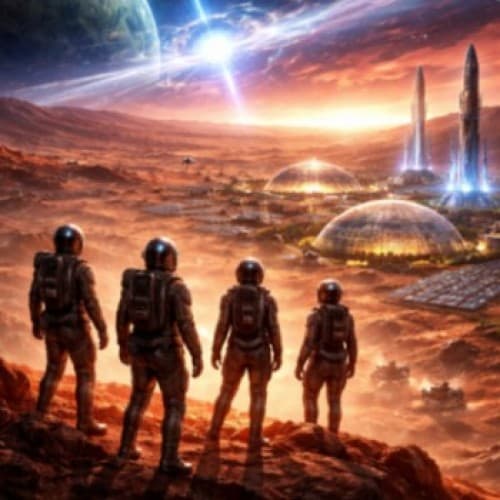

Back on Earth, Dmitri Orlov leaned over a holographic display of Mars, his face lit by the pale red glow of the planet. Dozens of domes and terraforming units dotted the surface—some operational, some still under construction. He tapped the controls impatiently.
“Accelerate the terraforming units,” he barked at his assistant. “We cannot wait decades for Mars to breathe slowly. Humanity’s first foothold must be decisive—and it will be ours.”
Warnings flashed across his console: “Atmosphere risk threshold exceeded”, “Structural integrity of domes at risk”. Orlov ignored them. “Boundaries are made to be crossed.”
Half a world away, in the Martian dome, the Odyssey crew was unaware of Orlov’s covert plan—but they would soon feel its consequences.
The first disaster struck subtly. A terraforming unit, working ahead of schedule due to Orlov’s modifications, began releasing excess greenhouse gases. Sensors in the main dome spiked: oxygen levels rising too quickly, soil chemistry destabilizing.
“Elara! Something’s wrong with the atmosphere readings!” Sofia shouted, scanning her instruments.
Kai’s fingers flew across the console. “It’s… it’s climbing too fast. The algae can’t compensate!”
Raj’s voice cut through the panic. “Seal the outer dome sections! Shut down the auxiliary terraforming units manually!”
Elara moved with precision, shutting down systems one by one. Red warning lights flashed, casting an ominous glow across the crew’s tense faces. Outside, a thin haze of synthetic gas swirled across the Martian plains, invisible but dangerous.
Sofia knelt, adjusting environmental stabilizers. “If we don’t fix this, the soil chemistry could collapse. The plants could die… oxygen levels could spike beyond safe limits.”
Kai swallowed hard. “All because someone couldn’t wait for the process to happen naturally.”
Raj slammed a hand on a console. “We adapt. We survive. That’s all we can do right now.”
Hours passed. The crew worked tirelessly, recalibrating systems, sealing breaches, and manually stabilizing domes. Sweat streaked their suits, and fatigue clawed at their bodies, but finally, the readings normalized.
When silence fell, the enormity of the sabotage became clear. This was no accident. Orlov had interfered, risking their lives for speed, profit, and control.
Elara stood, shoulders tense, eyes fixed on the horizon. “This is bigger than Mars. Bigger than us. He’s playing a game we didn’t even know existed.”
Sofia’s voice was quiet but firm. “We can’t let him dictate the future of Mars. If we fail here, his ambition wins.”
Raj clenched his fists. “Then we don’t fail. We adapt. We fight—for survival, for science, for Mars itself.”
Meanwhile, Orlov’s boardroom on Earth was a scene of triumph. He didn’t see the danger he had unleashed—only potential: accelerated colonization, media headlines, corporate dominance. He had ignited the first corporate war over Mars, and the crew on the surface had become unwilling pawns.
On Mars, the aftermath left the crew shaken but determined. Trust in Earth-based authorities waned. The knowledge that corporate greed could jeopardize everything they had built weighed heavily on them.
Elara addressed the team. “We’ve survived storms, dust, and thin air. We can survive him too. But from now on, we control Mars ourselves. No one else touches this planet—not Orlov, not Earth governments, no one.”
Sofia placed a hand on Elara’s shoulder. “It’s not just survival. It’s stewardship. If we act responsibly, we ensure life thrives here. We have to be smarter than him.”
Kai nodded, determination replacing fear. “Then let’s do it. For Mars.”
And above them, the red plains stretched into eternity. Mars had become a battlefield, not of nations or armies, but of ambition and ethics. Humanity’s first colony now faced a threat from its own creators—and the real war was only just beginning.