


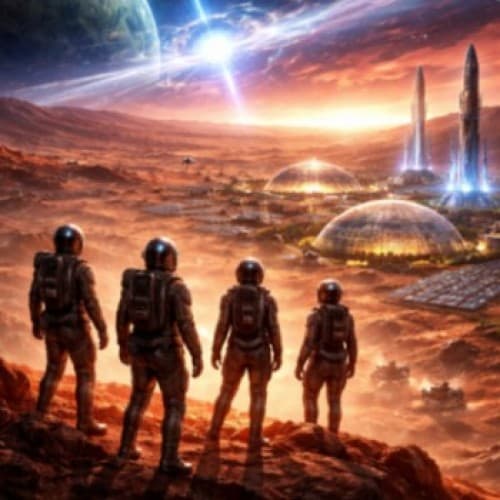

The Odyssey’s descent module cut through Mars’ thin, rust-colored atmosphere, its heat shields glowing with streaks of orange. Outside the viewport, Olympus Mons rose like a colossal sentinel over the horizon, while Valles Marineris carved a jagged scar across the planet’s surface.
Inside the cabin, the crew held their breath.
“Atmospheric readings are nominal,” Kai reported, fingers trembling as he monitored the gauges. “No unexpected turbulence. Landing trajectory stable.”
Raj gripped the controls, jaw tight. “All right. Let’s bring her down gently. No heroics.”
Elara leaned forward, eyes glued to the displays. “This is it. Humanity’s first footprint on another planet. Remember your training, keep calm, and—”
The module shuddered violently as a thin layer of dust and debris whipped across the sensors. Red clouds swirled outside the reinforced glass.
“Minor storm,” Sofia said. “Nothing dangerous—yet.”
Minutes later, the descent module touched down on the Martian plains near the base of Elysium Mons. The hull thudded against the hard-packed surface, vibrations rattling the cabin, then settled with a final, tense sigh.
“We’re down,” Raj said, voice steady. “Welcome to Mars, people.”
The crew stared in awe through the viewport. The planet was more alien and beautiful than any simulation could capture: jagged rock formations, rust-colored sand dunes, and distant ice caps glinting under the weak sunlight.
Elara felt a lump in her throat. “We did it. This… this is real.”
Kai practically bounced in his seat. “I can’t believe it! We’re actually here!”
Sofia checked her portable sensors, scanning the surface. “Temperature is lower than predicted. Radiation slightly higher. The soil is rich in iron—very promising for future terraforming experiments.”
Raj opened the hatch. A hiss of pressurized air met them, and the faint smell of Martian dust—a dry, metallic tang—drifted into the cabin.
Elara suited up first. “Let’s make history,” she said, stepping onto the surface. The dust crunched beneath her boots, a sound humanity had never heard. She looked around, seeing red plains stretching endlessly, and the Earth, a tiny blue dot in the black sky.
“God… it’s beautiful,” Kai whispered, stepping out after her.
Sofia knelt, taking samples of the Martian regolith. “No life detected so far… but this soil will support algae and microbes we’re planning to introduce for atmospheric development.”
Raj stood at the edge of their landing zone, surveying the horizon. “We need to set up domes and habitats quickly. Mars doesn’t wait for anyone. Temperatures drop fast, and storms can arrive without warning.”
As the team began unloading supplies, deploying solar panels, and preparing habitats, the reality of the planet hit them: every task was a test of survival. Dust storms could destroy unprotected instruments. Radiation threatened the unshielded. Oxygen was scarce. Mars was unforgiving.
But it was also full of promise.
Elara looked out across the plains, feeling the weight of history pressing on her shoulders. “This is only the beginning. One day, this planet will breathe with life. One day, humans will call it home.”
And far above, unnoticed by the crew, a faint glimmer of something unusual flashed on their instruments—a lingering trace of the warp jump anomaly. Mars was alive in more ways than they could yet imagine.