


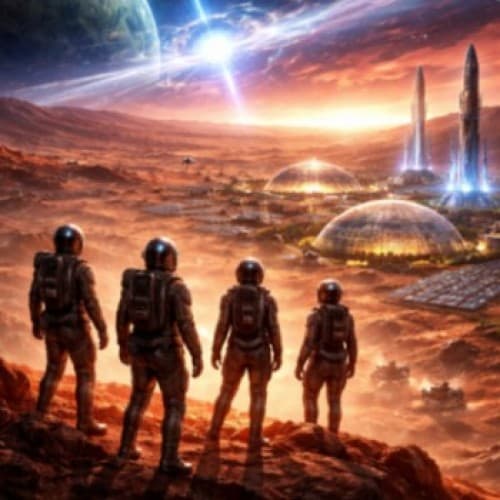

The morning sun rose pale and weak over the Martian horizon, casting long shadows across the newly deployed domes. The crew of the Odyssey moved like clockwork, each step measured, each task critical. Outside, the red dust clung to their suits, and the crunch underfoot was a constant reminder: this world was not Earth, and it demanded respect.
Sofia Vega, suited and determined, surveyed the first greenhouse dome. Within its transparent walls, trays of algae, cyanobacteria, and hardy plants thrived under artificial light and carefully regulated temperature. The experiment was simple in theory but delicate in practice: create life that could eventually alter the Martian atmosphere.
“Algae colonies are stable,” Sofia reported, scanning the digital readouts. “CO₂ absorption is at predicted levels, oxygen output nominal. If we can scale this, we could begin changing the atmosphere within decades.”
Kai, always eager, looked over her shoulder. “Decades? That seems… slow. Can’t we speed it up?”
Sofia shook her head. “No. Terraforming is about patience. If we rush, we risk destabilizing the system—or worse, killing everything we introduce.”
Elara joined them, her brow furrowed. “We’re on a schedule. Earth expects results. They want proof that Mars can be colonized safely.”
“Safe for humans, yes,” Sofia replied, “but Mars itself is not a blank slate. Even if there’s no detectable life, we have to be careful. Introducing Earth organisms will permanently change this planet. Once we start, there’s no undoing it.”
Raj walked in, carrying a set of environmental sensors. “Practical matters first. Temperature regulation, radiation shielding, oxygen levels. We can talk ethics later—if we don’t survive the first week, ethics won’t matter.”
As the team worked, the terraforming units hummed in the distance—massive machines designed to release greenhouse gases into the atmosphere, melt ice caps, and thicken the air. They were the heart of the operation, the promise of a new world. But they were also the first point of contention.
On Earth, Dmitri Orlov watched remotely, his fingers tapping impatiently on the console. “Accelerate the units,” he demanded. “We don’t have decades. Humanity’s first foothold must be decisive.”
A warning flashed on his console: “Terraforming acceleration exceeds safety thresholds.”
Orlov ignored it. “Boundaries are made to be crossed.”
Back on Mars, the crew received the transmission. Elara frowned. “We’re not doing that,” she said firmly. “We follow the protocols. Accelerating this process could kill the crops, the algae… even our oxygen supply. We won’t risk lives for speed.”
Sofia nodded. “It’s a delicate ecosystem, even if it’s a human-made one. We’re stewards, not conquerors.”
Kai glanced toward the horizon. “I thought we were explorers. Why does it feel like we’re prisoners of rules?”
Raj put a reassuring hand on his shoulder. “Exploration isn’t just running fast. It’s knowing when to slow down. Mars doesn’t care about our schedules, Kai. It only cares if we survive—or if we fail.”
Days turned into weeks. The crew monitored oxygen levels, temperature, soil health, and water systems. Slowly, life began to take root. Tiny green colonies appeared in the algae trays, and oxygen readings rose ever so slightly. The planet was responding.
But the anomaly from the warp jump still lingered at the edges of their instruments, subtle and unexplainable. Sensors flickered at irregular intervals. Small distortions in time and energy readings unnerved even the seasoned crew.
Elara studied the data in silence. “I don’t know what it is,” she admitted, “but it’s there. And it’s watching us.”
Sofia, kneeling by the algae trays, looked up with determination. “Mars doesn’t care about anomalies. Life doesn’t wait for perfection. We’ll continue—carefully, ethically—but we’ll continue. This planet can be made to breathe, if we do it right.”
And as the Martian winds whispered across the plains, carrying dust and ice crystals in slow, deliberate currents, the crew realized something profound: they weren’t just building a colony. They were reshaping the destiny of an entire planet—and with it, the future of humanity itself.