


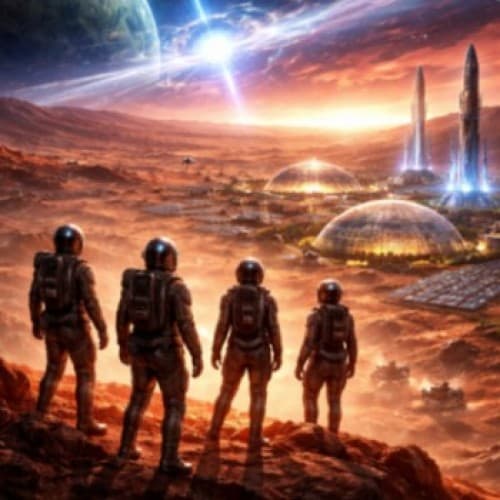

Back on Earth, in a gleaming high-rise in New Geneva, the boardroom of Orlov Interstellar hummed with quiet tension. Floor-to-ceiling windows looked out over a city of gleaming spires and flying transport drones, a stark contrast to the barren red plains the crew of the Odyssey would soon touch.
Dmitri Orlov, the corporate magnate whose fortune had been built on mining technology and private space ventures, leaned back in his chair, steepling his fingers. His sharp eyes followed a holographic display of Mars, its surface marked with proposed landing zones, domed colonies, and experimental terraforming sites.
“We cannot let Earth’s nations dictate the pace of colonization,” he said, voice smooth but laced with steel. “Time is our resource. Mars will belong to those who act decisively.”
Beside him, his chief strategist, Lena Kovacs, shook her head. “Dmitri, there are ethical protocols. Terraforming must follow strict simulations. Accelerating the process could destroy fragile ecosystems, not to mention risk the lives of the first settlers.”
Orlov’s lips curved into a thin smile. “Fragile ecosystems? Mars is dead. There is no life to preserve. That planet is ours to shape. Every delay is a missed opportunity to dominate the next frontier.”
Half a world away, governments were debating similar stakes. The United Nations Space Council convened an emergency session. “Warp travel has changed everything,” argued Ambassador Hiroshi Tanaka, a veteran diplomat from Japan. “Whoever controls warp drives and Martian colonies will control the future of humanity. We need international oversight before chaos erupts.”
But enforcement would be difficult. Private corporations, flush with cash and armed with technology that governments barely understood, could act faster than any treaty.
Meanwhile, on the Odyssey, tension simmered among the crew as well.
“Do you think Dmitri Orlov really cares about us?” Kai asked quietly to Sofia, as they ran final checks in the bio-lab.
Sofia shook her head, frowning. “He doesn’t care about exploration or science. He wants control. Profit. Power. Everything we do is a stepping stone for him. We have to be careful.”
Elara, overhearing them, walked over. “Careful, yes. But don’t forget why we’re here. This mission isn’t about corporations, or politics, or power. It’s about proving humanity can survive beyond Earth, and building something lasting.”
Raj added from his station, voice low and serious, “Elara’s right. But shadows follow every light. We need to watch the politics and the business deals, yes—but our first job is keeping each other alive and getting Mars ready for life.”
As the crew prepared for the landing, back on Earth, Orlov’s board approved a covert acceleration program: terraforming units that could alter Mars’ atmosphere faster than any safety regulations allowed. Sensors, biomes, and even synthetic microbes would be deployed, regardless of potential consequences.
The shadows of ambition were no longer distant—they were closing in. On Mars, the Odyssey’s crew would have to navigate not only the harsh, alien environment but also the human ambitions that threatened to follow them across the stars.
And as the planet drew closer beneath the Odyssey’s hull, the crew realized that the greatest unknown wasn’t the red desert or the thin, icy air—it was the humans themselves.