


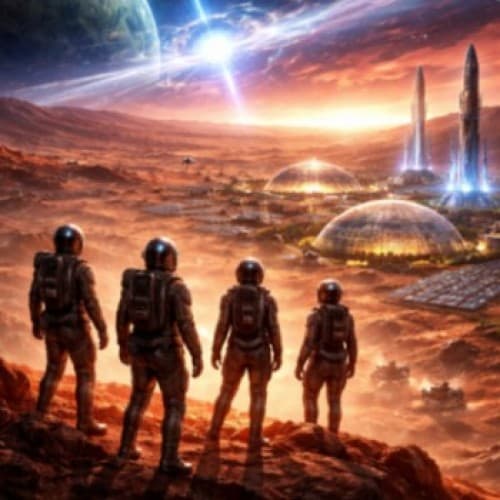

The Martian domes had grown into a network of settlements, connected by transit corridors, energy lines, and carefully monitored terraforming stations. Life on the planet was no longer fragile—it was thriving, though still dependent on constant vigilance.
Yet with growth came politics. Earth’s governments, corporations, and scientific organizations all claimed stakes in Mars’ future. Dmitri Orlov had not been deterred; his private fleets circled the planet, lobbying for accelerated terraforming and resource exploitation.
At the Mars Governance Summit, held in a reinforced orbital station above the planet, delegates from Earth, corporate entities, and the Martian colony itself convened. Elara Finch and Raj Iyer represented the settlers, the first humans who had walked on Martian soil.
Elara addressed the assembly. “Mars is not a resource to be claimed lightly. Every step we take here affects life, the environment, and the future of humanity. Cooperation is not optional—it is mandatory. We cannot allow greed to dictate our progress.”
Orlov, seated with his entourage, smiled coldly. “Progress waits for no one. You have delayed development with your caution. We can build a Mars that works—faster, stronger, and more profitable. Humanity deserves nothing less.”
Sofia Vega stepped forward, her voice calm but firm. “Mars is alive, even if you cannot see it. Terraforming is not just a technical exercise—it is ethical. Accelerating beyond safe limits risks destroying ecosystems, jeopardizing life-support systems, and putting every inhabitant at risk. Mars belongs to those who care for it, not those who exploit it.”
Kai Navarro, now older, watched the exchanges with awe. “I thought we were pioneers, exploring the unknown. Now we’re politicians, negotiators… mediators for a planet.”
Raj’s voice cut in, steady as ever. “Then we’ll act as pioneers of humanity and guardians of Mars. Unity is our only chance.”
The summit ended in uneasy compromise. Martian colonies were given increasing autonomy, with Earth-based corporations allowed limited operations under strict oversight. Warp travel provided near-instant communication and transport, but also allowed oversight—spying, monitoring, and intervention—ensuring that Earth could not completely abandon its influence.
On Mars, the first generation of Martian-born humans continued to grow. They were children of a world in transition, raised with a sense of responsibility that no Earth-born human could fully grasp. They were witnesses to humanity’s attempt to unite or fracture across planets.
Elara watched a group of children play near the greenhouse domes. Their laughter echoed across the plains, carried by filtered air systems. “They’ll judge us by what we leave them,” she said softly. “Our unity—or our division—will define the future.”
Sofia nodded. “And they will have choices we never had. Choices we have to preserve for them. Mars is alive, Kai. And one day, it will have citizens who call it home.”
Meanwhile, Dmitri Orlov plotted in secrecy. Corporate ambition never sleeps. Earth factions still tried to claim dominance. But for the first time, Mars itself had a voice—and humanity was learning that a divided species, even across worlds, could not survive the challenges of the universe alone.
Above, warp corridors pulsed like arteries of light, carrying humans, supplies, and knowledge between Earth and Mars. The first steps toward a true interplanetary civilization had been taken. But unity remained fragile, division ever-present, and the cosmos itself waited for the next move.