


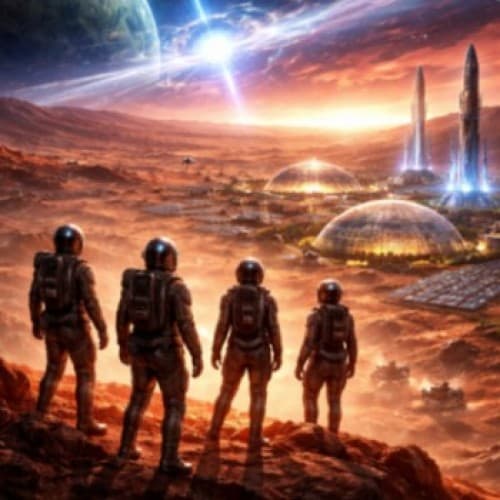

Decades had passed since the Odyssey first touched the Martian plains. The planet was no longer a barren red desert—it was alive. Algae colonies had multiplied into thriving bio-domes, oxygen levels had risen, and the first Martian-born children had grown into adults capable of walking outside the domes for extended periods.
Elara Finch, now older and grayer, walked along a pathway between two large domes. Children laughed and ran past her, their suits lighter than the early protective gear, their lungs stronger in the thinner Martian air.
Sofia Vega tended a large algae farm nearby, now automated but still carefully monitored. “The first terraforming units are fully integrated,” she said. “Mars is breathing on its own—slowly, but it’s breathing.”
Kai Navarro, a senior engineer now, looked up at the twin moons, Phobos and Deimos. “Sometimes I forget that we’re not just living on Mars. We’re shaping a world. And this world will outlive all of us.”
Raj Iyer, older and quieter than before, joined them. “It’s incredible. We survived storms, anomalies, corporate greed, and the universe itself. And yet… here we are. Humanity has a foothold beyond Earth. That’s a legacy worth leaving.”
Elara gazed toward the horizon, where the faint shimmer of warp corridors cut across the sky, invisible yet undeniable. “Warp travel gave us the stars, yes, but it also gave us responsibility. We’ve learned that the universe doesn’t bend to ambition—it tests it. And humanity has passed its first test.”
Above them, satellites monitored the warp anomaly, still flickering faintly. It had become a silent companion, a reminder of the unknown, a challenge for future generations.
On Earth, Dmitri Orlov’s ambitions had waned in the face of Martian autonomy. The first interplanetary treaties had been signed, ensuring ethical oversight and the protection of life on Mars. Orlov’s corporations had adapted, learning that cooperation sometimes yielded greater progress than greed.
Children played freely in the bio-domes, unaware of the sacrifices and struggles that had created their world. They were the true legacy of the first mission—the first humans raised entirely on Mars, destined to shape a civilization independent of Earth, yet still connected to it.
Elara turned to her team, eyes bright with hope and pride. “We did more than survive. We planted life. We created a future. Mars is no longer a frontier. It is home.”
Sofia smiled. “And one day, these children will carry humanity even further—beyond Mars, beyond the stars. The universe is vast, but we’ve learned how to reach it.”
Kai laughed softly. “I wonder what they’ll discover next. Planets we haven’t even dreamed of. Perhaps warp anomalies even stranger than ours.”
Raj’s voice was steady. “Whatever comes, we’ve proven that humanity can endure. Mars was just the beginning. The stars await.”
As the sun set over the Martian plains, painting the red dust in gold and crimson, the crew watched in silence. The wind whispered across the growing plains, carrying the scent of life, hope, and the promise of the future. Humanity had reached beyond its cradle, faced the unknown, and built a world that would stand long after they were gone.
Mars breathed. Humanity thrived. And the stars waited patiently for the next chapter.