



The first Martian-born children were small, fragile, and extraordinary. They were humanity’s proof that life could survive and even thrive on a new world.
Sofia Vega held the infant in her arms, marveling at the tiny fingers and the soft breath that misted the filtered air of the greenhouse nursery dome. “Born on Mars,” she whispered. “We’ve done it… humanity has a future here.”
Kai, now less wide-eyed and more tempered by months of hardship, watched in awe. “They’ll never know Earth as we do,” he said quietly. “This planet is their home.”
Raj, standing nearby, nodded. “And it will shape them. They’ll grow up knowing how fragile life is, and how vast the universe can be. That knowledge will make them strong—or wary. Or both.”
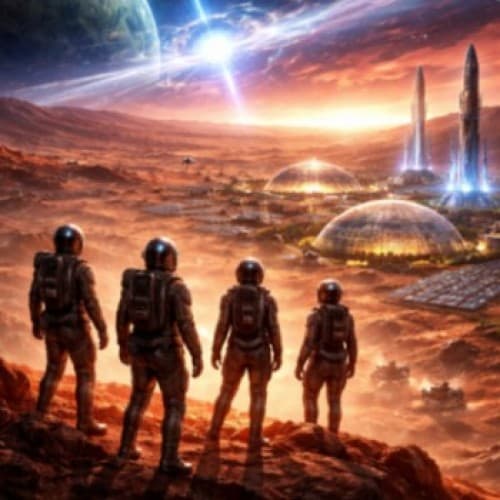
Elara, ever focused on the bigger picture, stepped to the observation deck. The domes below glowed softly in the Martian twilight, surrounded by dust and ice. “Mars was our first step,” she said. “Now it’s the gateway. Warp travel has made it possible to think beyond one planet. Beyond one star system. We’re not just Martians—we’re humanity expanded.”
The Odyssey had been the first to bring humans to Mars. Now, with warp travel refined and tested, other ships began arriving. Outposts expanded, domes multiplied, and the first trade and communication routes between Mars and Earth were established—almost instantly, thanks to warp travel.
Yet the universe remained unpredictable. The warp anomaly that had followed them from Earth continued to flicker at the edges of sensors. Instruments occasionally recorded impossible energy fluctuations. Time loops—though brief—created subtle disorientation in the crew.
Sofia frowned at her readings. “We’ve pushed Mars into life, yes. But warp space is still… unstable. Every jump, every connection to another system could magnify the anomalies. If we expand too quickly, we might unleash something we cannot control.”
Elara’s gaze hardened. “We move forward—but carefully. Warp travel gives us the stars, yes, but it also tests our limits. Our responsibility is not just to survive, but to understand. Every step must be deliberate.”
Meanwhile, Earth continued its watchful eye. Dmitri Orlov, furious that the crew had stabilized the domes and controlled the pace of terraforming, continued his covert operations. Corporate and political pressure mounted. Mars had become a prize that many wanted to claim—but the first Martians were learning to act independently.
Kai looked out over the domes, hands on the railing. “I used to think we were explorers. Now I see… we’re guardians. Mars belongs to no one until we prove we can protect it—and the children born here, they’ll inherit that responsibility.”
Raj smiled faintly. “And they will. We’ve survived storms, sabotage, and a universe that doesn’t care. They’ll survive too—and maybe even thrive where we barely managed.”
Elara turned, eyes shining with a mixture of exhaustion and hope. “The universe is vast. But humanity is learning how to reach it—and how to survive in it. Mars is just the beginning. Beyond red lies everything else. And we will go.”
As the twin moons of Mars rose in the sky, casting pale silver light across the plains, the first Martian children slept peacefully. Above them, warp pathways flickered with potential, waiting to carry humanity to other stars. And in the quiet, the faint pulse of the warp anomaly reminded them: the universe had been stirred, and humanity was no longer confined to one world.