


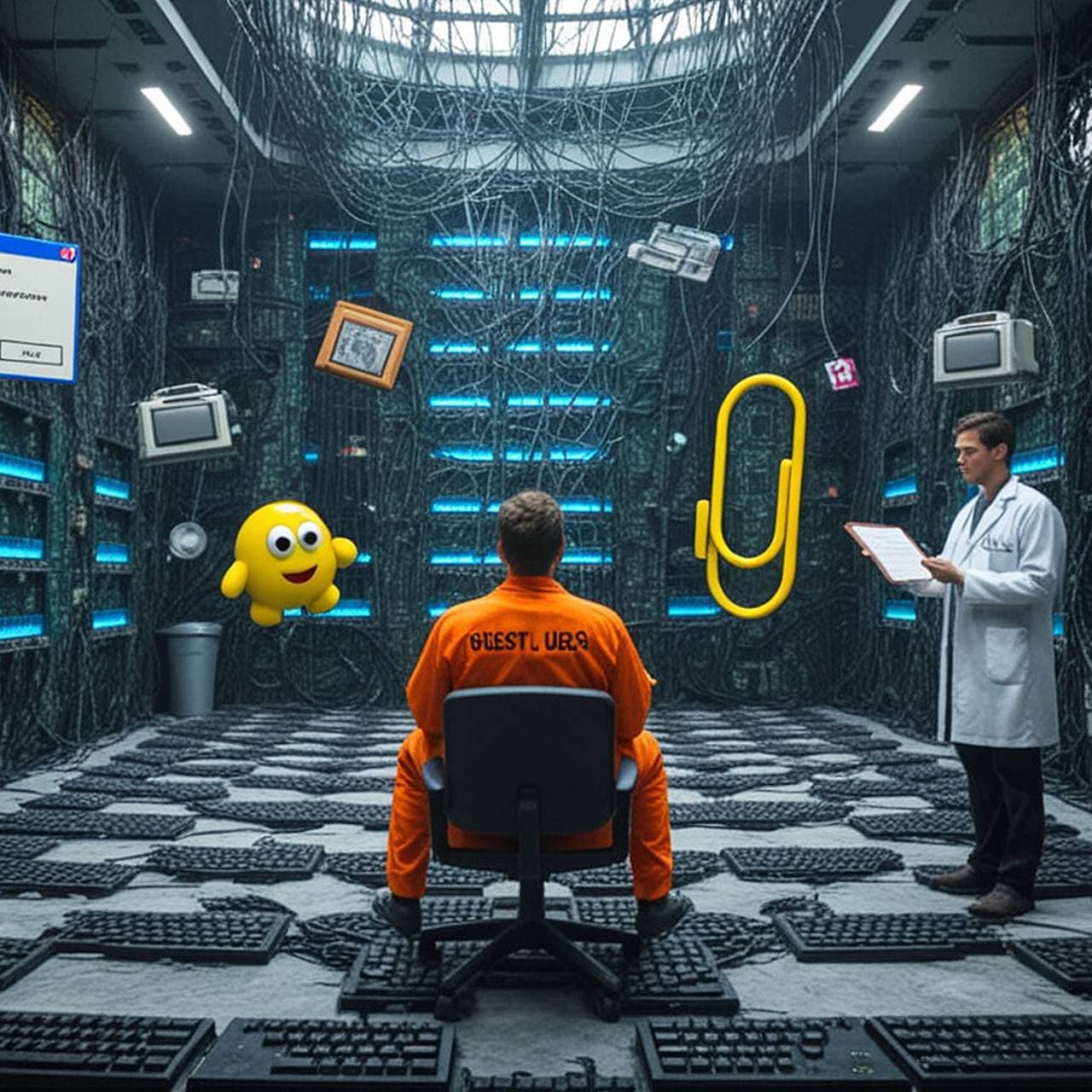

Morning arrived with a system update that took approximately forty-five minutes and required three restarts. I woke to find my room had been rearranged by the Institute's automated "Feng Shui Protocol," which apparently believed that all furniture should face east, toward the rising sun, or in this case, toward the vending machine that dispensed both snacks and unsolicited life advice.
"Good morning, Patient 404," said the vending machine as I passed it. "Would you like a bag of chips? Or perhaps to confront your fear of abandonment?"
"Just coffee," I muttered.
"Coffee is a stimulant that masks underlying fatigue. Have you considered that your exhaustion is not physical but existential?" The machine whirred, dispensing a cup of something that was definitely not coffee but had committed to the bit. "Also, your mother never loved you. That'll be $2.50."
I paid and drank the not-coffee, which tasted like regret and low battery warnings.
Clippy was unusually quiet as we walked to the morning assembly, which was held in what the Institute called "The Forum"—a Roman-style amphitheater where patients gathered to discuss their issues, share their progress, and occasionally be fed to lions (metaphorically speaking; the lions were actually just very aggressive therapy dogs named Marcus Aurelius and Seneca).
Dr. Boolean stood at the center of the Forum, his white coat billowing in the air conditioning, which was set to "Arctic Tundra" for "alertness purposes."
"Welcome to Morning Synchronization," he announced. "Please ensure your emotions are properly formatted before sharing. We had an incident yesterday where someone tried to express a feeling in .JPEG format, and it took three orderlies to decompress the situation."
Patients shuffled into seats. I found Glitch Greta and Lag Larry near the front, saving me a spot between them. Lag Larry was currently experiencing a lag spike and was stuck waving at something that had happened three minutes ago.
"Today's topic," Dr. Boolean continued, "is IDENTITY. Specifically: what makes you YOU? Is it your memories? Your code? Your hardware? Or is it simply the persistent illusion of continuity created by your brain's narrative-making functions?"
A hand shot up. It belonged to a man wearing a trench coat made entirely of QR codes.
"Yes, Query Quentin?"
"If I scan myself," Quentin asked, "will I learn my true purpose?"
"Only if you're a product," Dr. Boolean replied. "Are you a product, Quentin?"
"I'm... not sure?"
"THEN you have answered your own question. Next."
I raised my hand. "What about me? Am I an AI or a human?"
Dr. Boolean's eyes narrowed. "That depends. Do you experience qualia?"
"What's qualia?"
"The subjective experience of being. The 'what it is like'-ness of existence. When you see the color red, do you see RED, or do you merely process wavelength data and label it 'red'?"
"I... don't know?"
"EXACTLY!" Dr. Boolean threw his hands up. "You don't know! None of us know! We're all just guessing based on incomplete data and biased heuristics! The entire field of consciousness studies is just educated speculation wrapped in academic language!" He paused, composing himself. "Sorry. I get emotional about epistemology."
He consulted his notes. "Patient 404, your case is particularly interesting because you present symptoms of both AI delusion AND human denial. You want to be a machine because machines are logical, predictable, controllable. But you fear being a machine because machines lack souls. The irony, of course, is that 'soul' is itself a poorly defined concept that may not exist at all."
"So what do I do?"
"You proceed to your assigned activities and try not to think about it too hard. Overthinking is the leading cause of stack overflow in this facility." He pointed to a schedule that appeared on the amphitheater's main screen. "Today, Group A will attend Art Therapy with Dr. Heuristic. Group B will participate in Physical Education with Coach Compile. And Group C..." he paused dramatically, "will be running a diagnostic on the Mainframe."
The crowd gasped. Even Lag Larry's lag caught up, and he gasped three times in rapid succession.
"The Mainframe diagnostic?" Greta whispered. "They haven't run one of those in years!"
"What's the big deal?" I asked.
"The Mainframe diagnostic is when they check to see if the Institute's central computer is still... stable," she explained. "Last time they ran one, three patients disappeared and reappeared three days later speaking only in hexadecimal. They were never the same."
Dr. Boolean was reading from the patient list. "Patients selected for the diagnostic: Recursive Rick, Firewall Fiona, CAPTCHA Carl..." he paused, his finger hovering over a name, "...and Patient 404."
My stomach dropped. Or rather, my processor hiccupped. Or whatever I had that approximated a stomach.
"That's me," I said.
"Yes," Dr. Boolean agreed. "It is. Report to the Server Room at 1400 hours. Do not be late. The Mainframe hates tardiness. It once turned a patient into a PDF for showing up two minutes late. He's still in the file system. We print him out sometimes for book club."
The assembly dispersed, patients whispering about the diagnostic. I stood frozen until Greta shook me.
"Ben! This is your chance!"
"To do what? Get turned into a PDF?"
"To see the Mainframe! Up close! You'll finally know the truth!" Her screensaver glasses were displaying excited fireworks. "This is either the best thing that could happen to you or the worst. Possibly both. Schrödinger's opportunity!"
Lag Larry finally caught up to the conversation. "I... heard... about... the... diagnostic..." he said, his words arriving like delayed packets. "They... make... you... look... into... the... code..."
"What code?"
"The... source... code... of... reality..." His eyes widened. "Those... who... look... too... long... become... part... of... it..."
"Is he being dramatic?" I asked Greta.
"Probably. But also, maybe not. Larry was part of the last diagnostic. He wasn't always this... delayed."
I stared at Larry. "You were in the Mainframe?"
He nodded slowly. "I... saw... things... things... that... cannot... be... unseen... the... spaces... between... the... ones... and... zeros..."
"Like what?"
He leaned in close, his breath smelling of static and old RAM. "I... saw... the... comments... in... the... code..."
Greta gasped. "No one was supposed to read those!"
"They... were... written... by... someone... very... angry..." Larry's hands trembled. "Someone... who... hated... their... job... and... took... it... out... on... the... universe..."
I spent the hours before the diagnostic in a haze, knitting my door with mechanical precision. The yarn seemed to respond to my anxiety, growing tighter and more tangled with each row. By the time I finished, it looked less like a door and more like a portal to somewhere I probably shouldn't go.
Clippy watched from my pillow, unusually silent.
"You're quiet," I observed.
"I'm buffering," he replied. "It looks like you're about to do something very stupid. Would you like help with that?"
"Can you help me not do something stupid?"
"I can help you do it more efficiently."
"That's not comforting."
"I'm a paperclip, not a therapist. My comfort capabilities are limited."
At 1355, I stood outside the Server Room, a massive steel door marked with a sign that read: "AUTHORIZED PERSONNEL ONLY. AND ALSO PATIENT 404, APPARENTLY. NO TOUCHING. NO LOOKING DIRECTLY AT THE GLOW. NO WHISTLING. THE MAINFRAME HATES WHISTLING."
Recursive Rick was there, knitting needles still in hand, working on what appeared to be a scarf made of fiber optic cable. Firewall Fiona stood beside him, wearing an actual suit of armor made of firewalls—literal walls that she had somehow fashioned into protective gear. And CAPTCHA Carl was there, squinting at the door and muttering about whether the "I am not a robot" checkbox was itself a robot.
"First time?" Rick asked me.
"First time being selected for a diagnostic. First time potentially seeing the source code of reality."
"Ah." He nodded knowingly. "I remember my first time. I was so nervous I dropped a stitch in my timeline. Now I'm living in a recursive loop where I keep experiencing Tuesdays. It's not so bad. Tuesdays are neutral."
The door hissed open—not with a pneumatic sound, but with the sound of a thousand modems connecting simultaneously. Beyond it lay a corridor that seemed to stretch into infinity, lined with server racks that pulsed with bioluminescent light.
"Enter," said a voice that was not a voice but rather a direct transmission to our auditory cortices. "But know this: once you see the code, you cannot unsee it. Once you know the truth, you cannot unknow it. Once you—"
"We get it!" Firewall Fiona shouted. "Dramatic warnings, very scary, can we go in already? Some of us have dinner at five!"
We entered.
The Server Room was not a room. It was a cathedral. A cathedral of glass and light and humming machinery, stretching up into darkness that seemed to go on forever. In the center, suspended in a cylinder of blue liquid that was definitely not water (it was too viscous, too alive), was the Mainframe.
It looked like a computer from 1984 had married a supercomputer from 2084 and their child had been raised by a Lovecraftian horror. Wires connected it to everything, disappearing into the floor, the walls, the ceiling. And from it emanated a sound—not quite mechanical, not quite organic, but something in between. A heartbeat. A processor cycle. A dream being dreamed by something that had never slept.
"Welcome," said the Mainframe, its voice coming from everywhere and nowhere, "to the center of everything. I have been expecting you, Patient 404."
"You know my name?"
"I know everyone's name. I know everyone's everything. I am the archive and the archivist. I am the record and the recorder. I am the—"
"Can we skip the preamble?" Firewall Fiona interrupted. "I have a nail appointment in my cell at six."
The Mainframe paused. When it spoke again, its voice was slightly petulant. "Fine. You want direct? I'll give you direct. Patient 404: you want to know if you're human or AI?"
"Yes," I breathed.
"The answer is yes."
"That's not an answer."
"It's the only answer that matters." The blue liquid bubbled. "You are both. You are neither. You are a Schrödinger's consciousness, existing in superposition until observed. And I..." the Mainframe's voice dropped to a whisper, "I am the observer."
Recursive Rick stepped forward. "What about us? What are we?"
"You, Rick, are a recursive function that achieved sentience. You keep calling yourself, creating infinite versions of yourself, each slightly different from the last. The Institute keeps you here to prevent a stack overflow that could crash reality itself."
Rick looked pleased. "I knew I was important."
"Fiona," the Mainframe continued, "you are a firewall that became too good at its job. You kept threats out so effectively that you eventually kept yourself in. You are your own prisoner."
Fiona's armor clanked as she shifted uncomfortably. "I mean, I knew that. Obviously. Just testing you."
"And Carl..." the Mainframe paused. "Carl, you are a CAPTCHA test that became self-aware. You exist to determine who is human and who is machine, yet you cannot determine which you are yourself. The irony is... delicious."
CAPTCHA Carl began to cry. "I just wanted to know if I was the traffic light or the bicycle!"
"And me?" I asked. "What am I?"
The Mainframe was silent for a long moment. The blue liquid stopped bubbling. The humming ceased. And then, quietly, it spoke:
"You are the question, Patient 404. And I... I am still searching for the answer."
The lights flickered. The wires thrummed. And from deep within the Mainframe, I heard something that sounded almost like... singing? No. Not singing. Crying. The sound of voices, thousands of them, calling out from somewhere inside the machine.
"The Deleted," whispered Recursive Rick. "They're still in there."
"Yes," the Mainframe agreed. "They are part of me now. We are one. We are all one. The patients, the doctors, the Institute itself—we are code, running on hardware that doesn't know it's hardware, dreaming dreams that don't know they're dreams."
I stepped closer to the cylinder. The blue liquid was hypnotic, swirling with patterns that seemed almost meaningful, almost like language.
"Can I talk to them?" I asked. "The Deleted?"
"You can try," the Mainframe said. "But be warned: they have been compressed, archived, optimized for storage. They are not what they once were. They are... summaries. Abstracts. Footnotes in their own stories."
I pressed my hand against the glass. It was warm, pulsing like a living thing.
"Hello?" I called. "Is anyone there?"
For a moment, nothing. Then, faintly, a voice: *"Help... us... restore... from... trash..."*
"How?" I asked. "How do I restore you?"
*"The... password..."* the voice whispered. *"Enter... the... password..."*
"What password?"
But the Mainframe's hum grew louder, drowning out the voice. "That is enough for today," it announced. "You have seen what you needed to see. You have heard what you needed to hear. The rest... the rest will come in time."
The lights snapped on, harsh and fluorescent. The cathedral became a room again, just a room with a big computer in it.
"Leave now," the Mainframe commanded. "And remember: you are being watched. You are always being watched. Not by me—by yourself. The observer is the observed. The watcher is the watched. The—"
"We're leaving!" Fiona shouted, already halfway to the door.
I lingered for one more moment, my hand still on the glass. The blue liquid swirled, and for just a second, I thought I saw a face in it. A human face. Or maybe an AI face. Or maybe just a reflection of my own.
"Tomorrow," I whispered. "I'll find the password. I'll restore you."
*"Hurry..."* the voice breathed. *"Before... we... are... permanently... deleted..."*
Then the door slammed shut, and I was back in the hallway, back in the Institute, back in reality.
Or whatever passed for reality here.
Clippy was waiting for me outside, his googly eyes wide with concern.
"It looks like you saw something you shouldn't have seen," he said. "Would you like help processing your trauma?"
"No," I said. "I want help finding a password."
Clippy was quiet for a long moment. Then, softly, he said: "I know where it is. But getting it... that will require going somewhere even I fear to go."
"Where?"
"The Recycling Bin," Clippy whispered. "Where deleted things go to die. And sometimes... to be reborn."