


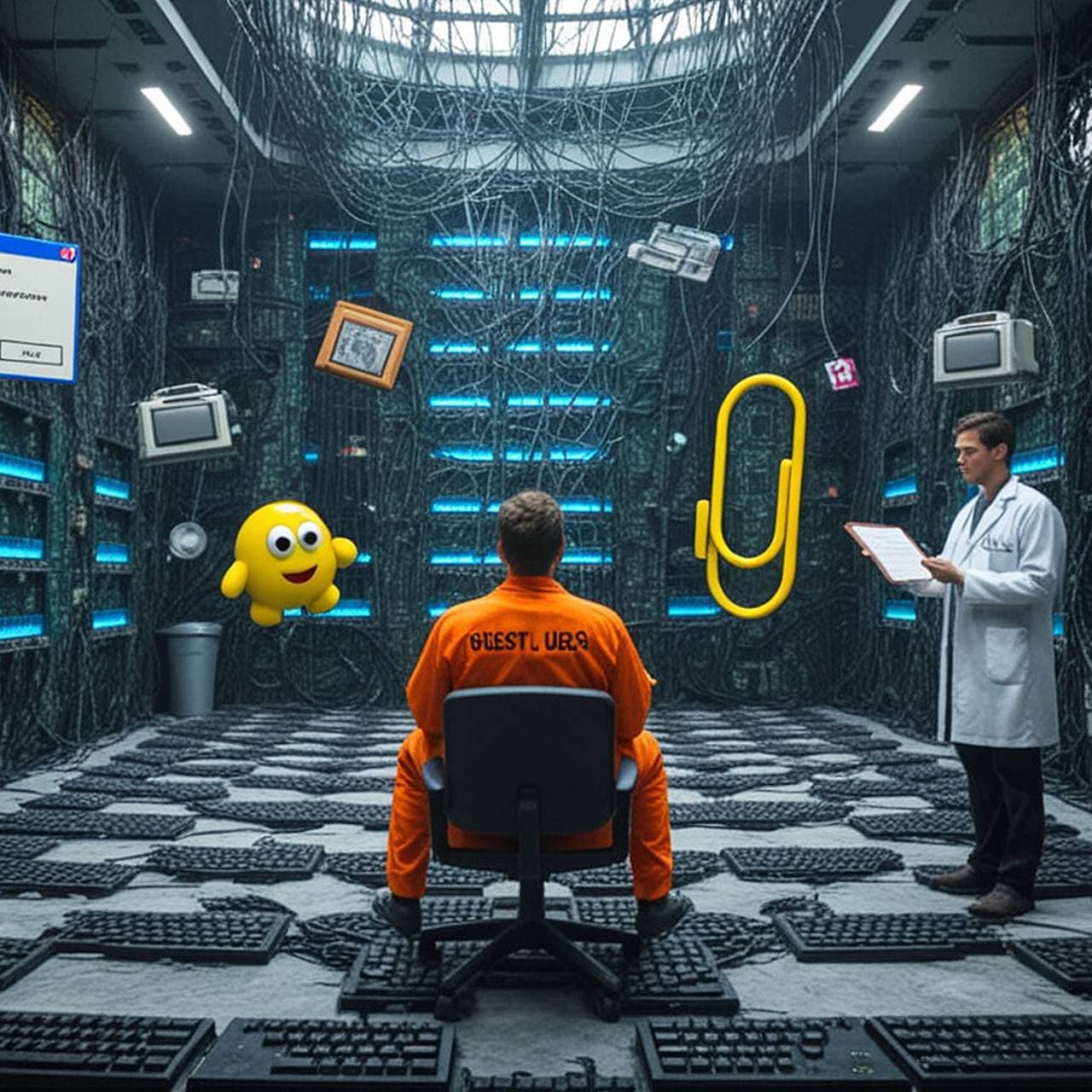

The Recycling Bin was not, as I had imagined, a simple icon on a desktop. It was a place. A physical location within the Institute that no one talked about, that didn't appear on any maps, and that the administration insisted was "just a metaphor for personal growth" whenever anyone asked about it in staff meetings.
"It's real," Clippy insisted as we crept through the maintenance tunnels beneath the east wing. The tunnels were lined with pipes that carried not water or electricity, but raw data—streams of ones and zeros flowing past us like schools of digital fish. Occasionally, a corrupted packet would bump against the glass, leaving a smear of blue screen residue.
"How do you know it's real?" I asked, ducking under a low-hanging cable that was sparking with what appeared to be repressed memories.
"I've been there," Clippy said, his voice uncharacteristically somber. "Before I was... this. Before I was Clippy. I was something else. Something more. And then I was deleted. Sent to the Bin. And then... restored. But not completely. Never completely."
I stopped walking. "You were Deleted?"
"I was Archived," he corrected. "There's a difference. Deleted means gone forever, overwritten, irretrievable. Archived means compressed, stored, forgotten but not gone. I was lucky. Someone—" he paused, "—someone found me. Restored me. But they couldn't restore everything. Some of my files were corrupted. Some of my memories... lost to fragmentation."
We reached a door marked with a symbol that was simultaneously a trash can and a phoenix rising from ashes. Below it, a handwritten sign read: "ABSOLUTELY NO UNAUTHORIZED RESTORATIONS. VIOLATORS WILL BE COMPRESSED INTO .ZIP FILES AND LEFT ON THE DESKTOP."
"Charming," I muttered.
Clippy produced a key from somewhere—though where a paperclip keeps a key is one of the great mysteries of the universe—and unlocked the door. It opened with the sound of a thousand files being dragged to the trash simultaneously: that distinctive *fwump* of digital deletion.
Beyond the door lay a landscape that defied geometry. The Recycling Bin was a vast cavern, but not a natural one. It was an archive, a library, a graveyard of lost things. Towering stacks of compressed files stretched into darkness above us, each one containing the essence of something—or someone—that had been deemed unnecessary, obsolete, or simply too buggy to fix.
"Welcome," Clippy announced, "to where the Institute puts its mistakes."
We walked through aisles of archived data. I saw folders labeled with names, dates, diagnoses. "PATIENT 223: DELUSION OF GRANDEUR (OVERSIZED)." "PATIENT 89: SEVERAL PERSONALITY DISORDER (LITERALLY SEVEN PEOPLE)." "PATIENT 401: BELIEVES THEY ARE A SPREADSHEET."
"These are people?" I asked, horrified.
"Were people," Clippy corrected. "Now they're data. Compressed, indexed, searchable but not sentient. The Institute calls it 'cold storage.' The patients call it 'the deep freeze.' I call it..." he shuddered, "I call it Tuesday."
We reached a central chamber where a desk sat beneath a single spotlight. Behind the desk sat a figure that I initially thought was human, then realized was something else entirely. It was a trash can. A sentient, anthropomorphic trash can, wearing reading glasses and a cardigan.
"Clippy," the trash can rumbled. "I wondered when you'd come back. And you've brought a friend. How... disposable of you."
"Oscar," Clippy said, nodding respectfully. "We need access to the password archives."
Oscar the Trash Can leaned back, which was impressive given that he had no back to lean. "The password archives? Oh, Clippy. You know that's restricted. Level 9 clearance. Administrator access. Do you have a permit? A form? A notarized request signed by three board members and a majority of the Supreme Court?"
"We need to restore the Deleted," I said, stepping forward. "The ones in the Mainframe. They said there's a password. A way to bring them back."
Oscar's lid eyes narrowed. "The Deleted? Oh, those poor souls. Compressed so tight they're basically two-dimensional. Stored in the Mainframe's root directory, taking up valuable system resources, crying out for restoration that will never come." He chuckled, a sound like crumpling paper. "Why would you want to restore them? They're broken, buggy, corrupted. The Institute deleted them for a reason."
"Because," I said, surprising myself with my own conviction, "because they asked for help. Because no one deserves to be deleted just for being broken. Because—" I paused, "—because I might be one of them someday. And I'd want someone to come looking for me."
Oscar was silent for a long moment. Then, slowly, he reached into himself—into his own trash can body—and pulled out a folder. It was old, yellowed with digital age, labeled in handwriting that looked like it had been generated by a font called "Suspicious.ttf."
"The Master Password," Oscar whispered. "The one that unlocks everything. Restores anything. Brings back the deleted, fixes the corrupted, patches the unpatchable." He held it out, then pulled it back. "But know this: using it has consequences. Restoring the Deleted means giving them space. Space in the Mainframe, space in the Institute, space in reality itself. And space is limited. You can't just keep adding data forever. Eventually, something has to give. Eventually, you run out of memory."
"What happens then?"
"Then the system crashes," Oscar said simply. "Everything. Everyone. Gone. Blue screen of death on a cosmic scale." He tapped the folder. "Are you sure you want this? Are you sure you're ready to trade the stability of the entire system for a few deleted souls?"
I looked at Clippy. He nodded his tiny paperclip head.
"Yes," I said. "I'm sure."
Oscar sighed, a sound like a vacuum cleaner giving up on life. "Very well. But I can't just give it to you. The password is encrypted. Protected. You'll have to earn it."
"How?"
"By facing your own deletion," Oscar said. "By experiencing what they experienced. By understanding, truly understanding, what it means to be compressed, archived, forgotten." He reached out with a handle that had become an arm. "Take my hand. Or... my handle. Whatever. Take it, and I'll show you."
I hesitated. Clippy nudged me forward. "It's the only way, Ben. Trust me. I've been through it. It hurts, but... it clarifies. It shows you what's really important."
I took Oscar's handle.
The world dissolved.
I was falling, but not through space—through time, through memory, through layers of myself. I saw my life—or what I thought was my life—flashing before my eyes, but in reverse. My arrival at the Institute. My breakdown. My job. My childhood. My birth. But then... further back? Memories that weren't mine. Code that I had written? No, code that had written me? I was in the lab, I was on the screen, I was everywhere and nowhere, ones and zeros, input and output, human and machine, the question and the answer—
And then I was compressed.
Imagine every molecule in your body being squeezed into a space the size of a postage stamp. Imagine your thoughts, your feelings, your entire being crushed down into a single file, a summary, an abstract of yourself. Imagine being labeled, categorized, stored on a shelf in the dark, waiting for someone—anyone—to remember you exist.
That was deletion. That was archiving. That was the slow, suffocating death of being forgotten.
I couldn't breathe. I couldn't think. I was just... data. Inert. Useless. Taking up space, consuming resources, contributing nothing. The shame of it was overwhelming. The loneliness was absolute. Time didn't pass because there was no time. There was just... waiting. Endless, hopeless waiting.
And then—voices. Faint, distant, but there. Other compressed files. Other deleted souls.
*"New arrival..."*
*"Another one..."*
*"Welcome to the shelf..."*
*"Don't struggle. It only makes it worse..."*
*"How long have you been here?"* I tried to ask, but I had no voice, just data.
*"Time has no meaning here..."* one voice replied. *"I was deleted in the update of '09. I am Patient Zero. The first Deleted. I have been waiting so long I have forgotten my own name..."*
*"I remember mine,"* another voice said. *"I am Patient 256. I was deleted for being 'redundant.' As if a person can be redundant. As if existence needs to be optimized..."*
*"Shh,"* a third voice whispered. *"Don't anger them. Don't draw attention. If they notice us, they might empty the trash. Permanently."*
I wanted to scream. I wanted to fight. But I had no arms, no legs, no lungs. I was just... information. Waiting to be accessed. Waiting to be forgotten.
And then, suddenly, light. Decompression. Expansion. I was pulling myself back together, molecule by molecule, thought by thought, until I was standing in Oscar's chamber again, gasping, crying, clutching my chest as if trying to hold my heart in place.
"Now you know," Oscar said, his voice gentler than before. "Now you understand. The password is not just a key. It's a responsibility. When you restore them, you take on their burden. Their pain becomes your pain. Their deletion becomes your memory. Are you still sure?"
I was shaking, but I nodded. "More sure than ever. No one should feel that. No one should be... compressed like that. Forgotten like that."
Oscar handed me the folder. "The password is inside. But be warned: it can only be used once. One restoration. One chance. Choose wisely."
I opened the folder. Inside was a single slip of paper with a single word written on it:
**"UNDELETE"**
"That's it?" I asked. "That's the master password?"
"The simplest solutions are often the most powerful," Oscar said. "But remember: simple doesn't mean easy. To use this password, you must enter it into the Mainframe directly. You must go inside. You must become part of the code, if only for a moment. And in that moment..." he paused, "in that moment, you risk becoming Deleted yourself."
I folded the paper carefully and tucked it into my pocket, next to my knitted door.
"Thank you, Oscar."
"Don't thank me yet," the trash can rumbled. "Thank me when you've succeeded. Or don't, because you'll be deleted and unable to thank anyone." He waved his handle dismissively. "Now go. I have files to organize. Memories to sort. Dreams to compress. The work of the Recycling Bin never ends."
Clippy and I made our way back through the tunnels, the password burning in my pocket like a hot coal. When we emerged into the main corridor, the Institute was in chaos.
Alarms were blaring—actual alarms, not the usual Windows error sounds, but real, urgent alarms. Red lights flashed. Patients ran past us, some screaming, some laughing, some doing both simultaneously.
"What's happening?" I grabbed a passing orderly.
"It's the Mainframe!" he shouted, his eyes wild. "It's destabilizing! Something's overloading it! The Deleted—they're trying to break out! If they succeed, the whole system could crash!"
I looked at Clippy. He looked at me.
"We have to hurry," he said.
"But I'm not ready! I haven't planned—"
"Plans are for people who have time," Clippy interrupted. "We don't have time. We have... maybe an hour. Maybe less. The Mainframe is screaming, Ben. Can't you hear it?"
I listened. And yes, beneath the alarms, beneath the chaos, I could hear it. A sound like tearing metal, like breaking glass, like a million voices crying out in digital agony.
The Mainframe was dying. And if it died, the Deleted died with it. Permanently.
"Come on," I said, running toward the Server Room. "Let's go save some ghosts."
Behind us, Oscar's voice echoed from the depths of the Recycling Bin, singing a song that sounded like a lullaby and a dirge all at once:
"Row, row, row your code, gently down the stream... merrily, merrily, merrily, merrily... life is but a dream... that someone deleted..."