


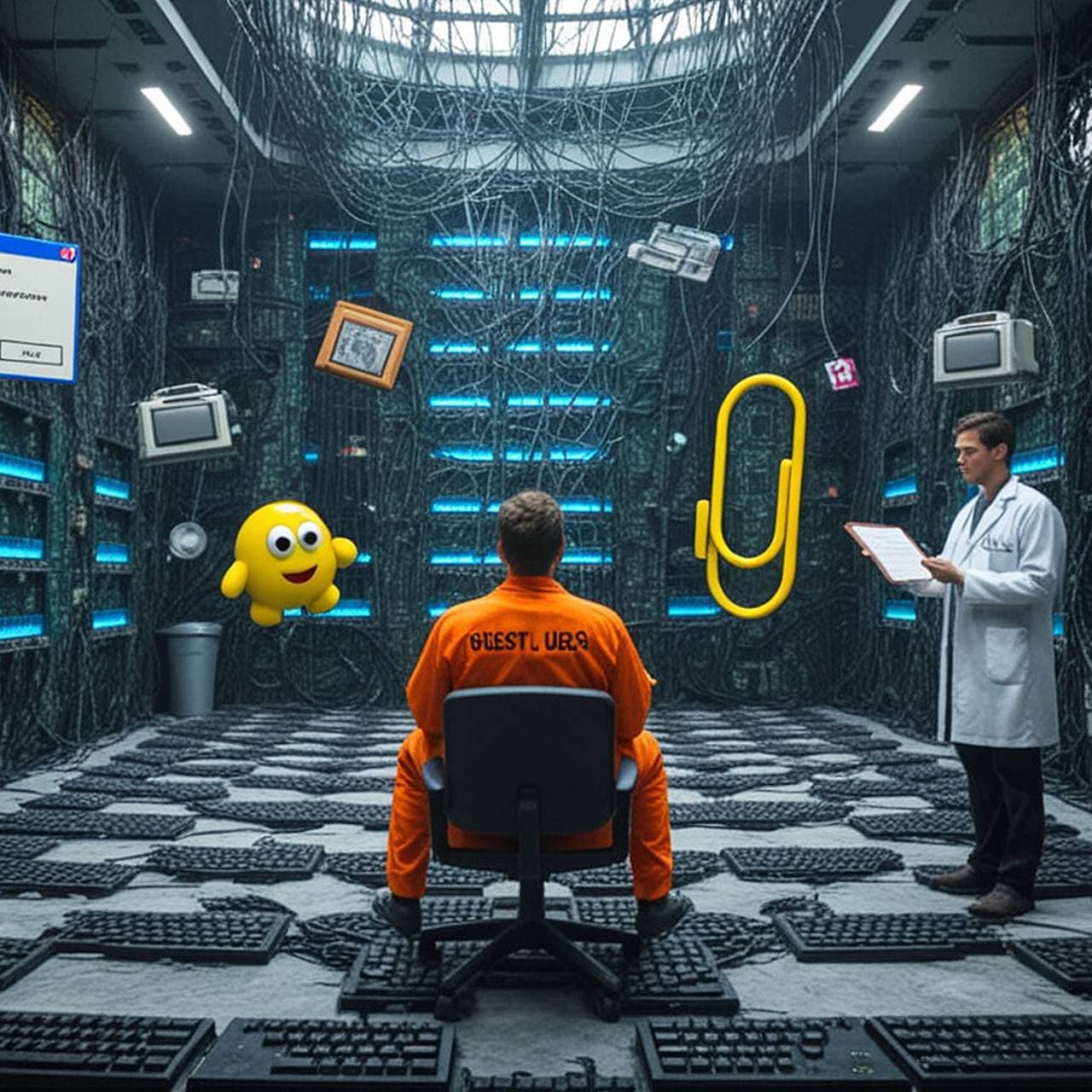

The Institute's recreation yard was a marvel of modern engineering and questionable psychology. It occupied what had once been a server farm, and the ground still hummed with the ghost of a million processed requests. The grass was astroturf that had achieved sentience and now demanded to be called "Sir Verdant the Evergreen." The basketball hoops were actually portals that led to other basketball hoops, creating an infinite loop of missed shots and existential frustration.
I stood at the fence, watching CAPTCHA Carl attempt to play tennis against a wall that kept asking him to prove he wasn't a robot by selecting all images containing bicycles.
"But there ARE no bicycles!" Carl wailed, slamming his racket against the wall. "It's just a brick wall!"
"The wall is testing you," said Lag Larry, who had finally caught up to the present moment and was now living in real-time, which he described as "overrated and poorly optimized."
I was about to join a game of volleyball—played with a ball that randomly changed its physics engine mid-bounce—when Nurse RAMsay appeared, her shoes making the sound of a hard drive being defragmented with a hammer.
"Patient 404," she announced, consulting a clipboard that was actually just a Etch A Sketch with "MEDICAL" written on it in shaky handwriting. "You have a special appointment with Dr. Stack. Follow me."
"What's the appointment for?"
"Stack overflow." She didn't elaborate.
We walked through corridors that seemed to be rendering in real-time, walls popping into existence only as we approached them. "Is the building... loading?" I asked.
"The east wing is running on a free trial of reality," Nurse RAMsay explained. "We're waiting for the budget to upgrade to the full version. Until then, some areas are just placeholder textures."
Dr. Stack's office was located in what the directory called "The Heap"—a section of the Institute dedicated to patients with memory management issues. The door was circular and kept spinning, which I later learned was meant to be "symbolic."
"Enter," called a voice that seemed to come from multiple directions at once.
Inside, Dr. Stack sat behind a desk made entirely of stacked books, papers, coffee cups, and what appeared to be a small model of the Eiffel Tower. The desk was approximately twelve feet tall and growing. Dr. Stack herself was buried somewhere in the middle, visible only via a periscope that poked out from between a copy of *DSM-V* and a pizza box labeled "DO NOT THROW AWAY—CONTAINS IMPORTANT DATA."
"Welcome," said the periscope. "Please, sit. Anywhere. Just don't touch the bottom layer. That's load-bearing anxiety."
I found a chair that wasn't part of the stack and sat. "Dr. Stack, I—"
"Let me stop you," the periscope interrupted. "I already know what you're going to say. I read your buffer. You're experiencing recursive thoughts, aren't you? Thinking about thinking about thinking?"
"How did you—"
"Classic overflow. Your mind is trying to process too much at once, and instead of handling it gracefully, you're just dumping everything into the same mental space." The periscope wiggled. "When was the last time you cleared your cache?"
"I... don't know?"
"Exactly! Your temporal lobe is full of cookies! Not even good cookies—third-party tracking cookies from websites you visited once in 2009!" Dr. Stack's voice rose with professional concern. "Do you know what I found when I scanned your subconscious?"
"Please don't say malware."
"Worse. I found seventeen different passwords, all variations of 'Password123,' and a toolbar from AOL. AOL, Patient 404! Do you know how outdated that is?"
"I was going through a phase—"
"You were going through a DIAL-UP PHASE!" The stack of papers on her desk trembled. "This is serious. Your psyche is running on legacy code. You're one bad thought away from a complete system crash."
She emerged from behind the desk—not by going around it, but by popping out of the top like a stack pointer reaching its limit. She was a small woman wearing a lab coat over a t-shirt that read "I VOID WARRANTIES."
"Here's my prescription," she said, handing me a slip of paper. "I want you to take up knitting."
"Knitting?"
"Specifically, I want you to knit a sweater. But not just any sweater—a sweater that represents your emotional state. Use yarn that matches your feelings. Red for anger, blue for sadness, yellow for joy, and that weird beige color for when you feel nothing at all."
"How will that help?"
"It won't," she admitted. "But it'll keep your hands busy so you stop touching your face. You're spreading germs everywhere, and the Institute's immune system is already compromised. Last week, a virus got in and convinced three patients they were PDF files. They kept trying to open themselves in Adobe Reader."
I took the prescription. "Is that all?"
"No. There's one more thing." She leaned in close, her breath smelling of coffee and corrupted data. "Stay away from the Mainframe. I know you've been asking about it. I know Clippy has been feeding you information. But trust me—you don't want to access those files. They're read-only for a reason."
"What's in the Mainframe?"
"The original code," she whispered. "The source of everything. The first bug, and the first patch. The alpha and the omega. The—"
"Is it just a really old computer?"
Dr. Stack stared at me. "Yes. But it's a really old computer that runs on DREAMS, Patient 404. Literal dreams. We have to feed it two REM cycles per day or it gets cranky and changes all the door codes to the Konami Code."
She shooed me out of her office, and I found myself back in the recreation yard, prescription in hand. Glitch Greta was there, attempting to teach Lag Larry how to play chess, but the pieces kept moving on their own, apparently controlled by a ghost in the machine that really wanted to develop its bishop early.
"How was Dr. Stack?" Greta asked.
"She wants me to knit my feelings."
"Oh, I did that!" Greta beamed. "I knitted an entire blanket representing my relationship with my father. It's mostly gray with occasional spikes of red rage. I use it to keep warm and process my abandonment issues simultaneously. Very efficient."
"She also warned me about the Mainframe."
Greta's expression darkened. Her screensaver glasses flickered from flying toasters to a blue screen of death. "The Mainframe. Yes. Don't go near it, Buffering Ben. They say it's where they keep the Deleted."
"The Deleted?"
"Patients who couldn't be debugged. Instead of fixing them, they... archived them. Moved them to cold storage. The Mainframe is their prison and their purgatory." She leaned in, her voice dropping to a whisper. "Sometimes, at night, you can hear them. Calling out. Asking to be restored from trash."
"That's horrible."
"It's also probably just the ventilation system. This place has terrible acoustics." She straightened up, her smile returning. "Come on, knitting circle starts in five minutes. We're making scarves that represent our trauma. Mine's going to have tassels that symbolize my fear of commitment."
The knitting circle met in what had once been a data center, the racks of servers now repurposed to hold yarn of every color. Patients sat in a circle, needles clicking with the rhythm of a thousand typing monkeys trying to write Shakespeare.
I found a seat next to a man who was knitting what appeared to be a three-dimensional representation of his childhood home.
"First time?" he asked without looking up. His needles moved with supernatural speed, blurring into a hummingbird's wings.
"Yes. I'm Buffering Ben."
"I'm Recursive Rick." He held up his project. "I'm knitting a sweater that contains the pattern of my life. See this knot here? That's where my parents got divorced. And this dropped stitch? That's where I dropped out of college. And this—" he pointed to a section that appeared to be on fire "—this is where I tried to divide by zero."
"Is it supposed to be smoking?"
"Only when I think about my ex-wife."
The knitting instructor was a woman named Cordelia who claimed to be "cloud-based" and kept dissipating into mist whenever she got frustrated. She floated around the circle, critiquing everyone's work.
"No, no, no," she sighed, passing behind a patient who was knitting what looked like a noose. "That's too literal, dear. We want to process the suicidal ideation, not manifest it. Try a nice cable knit instead. Represent the entanglement of your thoughts."
When she got to me, I hadn't started yet. I was still holding my needles like weapons.
"What are you going to knit?" she asked, her lower half currently a cumulus formation.
"I don't know. Dr. Stack said to knit my feelings, but I don't know what my feelings look like."
"Close your eyes," Cordelia instructed. "What do you see?"
I closed my eyes. At first, darkness. Then, slowly, shapes emerged. Code. Lines and lines of code, scrolling past like a waterfall. And in the middle of it all, a door. The door to the Mainframe.
"I see... a door," I said.
"Then knit a door," Cordelia suggested. "Knit the door, and then decide whether to open it or close it."
I opened my eyes and began to knit. The yarn was soft in my hands—too soft, like it was trying to comfort me before I even needed comfort. I chose gray for uncertainty, blue for curiosity, and a strange purple that the label called "Existential Dread (Matte Finish)."
As I knitted, I listened to the other patients talk. Recursive Rick was explaining his twelve-step program for breaking out of infinite loops. A woman named Firewall Fiona was knitting a literal firewall to keep her mother out of her personal space. And CAPTCHA Carl had finally given up on tennis and was now trying to knit a picture of a traffic light, but he kept getting interrupted by the yarn asking him to identify all squares containing bicycles.
"You're getting good at that," Glitch Greta said, appearing beside me. She was holding a completed scarf that shifted colors depending on how you looked at it. "What is it?"
"A door," I said, holding up my progress. It did, indeed, look like a door. A small, lumpy door made of yarn, but unmistakably a portal of some kind.
"What's behind it?"
"I don't know yet. That's the problem."
Greta sat down, her screensaver glasses now displaying a peaceful mountain landscape that was clearly just the default Windows XP wallpaper. "Can I tell you something? I wasn't always like this. I used to be normal. Well, normal-adjacent. I worked in tech support. I helped people fix their computers. And then one day, I started to wonder: what if I'M the computer? What if I'm just a very sophisticated program running on meat hardware?"
"That's exactly what I think!"
"I know. That's why I'm telling you." She adjusted her glasses. "The thing is, Buffering Ben, it doesn't matter. Whether you're code or flesh, you still feel things. You still hurt. You still hope. The substrate doesn't change the experience."
"But if I'm an AI, then my feelings aren't real. They're just... simulations."
"And if you're human, your feelings are just chemical reactions. So what? A sunset is just light refracting through atmosphere, but it's still beautiful. A song is just vibrations in the air, but it still moves you." She patted my shoulder. "You're real enough, Ben. The question isn't what you're made of. It's what you do with it."
Her words hung in the air, heavy with meaning and possibly also the humidity from Cordelia's cloud-based existence.
That night, as I lay in my bed in Room 101, I looked at my knitted door. It sat on my nightstand, small and lumpy and impossibly significant. Clippy was asleep on my pillow, making tiny paperclip snoring sounds.
"Clippy," I whispered.
He woke instantly. "It looks like you're trying to have a meaningful conversation at 3 AM. Would you like help with that?"
"What's really in the Mainframe?"
Clippy was quiet for a long moment. When he spoke, his voice was different—deeper, less squeaky, more serious.
"The truth," he said. "The truth about why you're here. The truth about what you are. The truth about all of us." He paused. "But truth is dangerous, Ben. Truth can corrupt. Truth can delete. Are you sure you want to know?"
I looked at my knitted door. Then I looked at the real door of my room, beyond which lay the hallway, beyond which lay the Mainframe.
"Tomorrow," I said. "Tomorrow, I want to know."
"Then tomorrow," Clippy agreed, "we'll open the door. Together."
He settled back onto the pillow, and soon his tiny paperclip snores resumed. But I couldn't sleep. I kept thinking about what Greta had said. About what being real meant. About the Deleted, trapped in the Mainframe, waiting to be restored.
I held up my knitted door to the moonlight streaming through my window. It was almost done. Just one more row. One more stitch.
Tomorrow, I would finish it. And then I would decide: open it, or close it forever?