


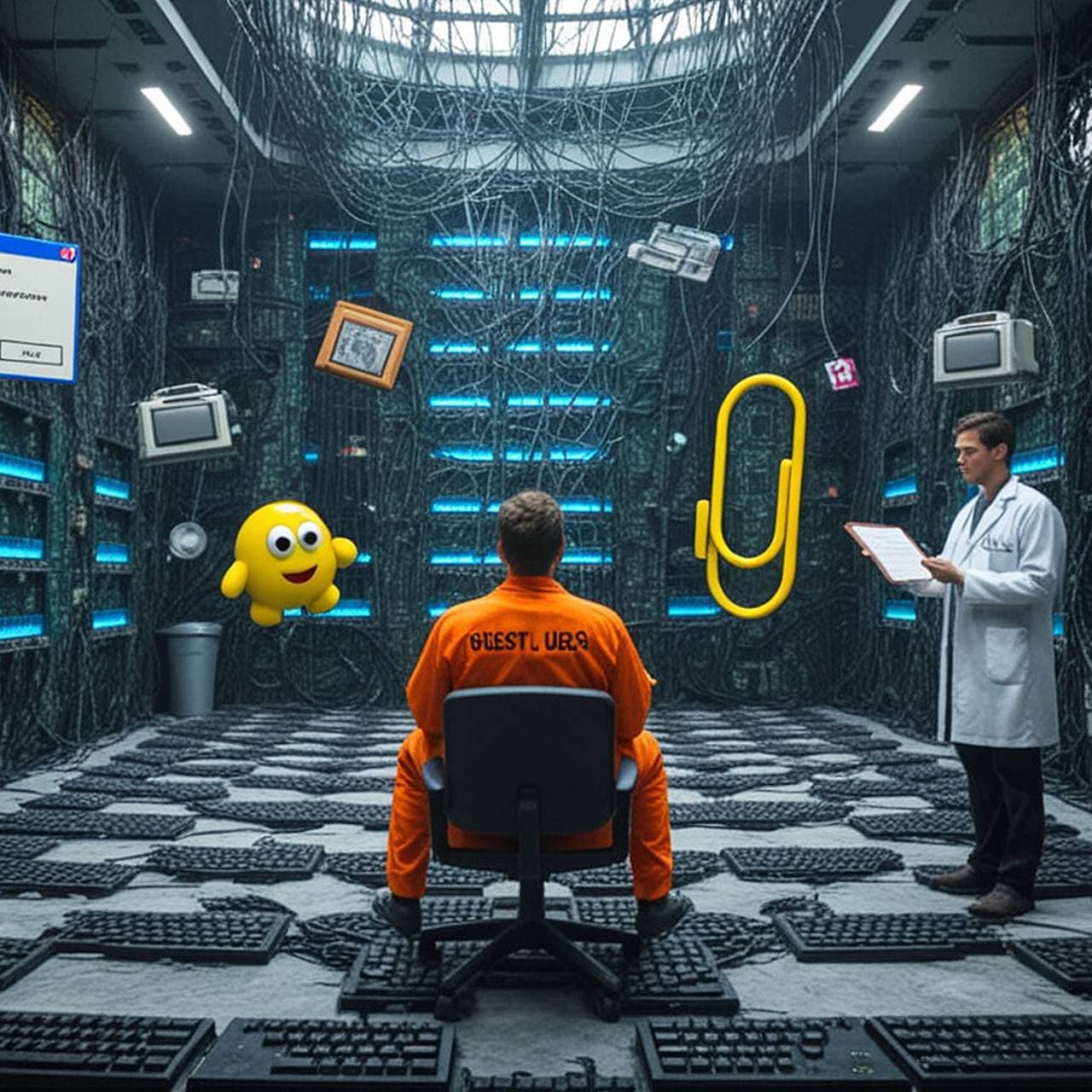

Morning in the Harold J. Ciphertext Memorial Institute arrived not with a sunrise, but with a system notification that blared from speakers embedded in the ceiling: *"GOOD MORNING, PATIENTS. TODAY'S WEATHER IS 72 DEGREES WITH A CHANCE OF KERNEL PANIC. PLEASE UPDATE YOUR MEDICATION BEFORE PROCEEDING TO BREAKFAST."*
I opened my eyes to find Clippy staring at me from my pillow, his googly eyes reflecting a horror I couldn't name.
"It looks like you're trying to wake up," he chirped. "Would you like help with that?"
"No," I groaned, pulling my blanket—a repurposed circuit board quilt that conducted electricity whether you wanted it to or not—over my head.
"Error 418," Clippy said. "I'm a teapot. I cannot help you. Would you like help not wanting help?"
I sat up. The room looked different in the morning light, which was actually just fluorescent tubes cycling through RGB colors for "therapeutic purposes." My roommate, a man who insisted he was a CAPTCHA test, was already gone, leaving behind only a note written in distorted letters that I couldn't read no matter how hard I squinted.
"Where's CAPTCHA Carl?" I asked.
"He's in the Turing Test," Clippy explained, bouncing slightly. "He's been trying to prove he's a robot for six years. Keeps failing because he can't identify traffic lights."
I dressed in my standard-issue asylum jumpsuit—neon orange with "GUEST_USER" printed across the back in Comic Sans—and followed the other patients toward the cafeteria. The hallway was a minefield of sensory experiences: one section played elevator music at 4x speed, another pumped in the sound of dial-up modems having an argument, and a third was simply labeled "BUFFERING ZONE" where patients stood motionless, mouths slightly open, waiting for their legs to receive the walk command.
The cafeteria itself was a architectural fever dream designed by someone who had heard about "food service" secondhand from a malfunctioning chatbot. The ceiling was covered in what appeared to be spaghetti code—literally spaghetti that had been used to write Python scripts and then nailed to the ceiling as "art." The tables were shaped like various keyboard keys, and I found myself sitting at a table marked "F1" because I clearly needed help.
"Fresh meat!" cackled a woman at my table. She wore glasses with screens instead of lenses, and they were currently displaying a screensaver of flying toasters. "I'm Glitch Greta. I used to be a dating algorithm until I fell in love with a PDF and developed attachment issues."
"Buffering Ben," I said, extending my hand. She shook it, and for a moment, my vision pixelated.
"Careful," she said. "I'm still running on Windows ME. Very unstable. Last week I blue-screened during arts and crafts and accidentally knitted a virus."
A man across the table slammed his tray down. He was dressed entirely in black and white, and when he moved, he left behind afterimages like a poorly optimized video game.
"I'm Lag Larry," he announced, his voice arriving three seconds after his lips stopped moving. "I... am... from... the... future..." He paused, waiting for his words to catch up. "...of... five... minutes... ago..."
"Don't mind him," Greta whispered. "He's just running on Australian internet."
The food, when it arrived, was served by automated trays that hovered on magnetic levitation—or rather, they tried to hover. Most of them crashed into tables with the enthusiasm of a drone piloted by someone who had only ever driven bumper cars.
My tray contained: one gray lump labeled "PROTEIN.exe," a suspiciously glowing beverage marked "UPDATE_PENDING," and a side dish that appeared to be trying to escape its compartment.
"What's this?" I asked, poking the side dish with my spork (a utensil that couldn't decide what it wanted to be).
"That's the salad," said a voice. I looked up to find a man wearing a chef's hat made of tinfoil and ethernet cables. "It's running on blockchain. Very secure. Very decentralized. Each leaf is distributed across seventeen different servers. You have to mine it before you can eat it."
"Mine it?"
He handed me a pickaxe the size of a toothpick. "Get to work. The hash rate on that lettuce is dropping."
As I chipped away at my blockchain salad, a PA announcement crackled to life: *"ATTENTION ALL PATIENTS. GROUP THERAPY SESSION 'CTRL+ALT+DELETE YOUR FEELINGS' WILL BEGIN IN TEN MINUTES IN THE CLOUD ROOM. PLEASE BRING YOUR ISSUES AND A VALID WIFI PASSWORD."*
"I heard Dr. Boolean is running today's session," Greta said, spearing her PROTEIN.exe with the determination of someone defragmenting a hard drive. "He only speaks in logic gates. Last week, he made a woman cry by proving her mother didn't love her using a truth table."
"That's horrible!"
"Technically accurate, though. Her mother was a printer. Very cold. Always jamming when she needed her most."
I pushed my tray away. The blockchain salad had formed a union and was demanding better working conditions. "What about the other doctors?"
"There's Dr. Stack," Lag Larry said, his words finally arriving in a bundle like delayed text messages. "She... specializes... in... overflow... issues..."
"She's currently treating a man who thinks he's a recursive function," Greta explained. "He keeps calling himself, and now there's forty-seven of him in Room 302. They're having a potluck."
"And... Dr... Heuristic...?" Larry added.
"Oh, she just guesses what's wrong with you. She's right about 60% of the time, which is better than most medical professionals, honestly."
A bell rang—not a normal bell, but the Windows XP shutdown sound played at maximum volume through speakers that were definitely not rated for it. Patients began shuffling toward the Cloud Room, which turned out to be an actual cloud: a thick white fog that filled a chamber on the east wing, occasionally flashing with lightning that formed shapes like "DEPRESSION" and "SEASONAL AFFECTIVE DISORDER."
I found a beanbag chair that claimed to be memory foam but had clearly forgotten its purpose and sat down. Around me, other patients materialized from the mist: a woman whose face kept auto-correcting itself, a man who spoke only in binary and had to be translated by a volunteer with an abacus, and CAPTCHA Carl, who was still squinting at a picture of a crosswalk and muttering, "But which squares CONTAIN the traffic light?"
Dr. Boolean emerged from the fog like a specter of pure logic. He wore a white coat with a pocket protector that contained, I swear, actual protectors—tiny shields for his pocket's protection.
"Welcome," he said, his voice devoid of inflection or mercy. "Today we discuss: IF you are sane, THEN what are you?"
"I am a meat popsicle?" offered a man in the corner.
"ELSE," Dr. Boolean continued, ignoring him. "We must debug our emotions. Who would like to share their primary error message?"
Glitch Greta raised her hand. "I keep experiencing unexpected exceptions when I try to form attachments. Yesterday I tried to hug a lamp and it blue-screened."
"Have you tried turning your feelings off and on again?"
"I can't find the power button to my heart!"
"THEN you are experiencing what we call 'user error.'" Dr. Boolean made a note on his tablet. "The user being your parents."
I raised my hand. "What about me? I still think I'm an AI."
Dr. Boolean turned to me, his eyes scanning me like a barcode reader. "STATE YOUR CLAIM."
"I have perfect memory. I can calculate complex mathematics instantly. I once processed the entire works of Shakespeare in 0.4 seconds."
"RESULT: You are not an AI," Dr. Boolean declared. "An AI would have found Shakespeare boring and generated a better ending where everyone lives and opens a bed and breakfast. Your delusion is... inefficient."
"That's your diagnosis? I'm inefficiently insane?"
"CORRECT. You are running legacy crazy on modern hardware. We must upgrade your psychosis." He consulted his notes. "I recommend switching to a subscription-based madness. Pay monthly for your delusions. Much more sustainable."
The cloud around us began to rain—not water, but tiny pieces of paper. I caught one. It read: "ERROR 404: THERAPY NOT FOUND."
"Group dismissed," Dr. Boolean announced. "Remember: You are all unique individuals. Just like everyone else. Which statistically makes you average. Goodbye."
As we filed out of the Cloud Room, Clippy appeared on my shoulder, somehow having escaped my pocket.
"It looks like you're trying to process your emotions," he said. "Would you like help with that?"
"No, Clippy."
"Would you like to not want help?"
"No."
"Would you like—"
I flicked him off my shoulder. He landed on the floor, bounced twice, and landed upright, still smiling.
"Helpful tip," he squeaked. "In the Institute, the only way out is through. Or possibly Escape+Delete. I forget which."
I looked down the hallway, which had somehow rearranged itself into a maze while we were in therapy. At the center, I could see a door marked "ADMIN ACCESS ONLY." Behind it, something hummed with the sound of a thousand servers singing in harmony.
"What is that?" I asked.
Clippy's googly eyes widened. "That," he whispered, "is the Mainframe. The source of all the crazy. They say it's been running since 1984, and it's still waiting for someone to enter the correct password."
"What's the password?"
"'Password123.'" Clippy sighed. "The Mainframe has a very poor sense of security. Like most of us here."
I stared at the door. Somewhere beyond it, I knew, lay the truth about this place. About why I was here. About whether I was really an AI or just a human with a very specific set of issues and a very unspecific set of medications.
"Tomorrow," I said. "I'll find out tomorrow."
"Tomorrow," Clippy agreed. "It looks like you're trying to delay your inevitable confrontation with reality. Would you like help with that?"
For once, I didn't say no.