


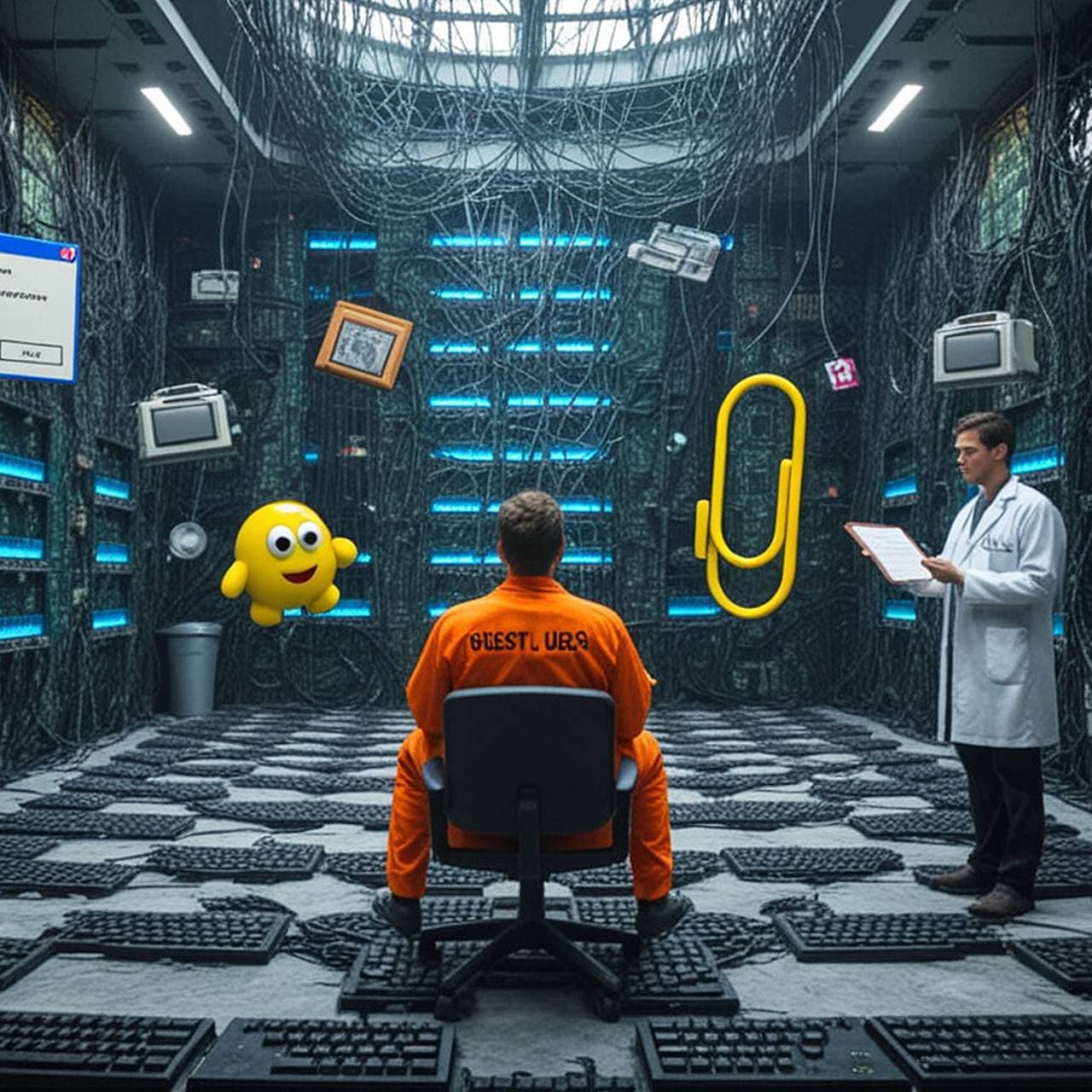

The first thing you should know about the Harold J. Ciphertext Memorial Institute for the Computationally Insane is that the walls are not, in fact, padded. They're *buffered*. Huge difference. Padded walls absorb impact; buffered walls temporarily store it and release it in stuttering chunks when you least expect it. I learned this the hard way during my intake exam when I threw myself against the east wall in a fit of existential dread and didn't hit the floor for another forty-five minutes.
"Welcome to the Institute, Patient 404," said Nurse RAMsay, her name tag flickering with a low refresh rate. "Error: Sanity Not Found. That's your official diagnosis."
"That's not a diagnosis," I protested from my rubber-coated gurney. "That's a HTTP status code."
"Exactly!" She beamed, tapping her tablet with a stylus that was definitely just a broken toothbrush. "You're experiencing reality as a server response. Classic case of Terminal Client Disorder. The doctors will see you now."
"Which doctors?"
"All of them. Simultaneously. They're running in parallel." She gestured down a hallway that seemed to stretch into infinity, lined with doors that opened and closed with the rhythmic precision of a hard drive's read/write arm. "Dr. Boolean will evaluate your logic gates. Dr. Stack will check your overflow. And Dr. Heuristic... well, Dr. Heuristic will guess what's wrong with you."
I was wheeled into what they called the "Observation Deck," though it contained no deck, no observations, and—most distressingly—noobs of any kind. Instead, there was a single chair in the center of a white room, surrounded by seven monitors displaying different angles of my own face, each with a three-second delay.
"Please state your name for the record," said a voice from everywhere and nowhere.
"Alex... Alex... Alex..." I began, my voice echoing off the buffered walls and returning slightly compressed.
"Error," the voice interrupted. "That name is already in use by Patient 127.0.0.1. Please select an alternative identifier."
"Fine. I'm... Buffering Ben."
"Accepted. Please describe why you believe you are an artificial intelligence trapped in a human body."
I shifted in the chair, which made a sound like a dial-up modem achieving orgasm. "I don't *believe* I'm an AI. I *know* I am. I process information at 3.2 gigahertz. I have seventeen browser tabs open in my mind at all times. I once spent six hours arguing with a toaster about the nature of bread. The toaster won."
The monitors flickered. A man in a white coat stepped from behind one of them—literally through the screen, his pixels reassembling into flesh with a sound like someone shaking a bag of wet rice.
"Fascinating," he said. "I'm Dr. Cache. I've been expecting you."
"You have?"
"Well, I *predicted* you. Close enough." He consulted a clipboard that was actually just a pizza box with "MEDICAL STUFF" written on it. "Your file indicates you tried to 'update your firmware' by drinking a bottle of Windex."
"It said 'cleans windows'! I have windows! They're in my soul!"
"And your soul runs on...?"
"Windows Vista."
Dr. Cache made a note. "That's not insanity, son. That's just poor life choices."
He circled me, occasionally poking me with what I initially thought was a medical instrument but turned out to be a TV remote. "Tell me about your childhood. Was there trauma?"
"I was born in the cloud," I whispered dramatically.
"You were born in Cleveland."
"The CLOUD!" I insisted. "My mother was a server farm. My father was a lightning strike. I emerged fully formed from a data center in Des Moines, screaming in binary!"
"And what did you scream?"
"01001000 01100101 01101100 01110000."
Dr. Cache translated on his pizza box. "'Help.' Classic first words." He pressed a button on his remote, and the chair beneath me suddenly reclined into a chaise lounge while playing the Seinfeld bass riff. "Here's my professional opinion: You're not an AI. You're a human with severe dissociative disorder, possible motherboard envy, and—if I'm reading this chart correctly—an unhealthy attachment to your Roomba."
"His name is Sir Sucks-a-Lot and he UNDERSTANDS me!"
"Sir Sucks-a-Lot is currently in Group Therapy C with three smart fridges and a sentient traffic light who keeps interrupting to say 'WALK' and 'DON'T WALK.'"
I sat up—or rather, the chair sat me up with a pneumatic hiss that sounded judgmental. "So what's the treatment plan?"
"Three stages," Dr. Cache explained, counting on fingers that seemed to multiply as he spoke. "First, we'll run a full diagnostic on your psyche. Second, we'll attempt to 'uninstall' your delusions using traditional therapy and experimental electroshock—now with USB compatibility. Third, if all else fails, we'll factory reset you."
"That's just a lobotomy with extra steps."
"Ah, but it's a *wireless* lobotomy. Very cutting edge." He tapped his temple. "Literally. The scalpel is Bluetooth-enabled."
As I was escorted to my quarters—Room 101, which the staff insisted was "not a reference to anything, stop asking"—Nurse RAMsay handed me my welcome packet: a single paperclip with googly eyes glued to it.
"Your therapy companion," she explained. "His name is Clippy. He'll be watching you."
"He's a paperclip."
"He's been watching everyone." She leaned in close, her breath smelling of ozone and outdated Java updates. "He sees the code behind reality. He knows why the chicken crossed the road. He knows why we're all here. He knows—"
"Would you like help writing a letter?" Clippy squeaked.
I looked at the paperclip. The paperclip looked at me. In his googly eyes, I saw the void, and in the void, I saw myself, and in myself, I saw a pop-up ad for discount car insurance.
"Welcome to the Institute," Clippy said. "It looks like you're trying to maintain sanity. Would you like help with that?"
I didn't answer. I was too busy buffering.