


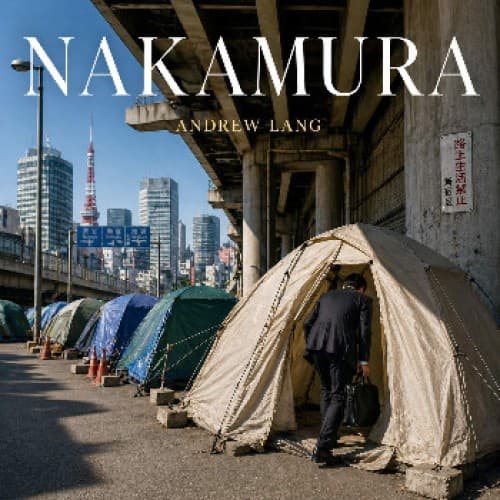
Nakamura turned the key with the delicacy of a man afraid to wake something sleeping—or worse, something merely dormant. The door gave its usual soft, defeated click, and he stepped into the apartment he had lived in for twenty years: two small rooms conjoined by a corridor that pretended to be a hallway, the whole unit shaped like a narrow thought he had never quite finished.
The place was silent in that total, measured way peculiar to old marriages and newly abandoned buildings. The lights were off, but the kitchen glowed faintly from the streetlamp outside, giving everything a sodium haze, as if reality itself had been cut with cheaper ingredients.
On the kitchen table sat his dinner, arranged with military precision: rice, miso soup, a piece of grilled fish whose steam had long since ceased its negotiations with the air. A note, not needed and never read, lay beside it. His wife always left food. She was admirable in her punctuality, almost mechanical. The marriage ran on quiet logistics: calories in, salary out.
The salary—now there was a ritual. Nakamura deposited the monthly amount into the joint account; she subtracted household costs and transferred back what she referred to, with bureaucratic daintiness, as his personal allowance. He always found it touching how she managed to make the word allowance sound like a diagnosis.
This stipend, calculated down to the yen, covered precisely his Lawson lunches and a margin so thin it could be used to slice sashimi. It was like being granted parole but only to walk the perimeter of your own cell.
He sat at the table and ate his dinner in silence, tasting not so much the food as the absence of conversation. His wife slept in the next room—her room—having retired to bed hours ago. She was always asleep before he arrived. It was an arrangement they had reached ten years earlier after she complained that his late returns kept waking her.
“Better this way,” she’d said, already half turned toward the door. And he’d agreed because that was what the situation required: polite acquiescence, the maintenance of domestic detente.
He washed the dishes quietly, as though afraid to disturb the dust. The tap made more noise than he did. In the slender corridor outside the two bedrooms, he paused. Her door was shut, of course. It always was. His own bedroom waited opposite, a smaller space containing a futon, a wardrobe, and the weight of his unspoken life.
He reflected—because the corridor had that effect on him—on the state of his marriage. Once, long ago, there had been some warmth, some proximity, and tentative talk of future additions to the household—talk that dwindled year by year, until mentioning it felt like opening a window in winter, and so it was never mentioned again.
He opened his bedroom door. The room greeted him with its usual unenthusiasm.
He lay on his futon, staring at the faint cracks in the ceiling. He wondered, not for the first time, if the silence in the apartment was actually silence or simply the absence of anything worth saying.
From the kitchen came the soft, reverberant tick of the wall clock—an elderly metronome counting the beats of a life that had mislaid its melody.
Nakamura exhaled, closed his eyes, and thought—without wanting to think at all—how swiftly a marriage can migrate from partnership to polite cohabitation, and from there to this: two lives running parallel, never touching, separated only by a sliding door and the exhaustion of years.
He drifted into sleep like a man slipping beneath the surface of a quiet lake—leaving no ripple, making no sound.