


Shachō’s office had the reverent hush of a shrine, albeit one financed by software contracts and maintained by men whose souls had long since moved to cheaper neighbourhoods. He sat behind a desk so polished it could have served as a reflective device for satellite calibration. Inada, Nakamura’s buchō, stood before him in the time-honoured posture of middle management: respectfully petrified.
Shachō didn’t look up from the folder he was annotating.
“We need to prepare a new deal for Ondo Corporation,” he said mildly, as though discussing the weather. “Our biggest client. Their money pays your salary, Inada. And I am… unhappy”—a soft, deliberate word—“with how you and your division have treated Nakamura.”
Inada twitched, producing a wince disguised as a bow.
Shachō continued, “He’s been here fifteen years. A solid man. A dependable man. A linchpin. And he’s the only person in this building who can rescue the Ondo deal. The only one.” He closed the folder with a gentle, judicial click. “Where is he?”
Inada swallowed. A bobbing, amphibian gesture.
“Well… Nakamura is… he’s gone… rogue again,” Inada said. “He’s, ah… down there.”
Shachō finally looked up, eyebrows arching with genuine amusement. “Down… there?” he repeated, and let out a warm, appreciative laugh. “Ah, Nakamura. The company renegade.”
The title hung in the air like something framed and hung on a wall.
“Fine,” Shachō said, brisk now. “Send three juniors down there. Give them pens, paper. We need his mind—his genius—on the opening salvo of communications. Ondo must feel our sincerity. Our vision. And Inada—”
“Yes, Shachō?”
“Treat Nakamura with the respect he deserves. He was one of my earliest hires. A good man. A very good man.”
Inada bowed so hard his tie swung like a pendulum.
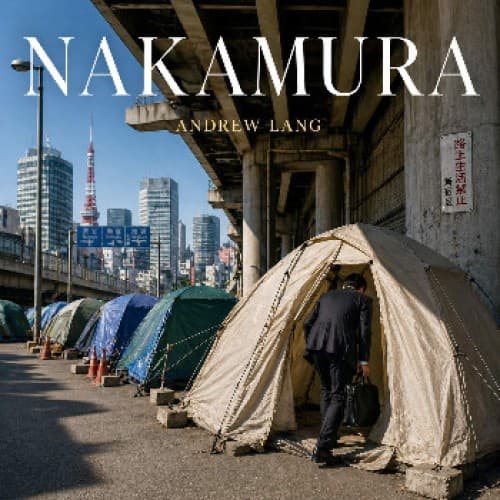
The underpass was unusually cold that afternoon, the air sharp and metallic, as if the city were exhaling through its teeth. Three juniors appeared at the mouth of the concrete corridor, clutching stationery like talismans. They approached the tent—a modest, mustard-coloured affair whose flaps fluttered with the weary dignity of a monk’s robe.
“Nakamura-san?” one of them ventured. “Are you… receiving visitors?”
A grunt from inside. Then: “If this isn’t life or death, go away.”
The juniors exchanged a fearful glance.
“It’s the Ondo contract,” the tallest one blurted. “There’s been a miscommunication. A… problem. Only you can help us.”
A long sigh. Then the flap slid aside, revealing Nakamura: dishevelled, wrapped in layers, holding a small flask of warm sake with the careless intimacy of long companionship.
“Well, why didn’t you say so?” he snapped. “Tell me the problem, then give me something to write on.”
One of the juniors explained the issue, then handed over the pad like offering tribute to a local deity. Nakamura uncapped the pen and began writing—furious little bullet points, arrows, marginalia, underlines, a miniature storm of thought. He sipped the sake between phrases, as if the liquor were powering the prose.
Finally, he tore off the page and thrust it at them.
“There you go. That’ll fix it.”
“Nakamura-san… this is—this is brilliant,” whispered one of them.
“I know,” Nakamura said, already bored.
He pushed the tent flap wider.
“Well? Don’t just stand there freezing your balls off. Come in. I’ll give you some advice.”
The three juniors obeyed, stooping into the cramped space. The smell hit them first: an overpowering cloud of sake vapour, like the tent itself was slowly brewing.
“You smell that?” Nakamura said, grinning. “That’s the smell of privilege.”
They nodded weakly, though their eyes watered.
“I get to live like this because Shachō and I go way back. Decades. He trusts me. My colleagues? Idiots, every last one. Even Inada.” He lowered his voice conspiratorially. “Especially Inada.”
They nodded again, now with reverence.
“Take my advice,” Nakamura said. “Build up your own knowledge base. Make it yours. Something only you can do. Then the company can’t fire you. You become indispensable. Untouchable.”
He gestured broadly at the tent walls with his sake flask.
“And then you get to live exactly as you damn well please. Like me. A free spirit. Drinking sake, reading my favourite authors”—he pointed to a corner where a small, uneven pile of books listed like a wounded ship—“and running my consultancy at my own pace.”
He leaned back, satisfied.
“This”—he tapped the floor with his foot—“is one of the most expensive consultancy rooms in Tokyo when you factor in how few hours I work. Two hours a week, tops. That’s my workload these days.”
The three juniors looked around in awe, trying very hard to ignore the fact that the consulting room’s ceiling was made of fraying canvas and its heating system consisted of Nakamura’s breath.
He smiled at them with patriarchal benevolence.
“Now go,” he said. “Take the memo to Shachō. He’ll know what to do. And remember what I told you.”
They scrambled out of the tent with the urgency of men fleeing an oracle whose prophecies were dangerously intoxicating.
Nakamura watched them go, took another contemplative sip of warm sake, and lay back on his flattened bedding like a man entirely at peace with his little empire.