


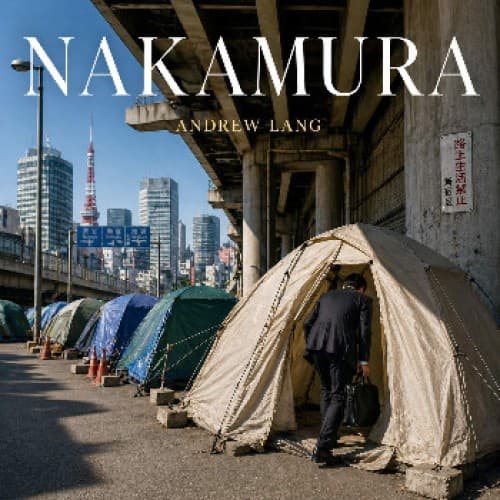
Every morning, Nakamura arrived at the office with the punctuality of an unloved ritual—one of those minor urban ceremonies Tokyo conducts automatically, like traffic lights or vending machines blinking awake after a power cut. He passed through the lobby as if shot from a silencer: no noise, no ripples. The security guard bowed to everyone except him. Nakamura bowed anyway, just in case.
He took his seat—his “seat” being a kind of clerical oubliette at the end of a beige row of partitioned penance. His desktop computer was not old enough to be retro, but old enough to hum resentfully about it. His job, officially, was “Client Communications Officer,” which meant he wrote letters no one read to clients who had forgotten they were clients. His colleagues had evolved a beautifully choreographed way of ignoring him: they flowed around him like commuters around a lamppost. Nobody resented him. Nobody noticed him enough to.
At 10:13 a.m., one of the junior chaps—slim tie, good haircut, the full disposable salaryman kit—strolled past Nakamura’s desk and said, cheerfully:
“Nakamura-san will be first to go in the next round of redundancies, ne?”
It was said in the same tone you might use to predict a warm spring. A harmless, meteorological observation. Nakamura nodded once, blandly, like a man who had just been informed that the sun would indeed rise in the east.
By noon he was free. Free, in the sense of being released from one kind of captivity into another. He bought his daily rations from Lawson: two egg-mayonnaise sandwiches—those damp little coffins of bread so sweet it was more accurately described as sponge, compressed into submission by plastic packaging pulled so tight you could almost feel the microplastics sluicing down your throat—and a bottle of sweetened oolong tea, cold enough to make his molars flinch. Taken together, the sandwiches had less in common with lunch than with dessert: a confection masquerading as sustenance. He loved the sandwiches precisely because they were so ultra-processed. No deceit, no nutrition, no surprises. He could rely on them to deliver the exact same experience every day: a brief uplift, followed by a spectacular mid-afternoon energy collapse. Nakamura treated the crash as a kind of pharmaceutical. His personal relaxation pill. At around 3PM, his limbs would fill with that warm, woozy torpor, and he would let himself sink gently into it, as though the sandwiches were lulling him into a state of chemically assisted serenity.
He walked to the underpass near the office, a concrete trachea for the city’s endless breath. Down here, the air smelled faintly of diesel, sweat, and human neglect. Beneath the overpass, the homeless men kept their tents pitched in ragged, oddly dignified formations, like a troop of veteran soldiers who had long ago stopped expecting orders.
Nakamura liked it here. The anonymity soothed him. The city above—his city, allegedly—ignored him; the city below at least acknowledged his presence with a nod, a cough, a rustle of tarpaulin. He sat on the same bench every day, a bench that sagged under him with the weary complicity of an old colleague.
He unwrapped his sandwiches with the solemnity of a priest handling relics. Bite, swallow, sip. The lunch hour was the most honest part of his day. Nothing pretended to be anything other than what it was. He watched the homeless men shuffle about their slow, minimal lives, watched suits hurrying across the overpass like industrious ants, watched bicycles flash past in streaks of commuter apathy.
No one here knew his name. No one here cared. And that, perversely, gave him a sense of belonging. This was a community of the unseen.
Back in the office, nobody asked where he’d been. Nobody had noticed him leave. He sat again at his desk, half-man, half-furniture. The room was filled with conversation from which he was exempt—laughter, arguments, the ecstasy of pointless meetings. He typed emails, adjusted phrasing, rephrased adjustments. It was work only in the sense that it resembled work.
The truth, though Nakamura himself rarely articulated it, was this: his life had entered the long, airless stage of quiet resignation. He had not been promoted in fifteen years. His responsibilities had been stripped from him one by one, like organs removed under anaesthetic. His marriage operated on a similar principle: food was left for him, a stipend exchanged, doors shut softly, conversations withheld for efficiency’s sake.
There were days—most days—when Nakamura could go from morning until night without hearing another human voice address him directly. Days when he felt translucent, as if his body had misfired in the process of becoming real.
In the fluorescent quiet of late afternoon, he caught his reflection in the darkened surface of his monitor. A faint shape, a blurred suggestion of a man. He adjusted his tie, though no one looked at him. He straightened his posture, though no one cared.
A ghost preparing itself for another day among the living.