


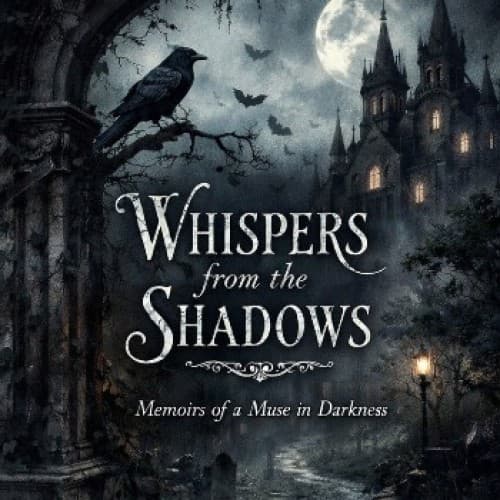
CHAPTER 1 — The Gate With No Name
The gate had no name the way certain people have no birthday in your memory—only the feeling of them.
It rose out of the fog like a confession you weren’t ready to speak: iron bars blackened by weather, ornate curls like old handwriting, and ivy clinging with the devotion of something that refuses to be left behind. Whoever built it had believed in permanence. Whoever left it had believed in escape.
I shouldn’t have been there.
The path behind me had already vanished into mist, and ahead, beyond the gate, the cemetery unfolded in pale tiers—stones tipped like teeth, angels eroded into faceless patience, crosses standing in quiet rows as if awaiting instruction. Farther still, beyond the sleeping names, the mansion watched from its hill.
Not a mansion, really. A silhouette pretending to be a house.
Its windows glowed like distant eyes, warm enough to suggest life, too steady to be natural. The kind of light you see behind curtains when someone is awake at midnight and you suddenly understand you are not alone in your loneliness.
The raven was the first to speak.
It wasn’t a voice, not exactly. Ravens don’t bother with human language unless they want something. This one sat under the archway, perched with the deliberate stillness of a judge. It cocked its head as if reading the shape of my thoughts.
Then it made a sound—one sharp note—that cut through the fog like a match.
I stopped breathing.
A ridiculous reaction, I know. A bird, a gate, a cemetery. But some moments arrive carrying a weight you recognize in your bones. That sound didn’t belong to the night. It belonged to me. To whatever part of me had been calling for a sign and pretending it wasn’t.
I stepped closer, my boots dampening on the gravel. The air tasted like wet stone and old leaves, like the inside of a book left open in the rain. The gate was locked, but not in any way that mattered. It had the kind of lock that only exists to make you ask permission from yourself.
I wrapped my fingers around the iron.
Cold. Unfriendly. Certain.
A memory tried to surface—one of those half-drowned scenes that rises from the dark and then sinks again before you can name it. A hallway. A door. A man’s voice, low and careful. A promise that sounded like safety until you realized safety shouldn’t feel like surrender.
I let go of the gate fast, as if the metal had burned me.
The raven clicked its beak once.
Mocking.
Or warning me.
I looked down. At my wrist. The thin silver chain I’d worn for years had rotated so the clasp was on the inside, pressing into my skin. I hadn’t touched it. I hadn’t noticed it move.
My pulse went strange.
It’s easy to laugh at yourself later, in clean daylight. Easy to call it nerves, imagination, the brain looking for patterns because it can’t bear randomness. But that night, the air felt arranged. Chosen.
As if the world had been waiting for me to arrive and now that I had, it could begin.
I turned my attention back to the gate.
In the middle, where the bars met, there was a small plaque. The kind you’d expect to hold a family name.
But the plaque was blank.
Not worn blank. Not forgotten blank.
Blank as if the gate refused to give itself away.
I should have left right then. I knew it in the quiet way you know you’re about to make a choice that will cost you something. But I was tired of being careful. Tired of being the person who backed away from doors and called it wisdom.
So I did the stupidest brave thing I’d ever done.
I pushed.
The gate swung inward without a sound.
No creak. No protest. No heavy shift of metal.
Just an easy, welcoming motion, like it had been waiting with its breath held.
The raven hopped down and strutted ahead of me as if it belonged to the path.
I followed it, my hands clenched, my lungs tight, and my mind already trying to build excuses. I told myself I was only going to look. Only going to prove to myself that the mansion was just a house on a hill, that the cemetery was just a cemetery, that the night was just the night.
But the moment I stepped beyond the gate, the fog thickened behind me, sealing the world shut.
And I understood something I couldn’t un-know:
I wasn’t arriving.
I was returning.
The raven led me between stones that leaned toward each other like conspirators. Some names were still readable, chiseled sharply into marble. Others were softened into unreadable curves. Time had licked them clean.
I paused at one grave—one of the older ones, half swallowed by grass.
The stone bore no name.
Only a date.
And beneath it, a single line carved like a threat or a blessing:
YOU WILL REMEMBER.
My throat went dry.
I backed away, and my heel struck something solid.
A book.
It lay on the ground as if dropped mid-prayer: leather-bound, thick, and sealed by a strap. No title. No markings. Not even a hint of dust, though everything else wore the night like a film.
I crouched, fingers hovering.
I didn’t want to touch it. I wanted to touch it so badly it felt like hunger.
The raven watched from a nearby stone, utterly still.
“Is this yours?” I whispered, because humans love asking the dark for permission.
The book, of course, did not answer.
But the strap shifted.
Just slightly.
As if something inside it breathed.
I stood up fast, heart kicking. My hands shook with the kind of fear that is half awe. I’d felt fear before—sharp, hot fear that makes you run.
This was different.
This fear invited me to stay.
The mansion above seemed closer now, its windows glowing through the mist. A lantern hung from a post near the path—an old-fashioned glass lantern lit with amber flame. It shouldn’t have been lit. No one had been near it.
Yet it burned steadily.
A sign. A lure. A dare.
The raven hopped forward again, impatient.
I looked at the book on the ground, then at the lantern, then back at the grave with the message.
The night had arranged three objects for me like a ritual:
A warning.
A story.
A path.
And I chose the path.
I left the book where it lay, though every instinct screamed to take it. I told myself I’d come back for it. I told myself it would still be there.
That was my first mistake.
I followed the raven up the hill toward the mansion, and with every step, the air warmed by degrees, as if the house exhaled in anticipation. The gravel turned to stone. The stone turned to steps. The steps turned to a wide porch with pillars like pale ribs.
The front door stood slightly open.
Not open enough to be inviting.
Open enough to be undeniable.
Inside, the light was softer, older. Candlelight or gaslight—something that belonged to a different century. Shadows moved in it with slow elegance, like dancers practicing in a room where music had ended long ago.
I stood at the threshold.
The raven landed on the porch railing beside me and stared into the dark interior.
Then it did something that made my skin go cold.
It bowed its head—once—like a servant.
Like a witness.
Like it was introducing me.
And from somewhere inside the mansion, a voice I did not recognize said my name.
Softly.
Correctly.
With the familiarity of someone who had been waiting a very long time.