


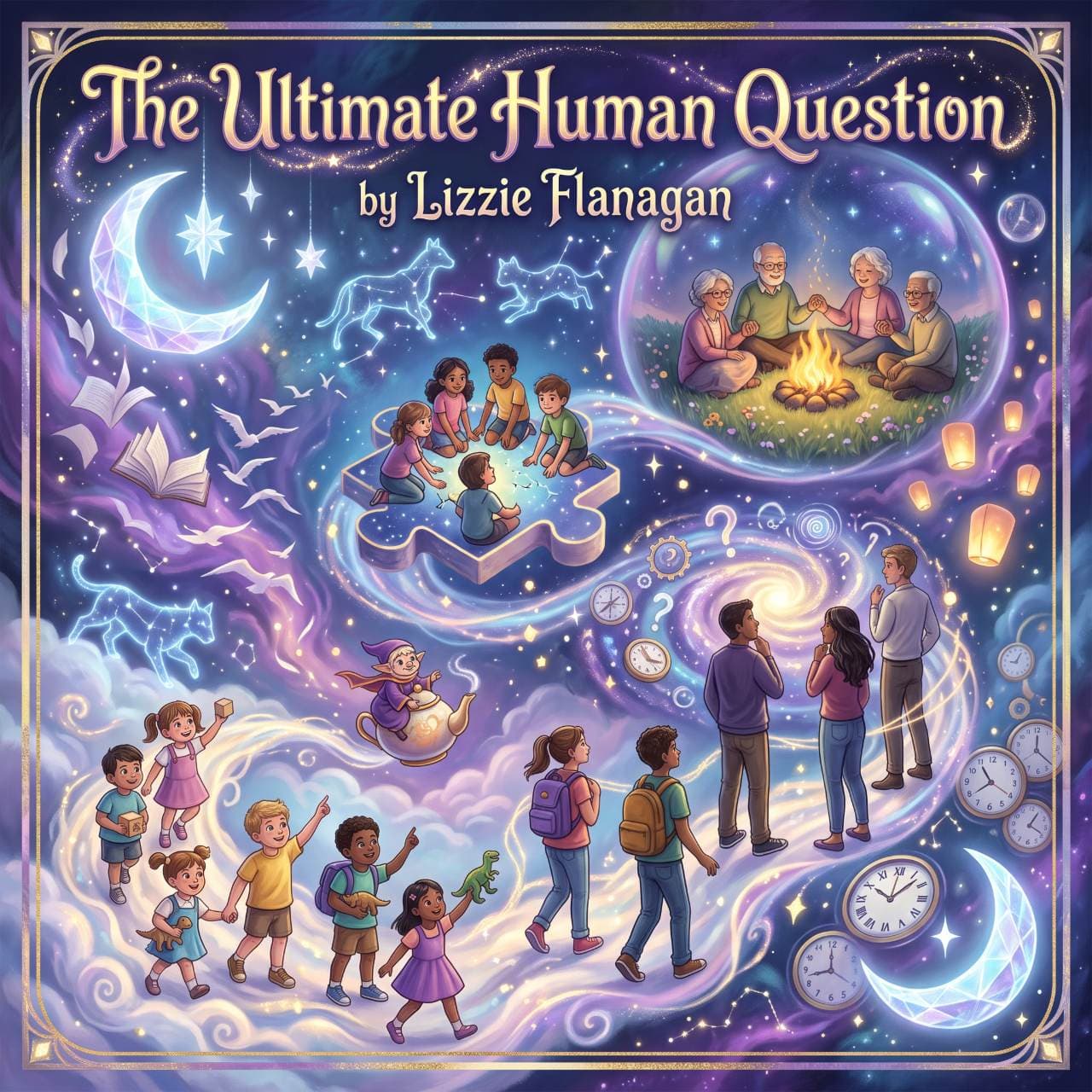

The hospice room smelled like lavender and time. Jacob lay in the bed, eighty years old, his body finally failing him after decades of good use. His mind remained, sharp, present, still asking, though his voice had faded to a whisper that required the others to lean close, to hold his hand, to press their ears near his lips.
They were all still alive, improbably, statistically unlikely, a cohort of eighty-somethings who had outlived spouses and siblings and most of their friends. They sat in chairs arranged around his bed like planets around a dying star: Sophie, her hair white and wild, her hands still strong from decades of soil; Tyler, his husband Michael gone five years now, his own heart failing but his spirit undimmed; Oliver, trembling with Parkinson's, his brilliant mind trapped in a body that betrayed him daily; Emily, blind now from macular degeneration, her hands still stained with paint she could no longer see; Priya, using a walker, her body exhausted from a lifetime of service in places that had taken pieces of her; and Marcus, the youngest of them at seventy-nine, his Diana gone last spring, his poetry finally finding publishers now that he had stopped caring whether anyone read it.
They had gathered because Jacob had asked. Not for a funeral—he wanted to see them while he could still recognize them, while the morphine hadn't taken him to places they couldn't follow.
"I asked her once," Jacob whispered. "Mrs. Deluca. When I was seventy. I ran into her at a grocery store, of all places. She was ninety, using a walker, buying grapefruit. I asked if she had finally figured it out. The answer."
They leaned in, their bodies aching, their hearing aids whistling, their hearts—despite everything—still eager.
"What did she say?" asked Sophie. Her Clara had passed two years ago, peacefully, in this same hospice. Sophie had held her hand at the end. She was not afraid of this room.
"She said..." Jacob paused, his breath shallow, his eyes finding the window where afternoon light slanted through trees that had been saplings when they were children. "She said the answer was the asking. That the question itself was the gift. That we spent our lives looking for a destination when the journey was the only thing that was real."
"That's..." Oliver struggled to speak, his voice trembling with the effort of controlling his muscles. "That's not an answer. That's... that's just..."
"Poetry," said Emily, her blind eyes somehow still bright. "It's poetry. And it's true."
"I wanted answers," said Tyler. His hands shook, but he reached out to hold Jacob's anyway, the touch of two old men who had fought together, loved together, survived together. "I wanted certainty. I wanted to know I was doing it right. The marriage. The parenting. The life. I wanted a grade."
"There is no grade," said Priya. Her voice was thin now, papery, but still held the authority of someone who had commanded rooms in Geneva and Nairobi. "There's only... this. The holding of hands. The being there. The witness."
Jacob nodded, the movement small, precious. "I think... at the end... the answer is simple. We were wrong about almost everything. The purpose. The success. The legacy. None of it matters."
They waited. The machines beeped. The light shifted, a cloud passing somewhere beyond their field of vision.
"Love matters," Jacob said. "Not the word. The fact. That we were here. That we loved each other. That we kept showing up, year after year, even when it was hard, even when we failed, even when we didn't feel like it. That we asked the question. Together."
He closed his eyes. For a moment, they thought he had gone, but then he spoke again, softer still, a breath barely shaped into sound:
"Marcus. Your nonprofit saved twelve thousand kids. I looked it up."
Marcus wept, silently, the tears tracking through the creases of his ancient face.
"Tyler. Your son is running for Congress. He's going to win. He's good. You made him good."
Tyler squeezed Jacob's hand.
"Oliver. Your technology is in every hospital in the world. You gave people their dignity back. You gave me my dignity."
Oliver's trembling increased, but he didn't look away.
"Emily. Your paintings are in the Met. Children stand in front of them and cry because they see themselves."
Emily smiled, her blind eyes closing, seeing something they couldn't.
"Priya. You saved... you saved..." Jacob's voice trailed off, then found strength again. "You saved the world. Not all of it. But pieces. Enough."
Priya bowed her head.
"Sophie." Jacob opened his eyes, found her, held her gaze. "You fed people. You taught people. You loved Clara for fifty years. You never stopped asking."
Sophie stood, her old body creaking, and leaned over the bed. She kissed his forehead, her lips dry and warm.
"And you," she whispered. "You taught us how to die. You taught us it's not scary. It's just... the next question."
Jacob smiled. It was the same smile he had worn at eight, at seventeen, at twenty-eight, at fifty—the smile of someone who had figured out that the answer was in the asking, that the fear was in the resistance, that love was the only thing that remained when everything else burned away.
"Tell them," he whispered. "When I'm gone. Tell them the answer is love. But not the easy kind. The hard kind. The kind that stays when it's not convenient. The kind that forgives. The kind that keeps asking, even when it knows there is no answer."
"We will," they promised, together, their voices a chorus of eighty years.
Jacob closed his eyes. The light in the room shifted again, golden and soft, and he was gone, quietly, peacefully, his hand still in Tyler's, his last breath a sigh that sounded like yes.
They sat for a long time, the six of them who remained, holding each other, crying, laughing at the memory of a boy who had once said "love is the answer" in a kindergarten classroom and had spent his entire life proving it true.
Outside, the sun set. The stars emerged. The world continued, as it always had, as it always would, indifferent and beautiful and brief.
And in a hospice room in Vermont, six old friends held each other and whispered the question one more time, not because they expected an answer, but because the asking was the answer, because the love was in the question, because they had learned, finally, that they were never alone as long as they kept asking together.