


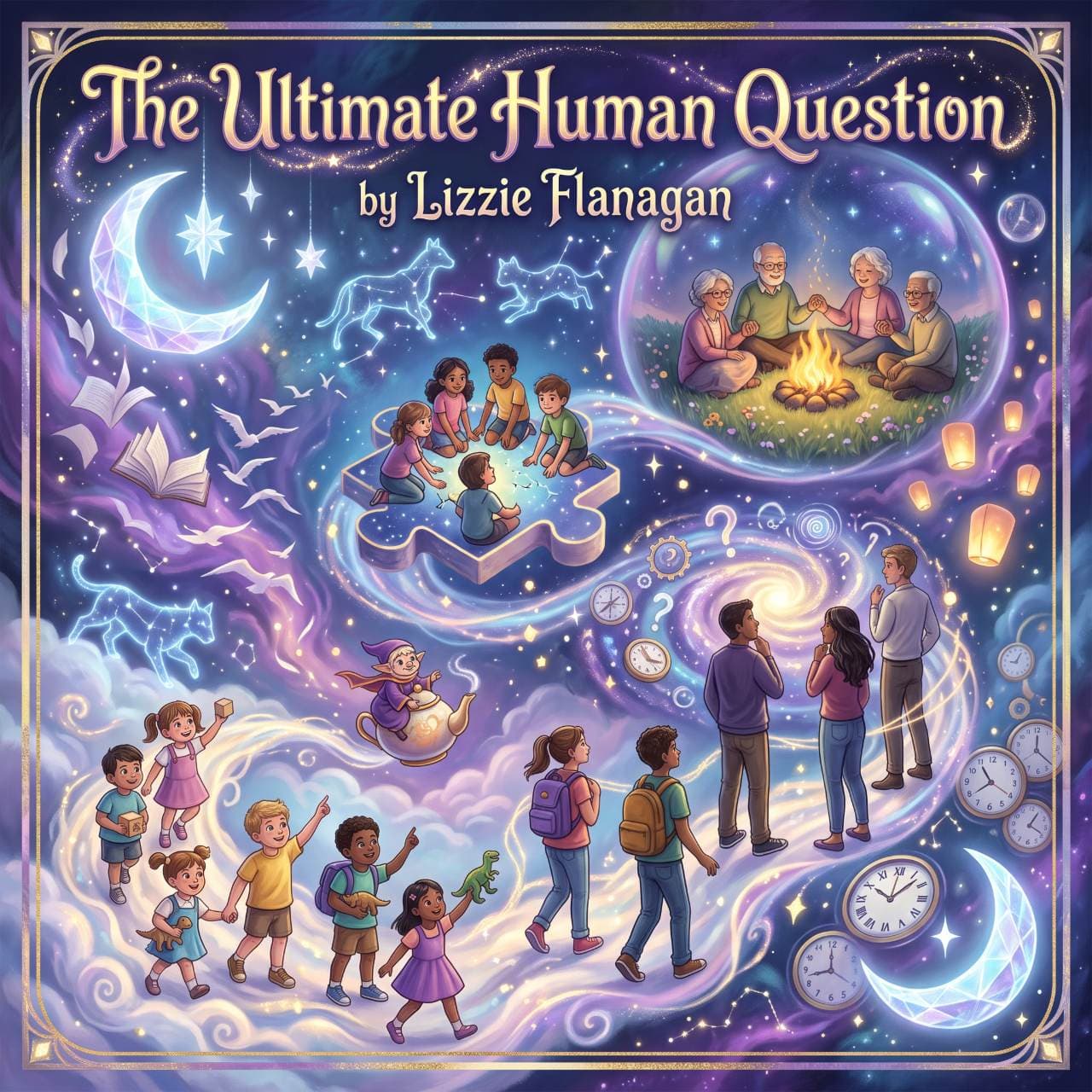

The story ends where it began: with a question.
But the question is not the same. It never was. And that is the point.
We began in a classroom that smelled like graham crackers and tempera paint, where twenty-two small humans believed the world revolved around snacks and dinosaurs, where love was a word spoken with a thumb in the mouth, simple and absolute. We ended in a room that smelled of lavender and farewell, where six old humans held hands around a deathbed, where love was the only answer left after everything else had been stripped away.
The question did not change. The questioners did.
This is the secret that Mrs. Deluca knew, that Jacob understood, that took the rest of them eighty years to fully grasp: the reason the answer changes throughout life is because the person answering has grown. A child of four cannot comprehend what matters to a person of eighty because a child of four has not yet lived. They have not yet failed. They have not yet lost. They have not yet built something only to watch it crumble, nor have they crumbled themselves and learned that crumbling is not the end.
We acquire knowledge throughout our lives that forms our opinions, our beliefs, our values. These are not static things. They are fluid, alive, responsive to the pressure of experience. The child who believes snacks are the most important thing is not wrong. She is simply speaking from a world where hunger is the greatest pain she has known. The teenager who believes fitting in is survival is not wrong. He is speaking from a world where exclusion feels like death. The young adult who believes purpose is paramount is not wrong. She is speaking from a world where she has just discovered that she is free to choose, and the weight of that freedom is terrifying.
The parent who believes showing up is the answer is not wrong. They are speaking from a world where they have learned that love is not a feeling but a discipline, a choice made daily in the small hours when children are sick and marriages are tired and the self screams for attention it cannot have. The elder who believes love—simply love, stripped of all ornament—is the answer is not wrong. They are speaking from a world where they have watched everything else fall away, where they have buried partners and friends and dreams, where they have learned that the only thing that remains is what we gave, not what we gathered.
To demand that a person hold the same values at eighty that they held at four is to demand that they stop growing. It is to insist that experience teach them nothing, that suffering refine them not at all, that joy and loss and time leave no mark. This is not wisdom. This is stagnation.
The child who valued snacks did not cease to value them. She simply learned to value other things more. The teenager who valued fitting in did not become a conformist. He simply learned that there are deeper forms of belonging. The young adult who valued purpose did not become a machine. She simply learned that purpose without love is hollow. The parent who valued showing up did not become a martyr. He simply learned that presence is the only gift that cannot be returned. The elder who valued love did not become sentimental. She simply learned that love is the only currency that matters in an economy of mortality.
This is growth. This is the human project. We are not born complete. We are born with the capacity to become, and becoming requires change.
Consider the alternative: a person who holds the same beliefs at eighty that they held at four has learned nothing. They have not read a book that challenged them. They have not met a person who changed them. They have not suffered a loss that broke them open, nor experienced a joy that remade them. They have simply persisted, unchanged, unchallenged, unalive.
The fluidity of our values is not a weakness. It is our greatest strength. It means we can learn. It means we can adapt. It means we can be wrong and then be less wrong. It means that the person who was cruel at twenty can be kind at fifty, that the person who was certain at thirty can be humble at sixty, that the person who knew everything at eighteen can arrive at eighty with nothing but questions and gratitude for the asking.
Jacob knew this. He knew it at eight when he said love was the answer, and he knew it at eighty when he whispered it one last time. The word was the same, but the meaning had deepened beyond recognition. At eight, love was a concept, inherited from a grandmother, precious but untested. At eighty, love was a practice, proven in the furnace of a lifetime, the only thing that had survived the fire.
This is why we must keep asking. Not because we expect a final answer, but because the asking keeps us growing. The moment we believe we have found the ultimate answer is the moment we stop becoming. The question is the engine of our humanity. It drives us forward, keeps us curious, keeps us humble, keeps us connected to one another in our shared uncertainty.
The child asks: What is the most important thing? And answers: Snacks. Dinosaurs. The immediate, the tangible, the now.
The teenager asks: What is the most important thing? And answers: Fitting in. Being real. Surviving the social jungle.
The young adult asks: What is the most important thing? And answers: Purpose. Choice. The freedom to become.
The parent asks: What is the most important thing? And answers: Showing up. Presence. The daily discipline of love.
The elder asks: What is the most important thing? And answers: Love. Simply love. The giving of it, the receiving of it, the memory of it, the promise of it beyond death.
None of these answers negate the others. Each builds upon the last. Each is true for its time. Each is necessary for its season.
We are not meant to be static. We are meant to be rivers, not statues. We are meant to flow, to change course, to carve new channels through the rock of experience. The child is not wrong. The elder is not more right. They are simply different stages of the same journey, different depths of the same well.
Mrs. Deluca's gift was not the question itself. It was the permission to keep answering differently. It was the understanding that growth is not betrayal. Changing your mind is not weakness. Evolving your values is not hypocrisy. It is the evidence that you are alive.
So ask the question. Ask it at four. Ask it at eight. Ask it at fourteen and twenty-two and twenty-eight. Ask it at fifty and eighty and, if you are lucky, at ninety. Expect different answers. Celebrate them. Mourn them. Let them go when they no longer serve you, and embrace the new answers that arrive, uninvited, in the middle of the night, after the diagnosis, after the divorce, after the birth, after the death.
The answer is not the point. The person you become while seeking it is.
And in the end, when all answers have fallen away, when the body fails and the mind fades and the possessions scatter, you will find that the question itself was the gift. The asking was the love. The seeking was the life.
Rest in peace, Jacob. You asked beautifully.
Keep asking, all of you. Keep growing. Keep changing. Keep becoming.
The question remains.
And that is enough.