


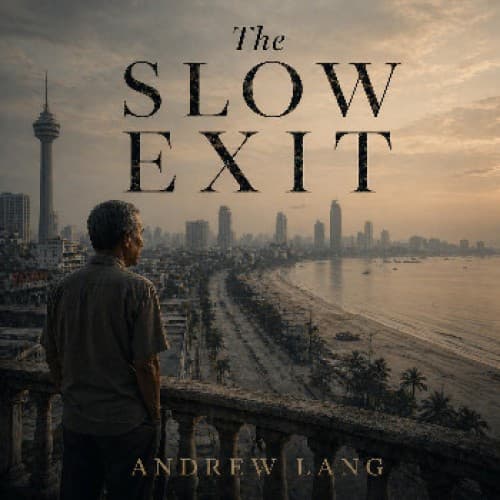
The glass walls of the Ministry of Population Stability’s south wing glowed faint orange from the sunset bleeding through Bangkok’s haze. Inside, the air was cold and dry, humming faintly with filtered sterility. Somchai sat with his hands clasped on the table. His jacket was open. He hadn't bothered with the badge.
Across from him, Deputy Minister Thirawat leaned back in his chair, stylus in hand, the lines around his mouth cut deeper than the last time they’d spoken. The man still had presence, but he was tired too—just in a different way.
"They had a fertility rate of 4.2," Somchai said, not bothering with a lead-in. "Out in the Red Zone. Off-grid. No subsidies. No housing credits. No oversight. Just land. Freedom. And children."
Thirawat's eyebrow twitched. "You're referring to that rogue settlement outside Ubon Ratchathani? The one we cleared last quarter?"
"Did we clear it? Or just re-absorb the data? You can bury a family but not a pattern."
Thirawat sighed. "They had no healthcare. No education. No infrastructure. They were living off dried cassava and river water. Is that the future you want to endorse?"
"It’s not about endorsement. It’s about recognition. They were reproducing. We aren't. We can call them unsustainable, but our current model is biologically extinct."
"They were uneducated. What use is a population that can’t operate a terminal or navigate civic protocols? What do they contribute to governance?"
Somchai leaned forward. His voice was steady, but something had hardened in his tone.
"You keep talking about governance like it's a sacrament. A holy function. But what are we governing, Thirawat? An aging population in shrinking zones? Ration queues and automated drones? We’re not governing. We’re administering decline."
Thirawat set the stylus down, slower now. "We are maintaining stability."
"Stability? We're packaging collapse in neater boxes every decade. You're so focused on accounting for every citizen that you’ve forgotten what citizens are for."
Thirawat’s jaw tightened. "And what, in your mind, is the alternative? Chaos?—Let two million people wander across the country like it’s the 1800s? You want a nation of homesteaders? A human garden? And then what? You think you’ll bring back governance when the weeds take over?"
Somchai smiled, a tired, knowing smile. "Yes. A human garden. Because that's what this country needs. We need to stop being a parent. We need to be a gardener. Let people grow. Let Thailand grow."
"You're romanticizing anarchy."
"No. I'm confronting entropy. You can't consolidate people into tighter and tighter spaces and expect them to reproduce. It’s not just a resource issue. It’s psychological. Existential. We’ve made life feel like a cage."
"We offer education. Healthcare. Safety."
"And sterility. Control. Fear. The settlers in Ubon—they felt space. They felt possibility. Even danger is better than stagnation."
"They had no roads."
"Let them build roads. Or don’t. Let them figure it out. Government shouldn’t disappear, but it must shrink. Loosen its grip. Be a guide, not a warden."
"And when they turn against each other? When someone fences land or builds with stolen equipment?"
"Then we mediate. We enforce peace. But we don't micromanage. And maybe some of us join them. Seed outposts. Grow families, not directives."
"You think you're planting hope. But it sounds like you're burning the map."
Somchai stood, slowly. "The map’s already burned. You just keep drawing new borders on the ashes."
He looked out the window. The sun had dipped below the skyline, and the city was flickering into its nightly coma—a grid of controlled illumination, glowing against the dark.
Somchai delivered the speech he'd had in his head for months: "What even IS Thailand anymore? Our forefathers would be ashamed of our pathetic governance. They forged ahead, they had stories to tell around the fire every night. They were warriors. We need to turn our small population back into pioneers, let them expand. Into fishermen, farmers, homesteaders, let their hands callous from hard work and honest toil. This is how we grow the garden and restore Thailand."
He turned back, one hand on the chair.
"Let them out. Let them try. Or keep them boxed in and watch this country fade with perfect administrative clarity."
Thirawat didn’t answer.
And Somchai didn’t need him to.