


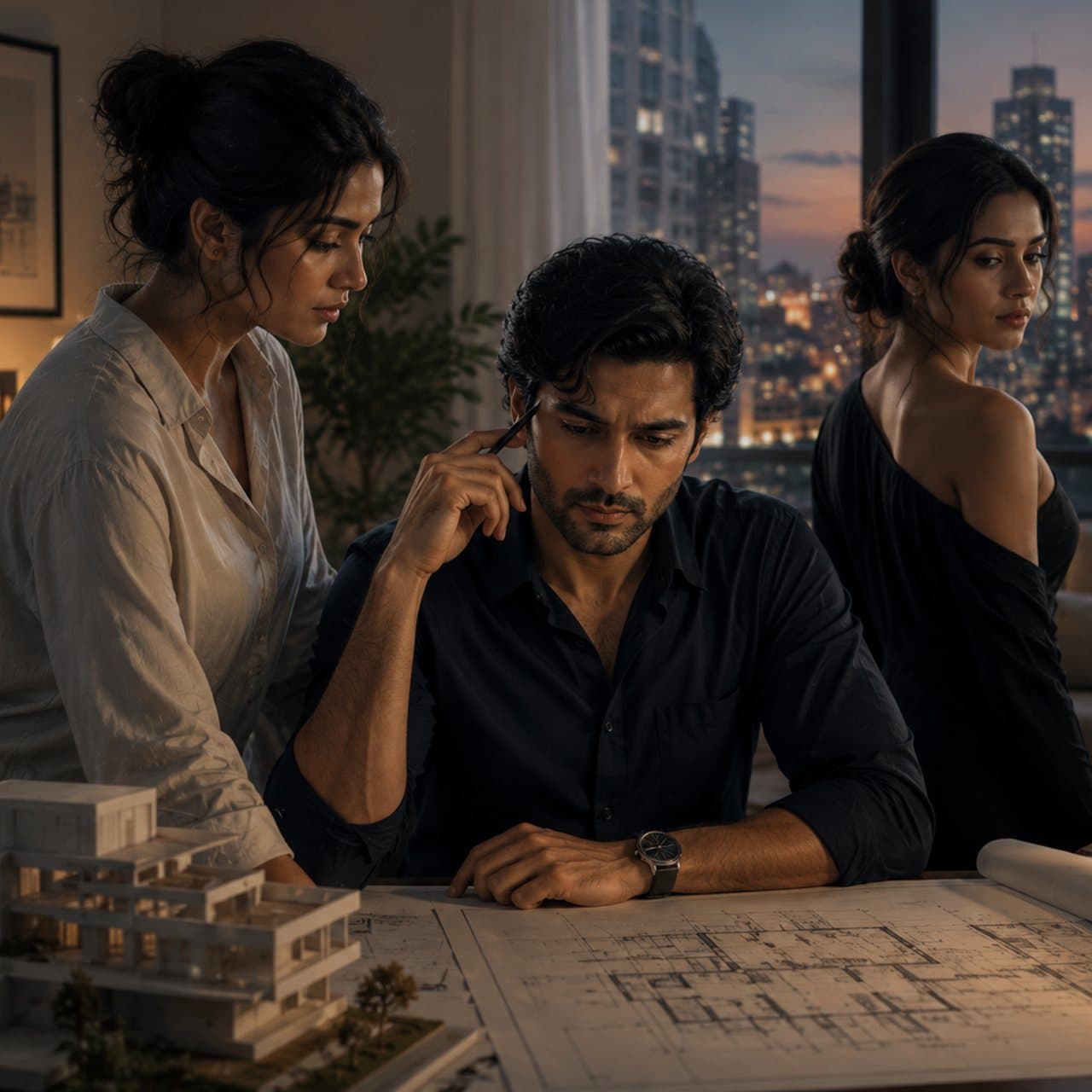

When Anaya meets Adhira at a neutral café, the first thing she does is look at Adhira's face. She looks at it carefully, comparing the living woman to the sketches she has photographed. She looks at the bone structure, the eyes, the way Adhira holds her face.
The resemblance is clear. Not perfect—there are differences that prevent it from being complete—but the resemblance is unmistakable.
"Thank you for meeting me," Anaya says.
Adhira sits carefully, as though she is not sure if the chair will hold her. "I do not know what this is about, but I assume it is about Shashank."
"How do you know his name?"
"He is my supervisor. I work as a consultant at your husband's architectural firm."
Anaya shows her the sketches. She places them on the table one by one—the photographs of the rendered images from Shashank's journal. She watches Adhira's face as she studies them.
Adhira's expression does not change dramatically. But something does change. Something in the way she is breathing, in the way her hand trembles slightly as she holds the photograph.
"These are of me?" Adhira asks.
"I do not know who they are of," Anaya says. "But I found them in my husband's journal. Rendered repeatedly. Over months. And when I met you, when I saw you walk into the break room at the office, I recognized you from these sketches."
Adhira sets down the photographs. When she looks up at Anaya, there is something in her expression that suggests she is on the edge of understanding something, but the understanding has not yet crystallized into words.
"I do not know why your husband would sketch me," Adhira says carefully. "I am merely a consultant. Our interaction has been professional."
But there is something in the way she says this that suggests she is lying, or at least withholding information. There is something in the way she holds Anaya's gaze that suggests she knows more than she is saying.
"Do you know anything about my husband's disappearance?" Anaya asks.
"No. I do not."
"Do you know why he would leave without telling anyone? Why he would disappear without explanation?"
Adhira picks up the photographs again. She studies them carefully, as though she is trying to understand what version of herself Shashank had seen when he rendered these images.
"I think," Adhira says slowly, "that your husband was confused about something. About me. Or about someone he thought I might be. But I cannot tell you what that confusion was based on. I do not fully understand it myself."
When they part, Anaya does not ask Adhira any more questions. She has seen something in Adhira's face when studying the sketches—something that suggests recognition, acknowledgment, a kind of knowing that goes deeper than the surface explanation.
But she does not pursue it. Instead, she returns home and opens her laptop. She searches property records, school registries, neighborhood databases from the city prior to Shashank's relocation. She finds an old school yearbook from twenty-six years ago. She finds a photograph of a young boy, age twelve, with dark hair and serious eyes. Standing next to him is a girl, age ten, also with dark hair, also with a serious expression.
The caption reads: "Memories for Life."
The boy is a younger version of Shashank. The girl is labeled: My Love
Anaya sits with this information for a long time. She understands now that her husband had known this woman when they were children. She understands that she has been confused with someone from her husband's past. She understands that the sketches were not attempts to render Anaya, but attempts to render a memory that had been haunting Shashank since childhood.
But there is still something she does not understand. Something about why Shashank would disappear now. Something about why the confusion had become unbearable enough to make him leave.