


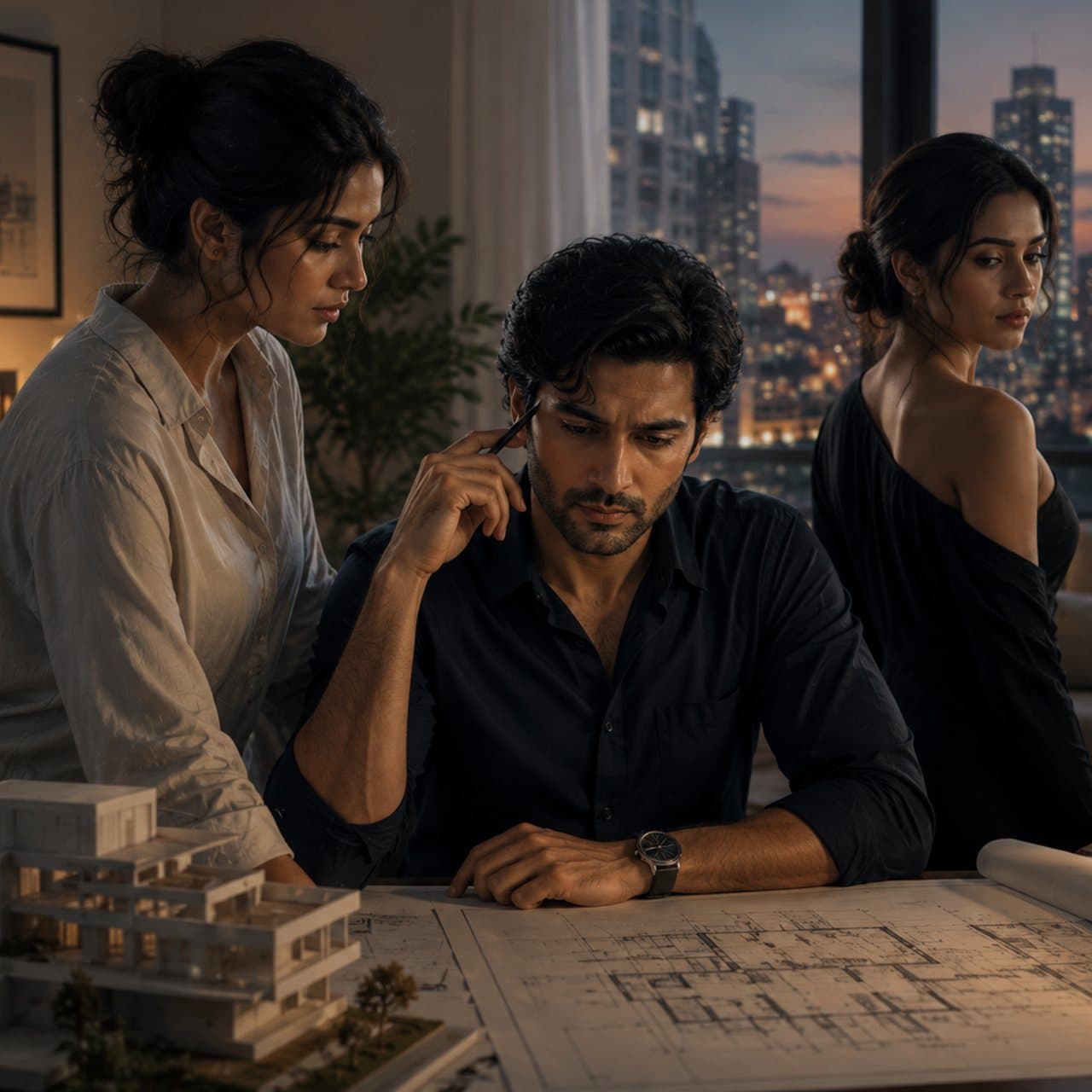

The penthouse felt different at 1:47 AM. Not emptier exactly—absence is not the opposite of presence—but changed in a way that suggested permanence. Anaya stood at the window where she had stood at 9:47 PM, watching her husband descend into the city. She had kissed him lightly on his forehead before he left. She had said, "Work well." She had not held him the way she wanted to hold him, the way marriage permits you to hold someone after eleven years.
She had wanted to hold him that evening. She had planned to hold him after dinner, after their anniversary was marked with the kind of physical presence that meant something.
But he had left.
By 6:30 AM, when Officer Deshmukh arrived, Anaya had already conducted her own investigation into the lie. There had been no meeting at Mehta's house. The investors had cancelled. Mehta's maid had been clear about this, her voice carrying the particular certainty of someone delivering bad news.
That morning, Anaya did not call the architectural firms or the hospitals, though she did those things too. First, she went to Shashank's office. She was still in her nightclothes, still wearing the face cream she had applied before bed, still moving with the careful precision of someone operating on automatic function while the real part of her mind was elsewhere.
She used her access card. She entered his office. She sat at his desk.
The journal was in the drawer where she had seen him place it weeks ago—she remembered watching him slide it beneath his personal files, the movement suggesting privacy, secrecy, things not meant for shared examination. She opened it now, not with the guilt of invasion, but with the necessity of someone who needs to understand what has happened to their marriage.
The sketches were the first thing that struck her. Not their presence, but their obsessive repetition. A woman's face rendered dozens of times—in margins, on blank pages, overlaid with structural drawings, inserted into architectural plans as though the architect was trying to build around her rather than alongside her. The sketches were dated. They went back months. Some were recent, sketched with the kind of intensity that suggested struggle rather than simple artistic exercise.
But the face was confusing. It looked like Anaya. The bone structure was similar. The eyes held a familiar architecture. But something was wrong with the similarity—the sketches did not quite capture Anaya's face. There was a quality in the rendered features that suggested the artist was trying to reconcile two different images, trying to draw one woman while remembering another. In some sketches, the face looked almost exactly like her. In others, it was subtly different—a different curve to the chin, a different quality to the gaze, a different set to the shoulders.
Anaya studied the sketches for over an hour, trying to understand what her husband had been seeing when he rendered these images. Had he been drawing her? Had he been drawing someone else? Had he been trying to draw her as he remembered her, rather than as she actually was?
She photographed each sketch with her phone. She documented the dates. She began to construct a timeline of when these renderings had intensified, when they had become most obsessive. The intensity increased beginning four months ago. The intensity became almost frantic beginning three weeks ago.
Three weeks ago was when Shashank had first mentioned hiring a consultant for the Plaza project. Three weeks ago was when the evening conversations had become shorter, distracted, as though his mind was elsewhere even when his body was in bed beside her.
She found his personal calendar next. Small entries, brief notations: "Coffee with A. 2 PM." Repeated. Multiple times. Always the same time. Always "A."
She did not understand what these notations meant. But she understood that they meant something.
The First Day of Investigation
Anaya spent that evening doing something that wives should not have to do: she built a case against her husband's disappearance based on fragments and fear. She called his colleagues one by one. Ramesh, his primary partner, said only that Shashank had been distant for weeks. He said he had noticed the distraction but had not asked about it, respecting professional boundaries.
She called Hari, the property developer who had been competing for the same contracts. She did this systematically, researching him first, understanding his reputation, confirming through professional databases that he was established, successful, unlikely to be involved in anything criminal.
"I am looking for my husband," Anaya told Hari when she called. "Shashank. He has been missing since last night. I am calling everyone associated with him."
Hari's response was immediate, professional, devoid of the hesitation that guilt produces. "I will cooperate fully with the police investigation. I have nothing to hide."
The next morning, Anaya visited Hari's office. She did this while Saanvi was at school, while the day was still structured around normalcy. Hari received her without suspicion, offering water and concern in equal measure.
"When did you last see my husband?" Anaya asked.
"At the architectural conference two weeks ago. We exchanged pleasantries. Nothing more."
"Did he seem disturbed?"
"Architects are always disturbed about something," Hari said. This was meant as humor, but it fell flat. "His focus was on the Plaza project. He seemed invested in that."
Anaya asked about the business offer. Hari confirmed what she already knew: he had offered partnership, Shashank had refused. There was no animosity. There was simply business.
She left his office convinced that Hari had nothing to do with her husband's disappearance. This conviction came not from his words, but from the fact that she was looking for her husband and Hari was simply a man with buildings and ambition. He did not have the architecture of someone harboring secrets.
That evening, she returned to the office. She used her access card again. She went to Shashank's desk. She opened his personal files. She photographed every sketch. She documented every notation. She built an archive of confusion on her phone, screenshot by screenshot.
"A," she whispered to the empty office. "Who are you?"
Anaya's Pure Devotion
What emerged in those early days was not primarily fear, though fear was present. What emerged was something more specific: a desperate need to understand what had happened to the man she had loved with a clarity that now seemed naive.
She had loved Shashank not as a romantic proposition or a social arrangement, but as something closer to recognition. She had met him in architecture college during a presentation on sustainable design. He had been sketching while listening, his pencil moving with the precision of someone who could not help but translate spoken words into visual form. She had watched him for the entire presentation, not listening to the content but studying the movement of his hands, the concentration in his face.
After the presentation, she had approached him directly. "You draw while you listen. That is unusual."
He had looked up as though waking from a dream. "I listen better when I am drawing. The act of rendering makes space for information. Does that make sense?"
It had made perfect sense to her. It had seemed like the most logical thing anyone had ever said.
They had been together since that moment—not always romantically, but always with the intensity of two people who understood each other's minds. She had watched him become an architect of note. She had supported his ambitions not as a spouse supports a spouse, but as a believer supports a vision. She had held space for his obsessions, his late nights, his periods of dissatisfaction when a project did not achieve what he had imagined.
She had loved him in the way that you love someone when you understand that they contain multitudes, and you are grateful to be trusted with witnessing those multitudes.
And now, looking at the sketches of a face that was almost her but not quite her, she began to wonder if that love had been pure at all, or if it had been something else—a kind of acceptance of being loved while being confused with someone else.
The thought made her physically ill.
The Verification
Anaya did what she had been trained to do as an architect: she verified information systematically. She pulled Mehta's guest list from the social media photographs posted from previous business events. She cross-referenced it with professional databases. She confirmed that the investor meeting Shashank had mentioned was not, in fact, scheduled.
She visited Mehta's house in person, on the pretense of asking about her husband's whereabouts. The maid who answered the door was sympathetic but clear: there had been no meeting. There had been no arrangement.
Anaya sat in her car in Mehta's driveway and understood that her husband had lied to her. Not dramatically. Not in the way that betrayals are supposed to happen. But strategically. He had constructed a false appointment in order to disappear. This meant that the disappearance was intentional. This meant that whatever he was running from, he had decided that leaving was the only way forward.
The question was not where he was. The question was what he was running from.
She returned to the office sketches. She studied them again with the knowledge that her husband had been rendering something obsessively while lying about his whereabouts. She began to see patterns she had missed before—the sketches were not random. They followed a progression. The early sketches were less defined. The recent sketches were almost photographic in their detail. The artist was drawing closer to something. The artist was getting clearer about what he was trying to render.
And whatever he was rendering, it was not quite Anaya's face.