


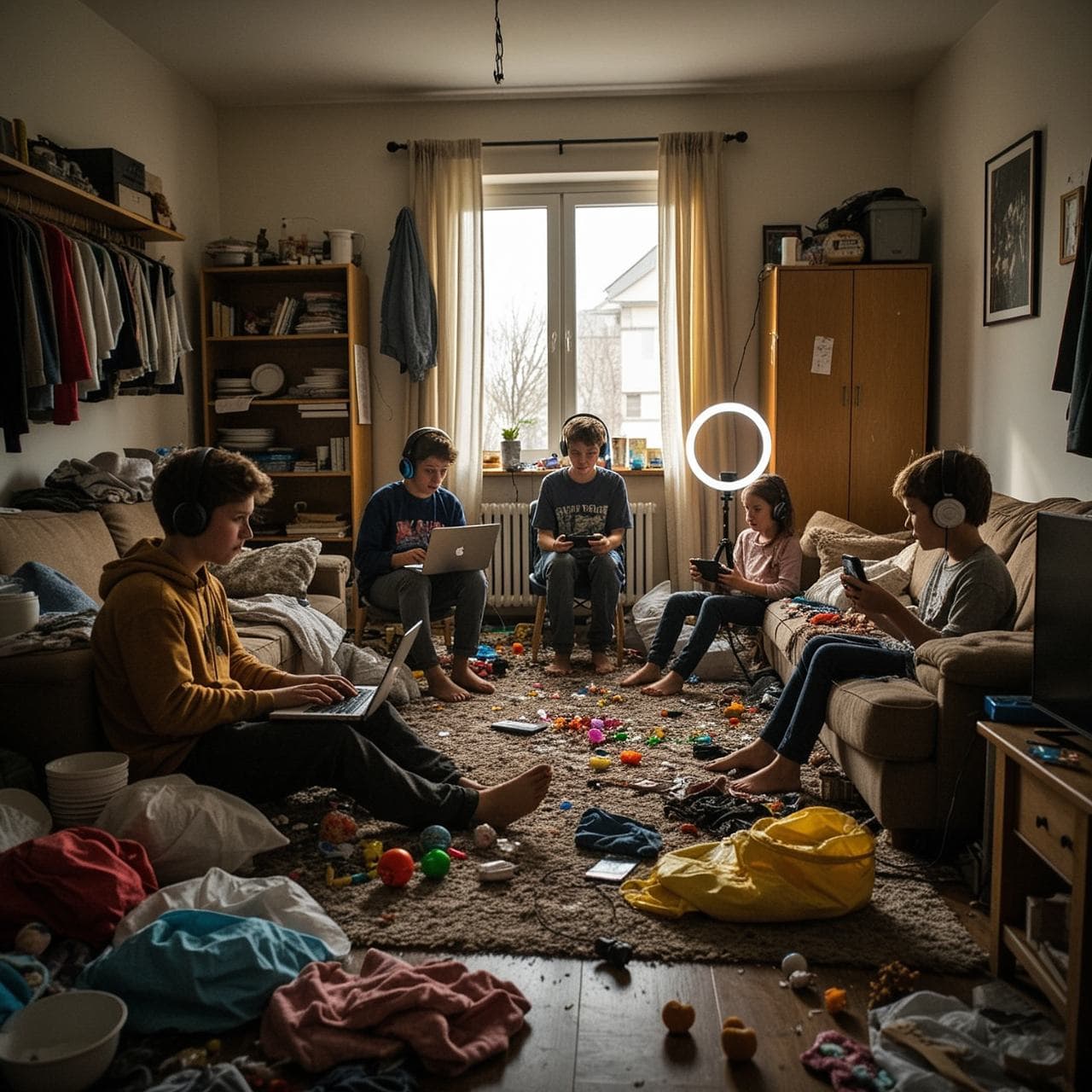

My mother had a stroke.
Not a big one. A "mini-stroke,"
the doctors said. A warning. A "transient ischemic attack," which sounded like a prog rock band but was actually terrifying.
She was seventy-four, still living alone, still driving (against our wishes), still insisting that she didn't need help, didn't need a nurse, didn't need anything except her independence and her casseroles.
But after the stroke, she couldn't live alone anymore. Or at least, she couldn't live alone safely. And so, after much argument and many "in my day" speeches, she moved in with us.
The Silent Crew became the Care Crew.
And everything changed.
My mother, who had spent her life taking care of others, now needed care herself. And she hated it. Hated every moment of it. The dependence, the vulnerability, the reversal of the natural order.
"I can do it myself," she would say, trying to stand, trying to walk, trying to maintain the dignity that had defined her entire existence.
"Mom," I would say. "Let me help."
"I don't need help. I'm fine. I'm—" and then she would stumble, and I would catch her, and she would cry, and I would hold her, and we would both pretend it wasn't happening.
But it was happening. Time was happening. Age was happening. The Boomer generation, the generation that had seemed invincible, was entering its final act. And my mother, my indomitable, impossible mother, was becoming fragile.
The children reacted in their generational ways.
Dakota, home from college for the summer, threw themselves into research. They read every article about stroke recovery, about elder care, about "ageism in healthcare." They wanted to fix it, to solve it, to activist their way through their grandmother's mortality.
"Grandma," they would say, "have you considered that your resistance to help is internalized ageism? That society has taught you that dependence is weakness, but actually interdependence is revolutionary?"
"Have you considered," my mother would reply, "that you're a know-it-all and I changed your diapers?"
Phoenix documented the experience, but differently than before. Not for content, but for memory. They filmed my mother telling stories, recording her voice, her laugh, the way she said "in my day" before launching into a tale. They were archiving her, preserving her, trying to hold onto something they knew was slipping away.
"Why are you filming me?" my mother asked.
"So I don't forget," Phoenix said.
"Forget what?"
"You. This. Everything."
My mother, who had never understood Gen Z, who had called them lazy and communist and screen-addicted, looked at Phoenix with new eyes. "You're a good kid," she said. "Annoying. But good."
Atlas avoided the whole situation by retreating into Minecraft, building elaborate structures that I eventually realized were replicas of my mother's house, her garden, the world she was leaving behind. They were processing through creation, through digital preservation, because the real world was too scary.
And Nova, the youngest, simply loved her. Sat with her, held her hand, brought her drawings and stories and endless questions about "the olden days."
"Tell me about when you were little," Nova would say.
And my mother would tell her. About the 1950s. About rotary phones and milkmen and a world that seemed, in retrospect, both simpler and more complicated than it had appeared.
"Were you happy?" Nova asked.
My mother considered this. "I was busy," she said. "I was raising kids. I was working. I didn't have time to be happy. That came later. When I slowed down."
"Are you happy now?"
My mother looked at Nova, at this Gen Alpha child who asked questions that cut to the bone, who wanted to know about feelings and happiness and meaning.
"I'm trying," my mother said. "I'm trying to be."
And I, Gen X, watched from the doorway, holding a cup of coffee that had gone cold, and I thought about time. About generations. About how we were all just passing through, leaving traces on each other, trying our best even when our best wasn't enough.
My mother recovered, mostly. She would never be what she was. But she was here. She was with us. And she had learned something in her fragility, something that all her strength had never taught her: how to accept help. How to be vulnerable. How to let the Silent Crew take care of her for a change.
One night, I found her in the living room, watching Phoenix edit a video on their laptop.
"What are you doing?" she asked.
"Making a video," Phoenix said.
"Of what?"
"Of you. Of us. Of this."
My mother watched the screen, watched images of herself flash by—laughing, crying, telling stories, eating casseroles—and she smiled.
"I don't understand it," she said. "The technology. The... the point of it."
"The point," Phoenix said, "is to remember. To share. To connect.
"Connect," my mother repeated. "In my day—"
"I know," Phoenix interrupted, but gently. "In your day, you connected in person. Face to face."
"Yes."
"But Grandma," Phoenix said, "this is face to face. Just... bigger. More faces. More connection. It's not worse. It's not better. It's just... different."
My mother looked at the screen, at the digital ghosts of moments that had already passed, and she nodded.
"Different," she said. "I can accept different."
And she did. Not perfectly. Not completely. But she tried. She learned to text (with many typos and much frustration). She learned to FaceTime with her friends (and complain about the delay). She even learned, finally, to accept the Wi-Fi.
"It's magic," she said one day, watching Nova stream a movie on the iPad.
"Not magic," Nova said. "Technology."
"Same thing," my mother said. "Same thing."
And I realized that she was right. It was magic. All of it. The connection, the love, the trying across generations. It was magic that we didn't understand but could still believe in.
The Silent Crew had become the Care Crew, and the Care Crew was just love by another name.