


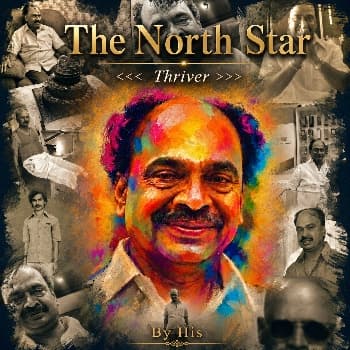

“Every daughter loves her father.
But every daughter also believes she is his favourite.
I never had to believe it.
He made me feel it.”
Among the three of us, I was the noisy one.
If my elder sister brought peace into the house, I brought movement.
I talked endlessly.
I asked questions no one expected.
I danced without an audience.
I sang without invitation.
Every story that entered my mind somehow found its way to Appa.
And he listened.
Patiently.
Completely.
Looking back now, I realise how rare that is.
Adults are often too busy to listen to children.
Appa never made me feel like an interruption.
He would quietly watch my little performances with a smile that said more than words ever could.
He never needed to applaud loudly.
His eyes did that for him.
Those eyes remain one of my strongest memories of him.
They were incredibly expressive.
Sometimes they smiled before his lips did.
Sometimes they spoke long before he found words.
I often think children know who their safe person is long before they understand why.
Mine was always Appa.
Whenever summer holidays arrived and he left for work without me, the house suddenly felt too quiet.
The day seemed longer.
The rooms seemed emptier.
It wasn’t that Amma wasn’t there.
She was.
But my little world revolved around one person.
Sometimes, if Appa travelled somewhere without me, I would even develop a fever.
As unbelievable as it sounds now, that was the depth of my attachment.
His absence unsettled both my heart and my body.
Only much later did I understand that children sometimes carry love physically.
I loved riding with him.
The destination hardly mattered.
It could be his office.
A nearby shop.
A temple.
Anywhere.
If I was sitting behind him on his two-wheeler, holding onto him while the wind rushed past us, I was happy.
Even today, when I smell petrol mixed with the evening breeze, a tiny part of me is transported back to those rides.
Some memories never leave through the mind.
They stay inside the senses.
I was not an easy child.
At least not in the ordinary sense.
I was endlessly curious.
Every drawer invited exploration.
Every diary deserved reading.
Every cassette demanded investigation.
I would pull the magnetic tape out with a pen simply to see what happened.
I dismantled things that fascinated me.
I asked questions that probably exhausted everyone around me.
Naturally, I received my share of scoldings.
But never because I was loud.
Never because I was imaginative.
Only because I had accidentally destroyed something precious.
Or because I had wandered where I wasn’t supposed to.
Appa somehow understood that curiosity wasn’t disobedience.
It was simply the way I experienced the world.
There was only one battle he never stopped fighting with me.
Food.
Unlike my sisters, eating never interested me.
I was forever distracted.
Forever forgetting meals.
Forever catching colds.
Morning allergies.
Mouth ulcers.
Weakness.
Those became regular visitors throughout my childhood.
He took me to every doctor someone recommended.
Every specialist.
Every clinic.
Every possible treatment that offered even a little hope.
I have lost count of how many waiting rooms we sat in together.
He never gave up searching for answers.
Looking back now, I understand why he worried so much.
His frustration never came from anger.
It came from fear.
Fear that I wasn’t healthy.
Fear that I wasn’t strong enough.
Fear that something might happen to the little girl he adored.
As a child, I only heard the scolding.
As an adult, I finally heard the love hidden beneath it.
The only request I consistently made was simple.
“Dosa.”
Whenever we travelled together on his scooter or motorcycle, stopping for dosa became our little tradition.
Those meals were never elaborate.
But somehow, they tasted like childhood itself.
He was the ultimate anchor when it came to my education. During my school years, he was my fiercest protector—if a teacher went too far with discipline, he’d be right there at the school, standing up for me and taking the matter straight to the principal. Yet, alongside that protective instinct was a remarkably thoughtful approach to our studies. He wasn't obsessed with the final grades themselves; instead, he tracked every single exam timetable for me and sisters, making sure we were prepared. After every test, he had me evaluate my own performance, later comparing my self-assessment against the actual results. If there was a big gap between what I expected and what I got, he’d sit me down to figure out where my reasoning went off track. I didn't fully grasp the lesson back then, but looking back, he wasn't just managing our schoolwork—he was teaching us the lifelong power of self-evaluation.
One lesson Appa taught me without ever calling it a lesson was this:
Respect effort.
If I had genuinely tried, he was satisfied.
He never compared me with anyone else.
He never measured my worth by numbers on a report card.
Character mattered more.
Honesty mattered more.
Trying mattered more.
Years later, when I became a mother, I realised I was repeating his words without even noticing.
I praise effort before achievement.
I celebrate sincerity before success.
Somewhere, without intending to, I had become my father’s daughter all over again.
As I grew older, something else became even more precious.
Appa respected me.
Not because I was always right.
But because he believed even children deserved to be heard.
Our family was wonderfully close, yet I often felt different.
I questioned traditions.
I challenged accepted ideas.
I saw the world differently from many around me.
There were moments when I felt like the odd one out.
Except with him.
Appa never laughed at my opinions.
He didn’t dismiss them because of my age.
He listened.
Sometimes he agreed.
Sometimes he didn’t.
But he always made me feel that my thoughts deserved respect.
That gift shaped me more than I realised.
It gave me the confidence to think independently without fearing rejection.
Even today, whenever someone tells me they feel heard after speaking with me, I silently thank him.
He taught me how powerful respect can be.
Years later, after my own daughter was born, I found myself remembering these moments more often.
Appa was a man of gentle devotion and steadfast habits. Even in a time when it was unusual for fathers to be close to their daughters after coming of age, he never drew that distance—he cared for me endlessly, always gently checking if I was in pain. He was a deeply disciplined man of fixed routines, leading to a moment I still laugh about today: on the night of my wedding, while everyone was scrambling to figure out room allocations, Appa had simply followed his usual routine, turned off his phone, gone home, and fallen asleep by 8:30 PM!
When the time came for me to leave for my husband’s house, he stepped away to avoid an emotional breakdown, having been heartbroken when my elder sister married. He later called to say he would rather visit me at my new home instead—a quiet, fiercely protective gesture. When a relative tried to tell me that my husband's place was now my real home, Appa immediately shut it down, declaring that his house would always be my permanent address.
That same tender heart showed when I was in labor with my own daughter. Though he had once insisted on wanting a grandson with my elder sister, he knew I longed for a daughter and never brought it up with me. When he saw me in pain, all he cared about was my well-being, unable to bear seeing me cry.
My Appa had bought a brand-new bike one day with my name on it, eager to surprise me with our very first ride together. But when a minor fall from a compound wall landed me in a garden pit instead, his grand surprise instantly dissolved into overwhelming concern. Seeing me hurt broke his heart so completely that the doctor had a harder time calming him down than treating me. What started as a scary mishap turned into one of my most cherished memories—a testament to a father whose proudest moments were always second to the fierce, tender love he had for his daughter.
I began asking myself a simple question.
“Can I become even one percent of the parent he was?”
If I can…
I will consider my life successful.
Because raising a child is not about giving them everything.
It is about making them feel they already have everything that truly matters.
That is exactly how Appa made me feel.
Like the richest little girl in the world.
Even now, after all these years, if someone asks me what love looked like, I don’t think of flowers or gifts.
I think of a man quietly listening to his talkative little daughter tell yet another impossible story.
I think of expressive eyes smiling with pride.
I think of scooter rides.
Dosas shared between errands.
Patient conversations.
Gentle guidance.
A father who never made his daughter earn his affection.
He simply gave it.
Freely.
Every single day.
And perhaps that is why, even today, whenever I try to love my daughter well, I know exactly where I learned how.
From my North Star.