


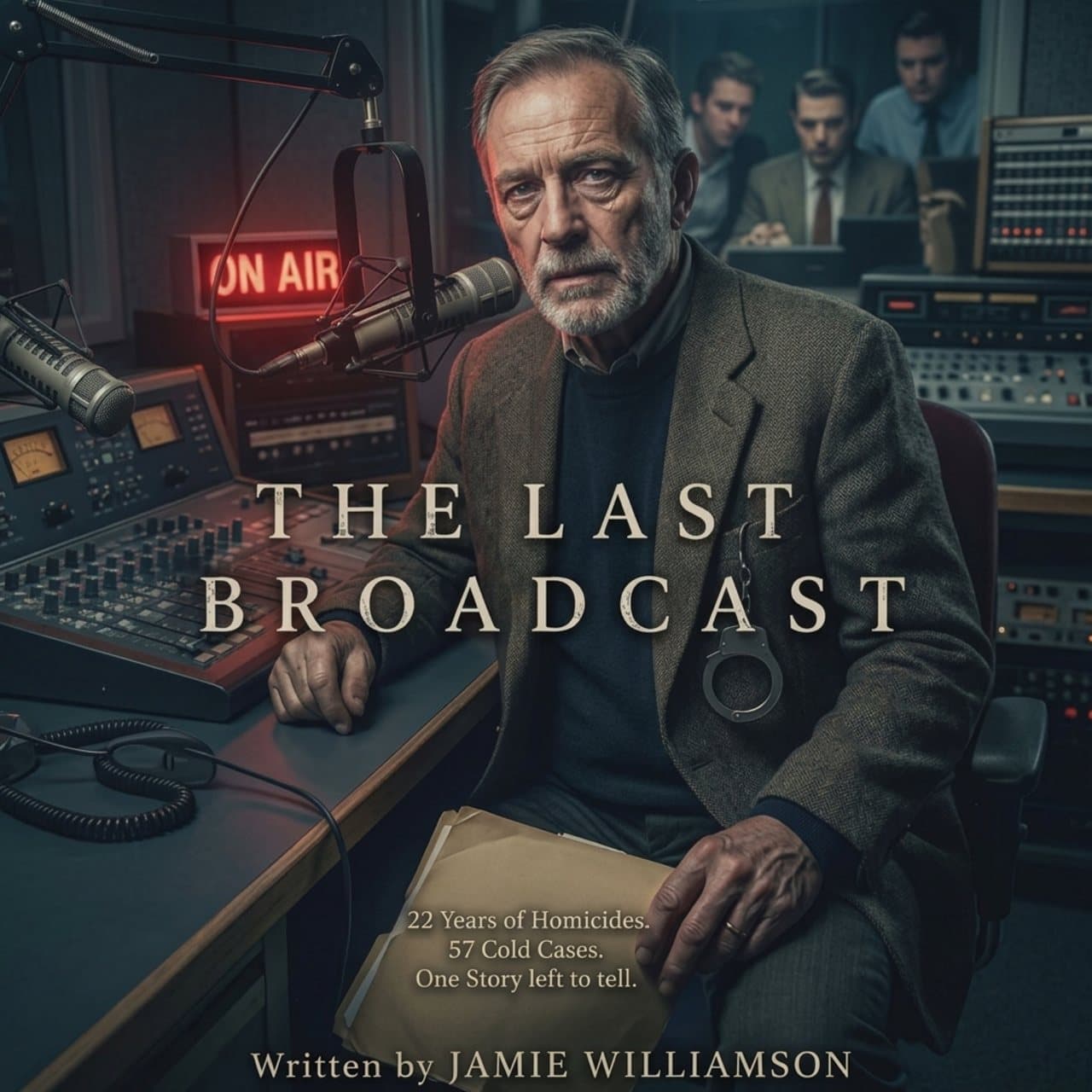

The Signal That Stopped America
At 11:43 p.m., every screen in America went black.
Not dim. Not glitching. Dead.
Cable anchors froze mid-sentence. Game shows vanished. Late night monologues choked off in the middle of laughter. In bars from Seattle to Charleston, conversations cut short as televisions lost their feeds and became flat panes of void. Car radios turned to a smear of static. Emergency backup channels flickered, failed, and came back carrying the same silence.
Then a face appeared.
An old man. Gray suit. White shirt. No tie. Hard light above him. Nothing visible behind him except shadow.
He looked straight into the camera with the grave patience of someone used to being believed.
Detective Silas Thorne.
In West Virginia, people knew him before his name was spoken. Across the country, millions recognized him a heartbeat later from old true crime specials, courthouse steps, anniversary interviews, the exhausted eyes of a man who had spent twenty two years talking about the dead. He had stood beside mothers. Beside ditches. Beside yellow tape in the rain. He was the face of the Appalachian Highway Murders, fifty seven unsolved killings scattered across southern West Virginia since 2004. He was the detective who never quit. The guardian of the dead.
When he spoke, the whole country leaned closer.
“My name is Detective Silas Thorne,” he said. “And tonight I am going to tell you the truth.”
No one moved.
Control rooms lit up in panic. Producers shouted over dead boards and failing uplinks. Federal agencies started tracing routes that bent in circles and vanished. Social media detonated. Screenshots. Clips. Guesses. Terror. Hoax. Coup. Cyberattack. The feed held steady through all of it.
Silas did not blink.
“The story you were told,” he said, “was a story about failure.”
His voice was low. Measured. The voice of a eulogy. Not a rant. Not a breakdown. Worse. It sounded prepared.
In Charleston, Detective Maya Vance stood in the dim blue wash of her apartment and watched him speak from a television she had not turned on.
She had been asleep on the couch. One lamp burning. Case notes open on her chest. Her phone buzzing itself insane on the floor. By the time she grabbed it, she had twelve missed calls from the department, three alerts from state emergency channels, and one text from a number she had not saved but knew anyway.
TURN ON THE NEWS NOW
Too late for that.
The news was already on. Everywhere.
Silas filled the room, his lined face calm under the white glare. Maya felt a pressure start behind her ribs. Not fear. Recognition. Something in his tone had reached through the screen and touched a nerve she had spent months trying to ignore.
He was not surprised to be here.
He had wanted this.
Onscreen, Silas folded his hands on the table in front of him. Maya noticed the tiny details first. The left cuff unbuttoned. A scrape on the knuckle. Dust on one sleeve. He looked older than he had in the photographs from retirement week. Smaller too. But the eyes were the same. Attentive. Human. Built to invite trust.
“For years,” he said, “you were told the Appalachian Highway Murders remained unsolved because the system was overwhelmed. Jurisdictions failed. Evidence was mishandled. Leads were buried under politics, poverty, distance, weather, and time.”
He paused.
“That was true. It was also not the truth.”
Maya sat forward.
Outside her apartment, somewhere down the block, people had stepped onto balconies and porches. She could hear voices carrying through the spring dark. Doors opening. Car alarms chirping. A city waking into alarm. Inside, she heard only him.
The first time she had met Silas Thorne, he had poured her bad coffee in a chipped mug and apologized for the state of the Beckley archive. He had smiled like a tired priest. He had said, We do what we can for the dead. She had almost believed that was all he meant.
Now he was on every screen in America.
A summons, the summary had called it. It felt more like a hand closing around the back of her neck.
Her phone rang again. State Police command.
She ignored it.
Silas began naming victims.
Not all of them. Not yet. Just enough to prove he could. Dates no one remembered. Road markers. Rain conditions. Which mother fainted at which press conference. Which county lost a rape kit refrigerator in the flood of 2011. He laid details out with almost holy care. The effect was instant and sickening. He sounded like the only honest man left in a collapsed building.
Maya knew that voice. She had heard it in archive basements, in county diners at 2:00 a.m., in his car rolling past dark ridgelines while he explained how grief aged a town. A noble voice. A reflective one. A man exposing rot. That was what made him dangerous. Even now, he was shaping the story, curating the past, deciding what the country saw first.
Then he said a sentence that turned the room to ice.
“If anyone still has the courage to open the boxes beneath Beckley Station,” Silas said, “this would be the hour.”
Maya was on her feet before the line ended.
The boxes beneath Beckley Station.
The archive.
For one second she stood motionless, every part of the old investigation firing at once. The basement confrontation. The wound in his side. The blood on concrete. The door she had thought would hold him. The certainty that backup was minutes away. The certainty that had failed.
He had escaped the system one last time. And now he was using the whole country as cover.
She killed the call from command again and moved.
Jeans. Boots. Jacket. Service weapon. Laptop bag. Keys.
The television kept talking as she crossed the room.
“The dead remember more than the living do,” Silas said.
Maya stopped just long enough to stare at the screen.
“No,” she said to him, to herself, to the months behind her. “The files do.”
Then she was out the door.
The elevator was too slow. She took the stairs six flights down, hand skimming the rail, lungs burning. By the third landing her phone had become a constant vibration in her pocket. By the lobby, the building manager was holding his own phone up in both hands as if it were broadcasting judgment.
In the parking lot, every car radio carried Silas.
The roads out of Charleston had turned into veins pumping panic south. Patrol lights strobed through intersections. Gas stations glowed with crowds staring through plate glass at mute televisions while the same old detective spoke from every mounted screen. Maya merged hard, engine whining, and headed toward Beckley with the broadcast spilling from her dashboard.
He talked about broken systems. About forgotten counties. About how geography protected evil. The gorge. The hollows. The dead roads past rusted mines and collapsing motels. He was building a map with his voice. The same landscape the case had lived in. The same Southern West Virginia of fogbound valleys and shut mouths and long black stretches where a cruiser could disappear for twenty minutes and no one would question it.
Halfway south, command finally patched through over the feed.
“Vance, identify your location.”
She clicked over. “Route 77. Nineteen minutes out.”
“Turn around.”
“No.”
“Federal is taking point.”
“He mentioned Beckley Station.”
“We heard him.”
“Then you know where I’m going.”
A pause. Paper shuffling. Someone breathing too close to a mic.
“Maya,” the voice said, dropping rank for urgency, “if Thorne set this up, the station may be compromised.”
“It was compromised twenty years ago.”
Silence.
Then, quietly: “You think this is about the archive.”
“I know it is.”
She killed the line and switched back.
Silas was smiling now. Barely. The smile of a man who knew the whole country was following exactly where he led.
By the time Beckley appeared through the windshield, the town looked like it had been wrenched awake by a storm. Blue lights painted the storefronts. Reporters clustered near the station barricades. Residents stood behind tape in house shoes and coats thrown over pajamas. Above them all, in diner windows and pharmacy televisions and idling pickup trucks, Silas still spoke.
Maya parked two blocks away and went on foot.
The Beckley station loomed ahead, brick dark against a silver sky threatening rain. She had not seen it in months, but her body remembered the way in. Side entrance. Down the service corridor. Past records. Past the old property cages. Then the steel door with the warped latch leading to the basement archive where fifty seven lives had been boxed, labeled, misfiled, and tended by the hands that had ended them. Or so she now believed. Soon the country would know it too. But not yet. Not until he said it. Not until she proved it.
She flashed her credentials, ducked under tape, and ignored three shouted questions from press.
Inside, the station was a hive of noise and fluorescent panic. Deputies ran printouts between rooms. Dispatch phones screamed. Someone had set a conference room television loud enough for half the floor to hear.
Silas’s voice drifted down the hall.
“History,” he said, “belongs to whoever can stand the sight of it.”
Maya kept moving.
Because she could.
And because somewhere inside that building, or somewhere he intended her to go next, he had left a final arrangement waiting.
Maya Vance Opens the Archive
The steel basement door was unlocked.
That scared her more than if it had been forced.
Maya stood still in the narrow corridor, one hand on her weapon, the other on the cold bar of the door, and listened. Above her, the station shook with footsteps and shouted orders. Down here, nothing. Just the old building settling around the archive like dirt over a coffin.
She pushed through.
Fluorescent lights buzzed to life one bank at a time, revealing rows of shelves, gray boxes, metal cabinets, old map tubes, tagged evidence bins, and the long central table where she had once spent whole nights feeding the dead into a scanner. Dust lived everywhere. In the seams of cartons. In the corners of file labels. In the stale air itself. The basement still smelled of paper, mildew, and old adhesive.
And memory.
This was where the real story had started. Not with the broadcast. Not with tonight. Here. When the department had brought in a young detective from the capital to modernize a paper graveyard before a legend retired. She had arrived expecting resistance from tired cops and bureaucrats. Instead, Silas Thorne had welcomed her. Warmth. Patience. The polished sorrow of a man who seemed to have spent half his life carrying other people’s losses. He had guided her into the archive like a priest into a crypt.
Now the crypt felt rearranged.
Three boxes sat open on the central table. Not randomly. Intentionally. One from 2004. One from 2008. One from the final year before she had left Beckley. Beside them lay an old property ledger and a portable radio hissing with the national feed. Silas was still speaking through it, his voice thin and ghostly in the basement air.
He had set a stage.
Maya approached the table slowly.
The 2004 box held the first victim file. Highway shoulder. Female. Nineteen. Rain. Partial drag marks. Misplaced witness statement. She remembered that one. She remembered all of them. The system had tried to keep them separate. County lines. years. weak databases. paper walls. She had been the one to break those walls, uploading everything into a searchable model, forcing twenty two years of isolated misery into one visible shape. That was when the pattern started to breathe. Patrol gaps. camera outages. redirected search grids. missing hours lining up too cleanly to be chance.
The 2008 box held the preserved clothing sample that had shifted her thinking from incompetence to access. Police issue synthetic fiber. Tiny. Ordinary. Catastrophic. The clue that made one fact unavoidable. The killer had not simply slipped past law enforcement. The killer had come from inside it.
The third box held copied vault access records.
Silas’s badge number repeated through two decades like a pulse.
Maya shut her eyes for one second.
He was telling her he knew exactly what she knew.
The radio crackled. On the broadcast, Silas was describing evidence chains. How records vanish. How men in uniform move through rooms no civilian ever sees. How the story of a murder can be altered by a single form signed at the right hour. He still had that same measured cadence. Not confessing. Educating. He wanted the nation hypnotized before he cut the floor out from under it.
Maya opened the property ledger.
Inside, a page had been marked with fresh red pencil. Not ink. Carpenter’s pencil. One line circled.
TEMP TRANSFER, AUDIOVISUAL STORAGE, SUBLEVEL C
There was no audiovisual storage on sublevel C.
There was, however, an old maintenance annex beyond the archive, sealed years ago after flood damage. It backed onto a service tunnel that connected to a disused records intake bay. A route almost no one in the modern station remembered.
Her pulse kicked.
He could have used it to get in. To get out. To stage this room and vanish before local units even locked down the perimeter.
The realization came with another one, colder still. He did not necessarily want her to find him here. He wanted her moving. Following. Reading the map he was leaving in objects and phrases and years. The livestream was not just a confession. It was a countdown, exactly as she had feared.
She checked the annex door. Chained. Old rust. Undisturbed.
Too obvious.
She turned back to the table and scanned again. The selected years. 2004. 2008. final pre-retirement. Beginning. Turning point. Endgame. Not chronology. Narrative.
Curator of history, she thought. Even now. Especially now.
She rifled deeper into the 2004 box and found a county map folded beneath intake photos. New creases cut across the old paper. Someone had unfolded it recently. A red line traced Route 19 south, then hooked west toward the gorge. Near a dead mining spur, a small X had been pressed so hard the pencil nearly tore through.
Maya stared at it.
First victim geography. Earliest patrol anomalies. The roads he used to talk about when he was teaching her the region. Not teaching. Conditioning. Showing her which distances mattered. Which blind turns stayed blind. Which hollows swallowed radio calls when weather rolled in. She had thought he was passing on hard won wisdom. Maybe he had been rehearsing the shape of his own kingdom.
Her phone buzzed with a fresh stream of messages. Federal tasking. media perimeter. command orders. one from a Beckley deputy she trusted.
FOUND GARAGE CAM. THORNE NOT IN STATION. MAY HAVE LEFT HOURS AGO.
Of course he had.
Maya looked up at the naked fluorescent tubes, at the endless shelves, at the boxed evidence of fifty seven ruined lives, and for one ferocious instant she hated him not only for the murders but for the architecture of them. He had a hidden inside process. Inside sympathy. Inside paperwork. He had made the archive itself complicit.
Above, muffled through concrete, a cheer or gasp rolled from the station floor.
The radio carried the reason a second later.
Silas had changed pronouns.
For the last several minutes he had spoken of what they did, what the system allowed, what investigators missed. Now his voice is sharpened, calm as ever.
“I remember,” he said, “the first time I moved one.”
Maya froze.
Not they.
I.
The air went out of the room.
Upstairs, people were hearing it too. The nation was hearing it. The slow, monstrous shift described in every nightmare she had tried not to articulate. He had stopped saying they. He had started saying I.
She grabbed the map, the ledger page, and the access log copies.
No more waiting for command. No more securing scenes for committees and cameras. He was heading for somewhere bound to the beginning, the archive, and the geography of his earliest kill. The files had said as much before tonight. The summary of his end had always pointed back to the gorge, the hollows, the state roads, the landscape that kept his secrets.
She killed the radio, and the silence that followed felt like stepping off a ledge.
Then she went upstairs at a run, carrying the dead with her.