


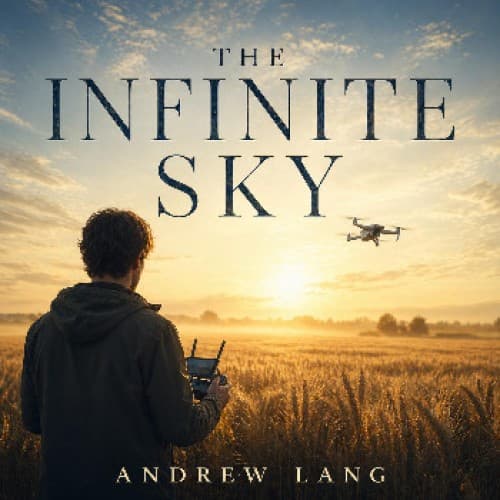
The sky above Warminster was the colour of milk left too long in a mug.
Simon Holdsworth clocked off at five, signed his name in the Tesco logbook, and stepped out into the thin, pink light. He’d been stacking shelves since midnight. His ears still hummed with the drone of the refrigerators.
He sat in his car, rubbed his eyes, and felt the vibration of his phone against the dashboard. A ping from the group:
“New formation, Upton Scudamore. Big one. Looks legit.”
Simon straightened a little. He’d driven those lanes a hundred times, always looking for the shimmer of flattened barley. Upton Scudamore was ten minutes away.
The roads were empty. The hedgerows gleamed wet in the dawn. A kestrel hung in the still air over a field already silvered with mist. When he reached the gate there were three other cars, a few figures with cameras, one with a thermos. He recognised one of them from the forums — FieldWatcher82 — though no one used real names here.
Simon kept a respectful distance. He always did. He lifted the boot of his car, took out the case, and unfolded his drone. Battery full, SD card clean. The blades whirred into life, high and thin like gnats.
From the ground, the circle just looked like disturbance — barley bent with a certain logic. From forty metres up, the screen on his controller blossomed into geometry: a flower of life, crisp, unbroken, almost luminous against the gold of the crop.
He felt the old familiar ache in his chest — beauty disguised as mathematics.
Then he saw them: four circles, set apart to the left.
Not decorative. Not random. A column of four — one small, one slightly bigger, one enormous, the final one a similar size to the second — as if arranged deliberately.
He took stills, switched to measure mode. The drone traced their diameters:
The first, 1.59 metres. The second, 2.85. The third, an expansive 32.91. The fourth — exactly three metres. Exactly?
He frowned. Ratios flickered through his head like remembered tunes. The biggest was roughly eleven times the size of the last; the smallest half that. It itched at him — where had he seen those proportions?
Then the thought came, sly and perfect: planets.
He opened his AI app and asked, “Give me the size ratios of the planets, with Earth as 1.” Within seconds, the numbers blinked back — neat, obedient, cosmic.
Mars, Venus, Jupiter.
He matched them, one by one. The ratios were exact:
Mars: 0.53 Earth.
Venus: 0.95 Earth.
Jupiter: 10.97 Earth.
By that measure, the last circle — the three-metre one — had to be Earth. The smallest was Mars, the next Venus, the great thirty-metre disk Jupiter. Four worlds laid out in barley, in perfect proportion.
A coolness ran through him, from scalp to heel.
He knew the trajectory of 3I / Atlas — the interstellar comet now ghosting through the inner system. Mars, Venus, Jupiter: the "planned" fly-bys.
But here was a fourth.
He stared at the image on his screen. The drone hovered, the barley rippling faintly beneath it like the surface of water.
What if it wasn’t a mistake?
What if it was a message?
He whispered, almost shyly, “You’re coming here, aren’t you?”
A tractor started somewhere beyond the hedgerow. One of the watchers coughed and zipped his jacket.
Simon recalled himself, landed the drone, folded it back into its case. He glanced once more at the circles.
They looked impossibly neat, as though stamped into the earth by a celestial hand.
He stood there, a man in fluorescent overalls, the smell of diesel on his fingers, and felt the strange conviction that the universe had just spoken to him in barley and light.