


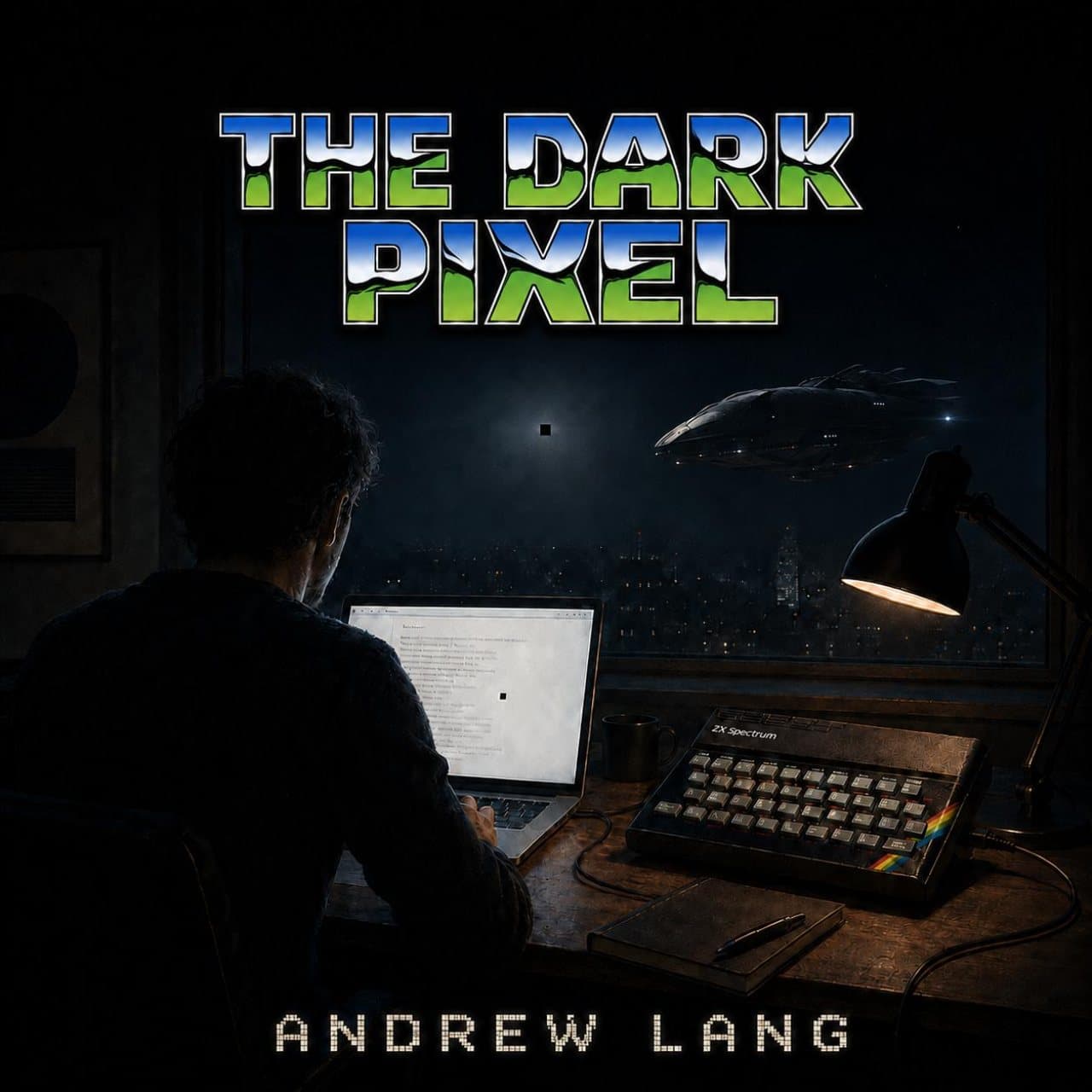
“How did you research it?” Kris asked.
Mark looked at the manuscript between them. It had grown considerably since their previous meeting and acquired, without becoming better, the dense authority of a document entered into evidence.
“Research what?”
“The 1984 chapter.”
“I didn’t.”
Kris waited. He had developed several different silences during their friendship. This was the one which accused Mark of wasting both time and oxygen.
“I checked a few things,” Mark said. “The Eurythmics album. What was in the charts. Top of the Pops was still on Thursdays. Cursory stuff.”
“The Spectrum?”
“I knew what a Spectrum was.”
“Did you?”
“Small black computer. Rubber keys. Made an appalling noise.”
“You’ve described the entire British electronics industry.”
Mark moved the manuscript aside and made coffee. Kris had arrived without warning at nine in the morning, carrying a thin tablet whose presence in Mark’s kitchen was already an ideological provocation. Mark distrusted any object that improved while its owner slept. His telephone made calls, received calls and displayed weather with a degree of confidence unjustified by English weather. Everything else he did on a twelve-year-old laptop disconnected from the domestic intelligence system. He referred to this as privacy. Kris referred to it as maintaining a technological shrine to 2027.
“You liked the chapter, then,” Mark said.
“I didn’t say that.”
“You’ve driven across London before breakfast to ask about its research.”
“I came to determine the scale of the fraud.”
“That’s practically a review.”
Kris accepted the coffee and did not drink it.
“The chapter is ... okay,” he said.
Mark sat down.
“I’m sorry?”
“Don’t make me repeat it. You’ll turn it into dialogue.”
“Too late.”
“But it’s a dot-joining exercise in the fall of modern man. Cheap houses, open machines, pop music with somewhere to go, Orwell, surveillance, lost abundance. I could see you drawing the lines. Several of the dots had numbers beside them. Some of them were Bible verses.”
“That’s how dot-to-dot works.”
“Usually you remove the numbers before publication.”
“Thank you.”
“It is still indulgent beyond accepted medical limits.”
“There he is.”
“A prodigious little programmer representing the final year of cultural abundance? Called Andrew Lang? You might as well have given him a luminous forehead.”
“I liked him.”
“Of course you did. He has 255 lives and the narrator’s full pension.”
Mark smiled. Kris did not.
“Well, he - like Neil in Chapter Two - has got me writing again, with enthusiasm.”
“How did you find Andrew Lang?”
“I didn’t.”
“Which archive?”
“None.”
“Did someone send you the clipping?”
“What clipping?”
Kris watched him with a concentration that was beginning to feel impolite.
“Stop answering questions with questions.”
“Stop asking questions whose nouns I don’t understand.”
“Andrew Lang.”
“What about him?”
“How did you find him?”
“Find him where?”
“Don’t do that.”
“Do what?”
“Make me feel insane while we discuss your insanity.”
Mark leaned back.
“Kris, I made him up.”
“No, you didn’t.”
“I invented a twelve-year-old called Andrew Lang.”
“Then you invented someone else’s childhood four years before your own began.”
Kris touched the tablet. The screen brightened instantly, pleased to be useful. He turned it around.
The page was yellow-grey and imperfectly squared. Its columns leaned towards one another with the intimacy of old print. Advertisements crowded the margins: joysticks, cassette compilations, memory expansions promising a future in units no modern refrigerator would accept. Across the top of the scan ran the title Popular Computing Weekly and a date in October 1984.
Kris enlarged a column.
Mark read his own sentence.
Or almost his own sentence. The typeface was different. The words around it were different. But the name, town and instruction were the same.
Andrew Lang, Northampton.
POKE 24760,255
Mark looked at Kris.
“What is this?”
“It’s Popular Computing Weekly.”
“I can see that.”
“October 1984.”
“I can see that too.”
“For fuck's sakes.”
Mark drew the tablet closer. The scan resisted enlargement by becoming blocks. Andrew’s name remained legible after the surrounding language began to dissolve.
“Where did you get it?”
“An archival search.”
“On what?”
“Everything.”
Kris explained. The public web knew little about obsolete British computer magazines and considerably too much about the nineteenth-century Scottish folklorist Andrew Lang. An ordinary search had produced fairy books, biographies and several thousand retailers offering Spectrum memorabilia at prices calculated to punish nostalgia. Kris had asked an archival intelligence to combine the name, Northampton, Hunchback, the magazine and the memory address. It searched undigitised periodical indexes, requested scans, interpreted degraded type and found the item buried in a miscellaneous readers’ column.
“It took two hours,” Kris said.
“You spent two hours checking a POKE?”
“I spent two hours trying to catch you cheating.”
“At what?”
“Reality, apparently.”
Mark read the clipping again.
Kris finally drank his coffee. It had cooled, but the morning had acquired other priorities.
“You were born in 1988,” he said.
“I remember.”
“You hate computer games.”
“I don’t hate them. I regard them as household tasks with orchestral accompaniment.”
“You write on a machine old enough to have voting rights. You once called cloud storage ‘burglary with branding’. When I asked what a POKE was yesterday, you said it was probably a command.”
“It is probably a command.”
“You don’t know what the numbers mean.”
“Do you?”
“No. But I’m not the one who put them in a novel.”
Mark looked down at the manuscript. The chapter had appeared after Evan’s walk and the scriptural interlude, a leap backwards into a year Mark had never inhabited. He remembered writing it in the same way he remembered writing the rest of Shomrim: an afternoon lost without unconsciousness, the words arriving already impatient with the speed of his hands.
“I remember writing it,” he said.
“Do you?”
Mark considered this.
“I remember having written it.”
Kris put down the mug.
For once, he did not exploit the sentence.
“You always write from what you know,” he said.
“Most writers do.”
“No. Most writers research. You cannibalise. Your divorce lawyer came from your divorce. The hotel in Departure Tax was the hotel in Leeds. The adult-education class was your mother’s. Even your ghosts haunt properties you’ve rented. You don’t fabricate detail. You steal it from your life and alter the curtains.”
“Andrew isn’t from my life.”
“That is my concern.”
The kitchen settled around them. A delivery vehicle moved along the street with its motor reduced to an administrative hum. Somewhere inside the wall, the house made a decision about temperature.
“This doesn’t prove anything,” Mark said.
“Correct.”
“It doesn’t prove the Shomrim exist.”
“Obviously.”
“It doesn’t prove Fah sent me the book.”
“No.”
“It doesn’t prove the decline after 2035 is an agricultural operation conducted by an interstellar hive of consciousnesses converting misery into artificial psychological stability.”
“Please don’t make Neil come back.”
Mark pushed the tablet away.
“Then what does it prove?”
Kris looked at the manuscript. Now seventy thousand words of cosmological exposition; a warning in the form least likely to be believed; a terrible novel that had somehow, for one chapter, remembered being alive.
“One part of your book is true.”
Mark said nothing.
“And you didn’t know it was true.”
On the screen, the old page waited. The clipping was comically small. It did not announce a visitation, predict a war or disclose the presence of invisible cultivators. It merely allowed a boy to fall from a castle two hundred and fifty-two more times than its developer - Ocean Software - had intended.
“Did it work?” Mark asked.
Kris frowned.
“What?”
“The POKE.”
Kris consulted the archive.
“Yes,” he said. “It worked.”
On the screen, in 1984, Andrew Lang still had 255 lives.