


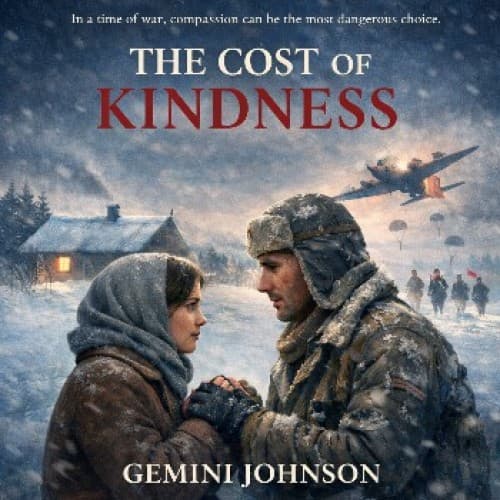

The warning came first in the dogs.
There were no dogs on Yelena’s farm—her father had once kept one, but that had been before the fever, before conscription, before there had been too little food to justify another hungry mouth. Still, sound carried strangely over snow, and in the stillness of late afternoon she could usually tell when something on the distant road had disturbed the neighboring yards. A chain of barking would start thin and far off, pass from one unseen homestead to the next, then die away again into wind.
That day it did not die away.
Austin was at the chopping block in the yard, splitting the last of a stack of rounds that had frozen together at the base. The axe came down with a crisp crack, wood opening under steel. He had learned the motion now—hips, shoulders, follow-through—and though Yelena still watched him for signs of strain, he no longer looked like a convalescent pretending to work. Sweat had dampened the hair at his temples despite the cold. His breath moved steadily in pale bursts.
Yelena stood at the well with two pails braced against her legs, listening.
From the road beyond the birch stand came not one dog, but several, all barking with the rough, uncertain alarm reserved for strangers and vehicles. Then, beneath it, another sound reached her in broken pieces when the wind turned.
Engines.
Not one. More than one.
Her hands tightened on the pail handles.
Austin saw her face before he heard the rest. He straightened slowly, the axe still in his hands, and turned toward the road.
“What?”
She did not answer immediately. She was listening too hard.
Then the engine noise resolved itself enough that there could be no mistake. Not civilian. Not a lone wagon. Trucks, maybe. Or a patrol car and something behind it. The kind of movement that meant men with orders.
“Inside,” she said sharply.
Austin was already moving, but instinct pulled his eyes once toward the tree line, once toward the road, measuring distances, options. There were none worth speaking of. Snow lay deep and crusted. The trees stood naked of concealment except at the far edges. He could not outrun a truck, and if soldiers were already near enough for the dogs to pick them up, flight across open yard would only draw them in.
He dropped the axe by the block and went.
Yelena caught up the pails and followed, water sloshing over her mittens. She kicked the door shut behind them so hard the latch rattled against the frame. For one suspended second both of them stood in the center of the cottage, breathing hard, listening to the engines grow nearer.
The room seemed suddenly full of evidence.
Not obvious evidence. Not a uniform hanging on a peg or papers spread across the table. They had been too careful for that. But Austin’s boots by the door, larger than any her father had worn. The second spoon. The extra cup. The repaired axe handle with his knife marks still plain in the wood. The narrow cot no longer looking improvised but used. The sheer shape of him, six feet of foreigner in a room built around one girl’s solitude.
Yelena’s gaze snapped to the shelf above the stove.
His pistol was there, wrapped in cloth. His papers and dog tags tucked behind a crock. She had put them away after he was strong enough to leave them on the table but not yet gone. A tiny habit of caution. Now that habit might save them or condemn them.
“Back room,” she said.
Austin did not move.
“Yelena—”
She crossed the room in three strides, reached up, and dragged the cloth-wrapped bundle from the shelf. For one wild instant she considered throwing the papers into the stove then and there. But paper smoked before it burned. Metal survived. And if men were near enough already, the smell alone might raise more suspicion.
“Yelena.” This time there was urgency under his voice, but also control. “Listen.”
She looked at him.
He was pale—not with illness now, but with the sudden clarity of danger. He had gone very still, which she had learned meant his mind was moving fast.
“If they search—”
She cut him off with a violent shake of her head. “No speak English.”
He stopped.
The old practical truth of it dropped between them. Whatever plan he was trying to form depended on words she could not catch fast enough and he could not say in Russian well enough to matter.
The engines were closer now. So close she could hear the tires grinding in ruts beneath the snow.
There was no more time.
She thrust the cloth bundle into his hands and pointed to the bed. “Mattress.”
Comprehension flashed. He moved at once, pulling up the straw tick and shoving the bundle beneath, deep toward the wall. Not safe against a full search, but safer than a shelf.
Yelena was already at the pegs by the door. She snatched down his outer coat—one of her father’s old sheepskin layers that still fit Austin badly around the shoulders—and stared at it as if cloth itself had betrayed her. One man’s coat too many. A second winter scarf. His work gloves drying by the stove.
She swore softly and threw both gloves into the woodbox.
The coat she shoved into the grain chest beneath a sack of oats.
“Boots,” she said.
Austin looked down.
His felt boots stood beside hers by the door. Too large. Too new in places where her father’s had been cracked and resoled twice. He grabbed them, crossed to the back room, and crouched to push them under the cot.
The first hard mechanical cough of a truck shutting down came from the yard.
Yelena’s heart lurched so hard she felt it in her throat.
Austin straightened too fast and winced. She saw the movement, saw at once how obvious it would be if he tried to stand or fight or run. He was stronger, yes. But one wound reopened or one wrong move in front of armed men and all of this ended in blood on her floor.
She crossed to him and seized his sleeve.
“No. Bed.”
“What?”
“Bed,” she repeated, pushing him backward. Then she pointed to her own chest. “Brother.”
He stared at her. The word landed; she saw it land.
He looked toward the door as a fist struck it once, hard enough to shake frost from the frame.
Then back at her.
“You sure?” he asked.
She did not understand the sentence. She understood his face.
No.
Of course she was not sure.
But uncertainty was useless now.
She shoved him again toward the narrow cot in the back room. “Sick,” she said, pressing a hand to her own side, then making a face of pain. “Brother. Sick. No talk.”
The door shook under a second blow.
Austin sat.
Yelena yanked the blanket up over his legs, then another over his lap and chest. She dragged the stool close to the bedside and snatched one of the dirty dressings from the basin where she had left it after changing his bandage that morning. The cloth still held old blood and the smell of spirits. She set it on the little table beside him where men might see and not look too closely.
“No look,” she said, touching his chin and pushing his face half toward the wall. “No eyes.”
He caught her wrist.
For one impossible second, in all that noise and haste, they were completely still.
If soldiers found him, they would shoot him or take him. They might shoot her too, or worse. They both knew this. There was no need to say it.
His grip tightened once, not hard.
Then he let go.
Yelena pulled free and went to the door.
She forced herself not to run, though every part of her wanted to bar the door and hide in the loft like a child. Running inside one’s own house looked guilty. Fear itself looked guilty if the wrong man was looking at it.
She paused once by the stove, snatched up the ladle, and plunged it into the pot of cabbage soup simmering at the back. Steam rose at once. The smell of boiled vegetables and old stock filled the room more strongly. Good. Let them smell food and heat and illness and ordinary poverty. Let them smell a farm, not a secret.
The pounding came again.
This time a voice accompanied it. Male. Harsh. Official.
Yelena lifted the latch.
Cold burst in first, carrying diesel, wet wool, and outside air sharp enough to knife the lungs. Three men stood on the threshold in Red Army greatcoats gone dark at the hems with slush. Behind them, through the drifting exhaust, she could see the nose of a truck and another vehicle idling beyond it. The lead soldier wore sergeant’s tabs and a fur hat dusted white at the brim. He was not old, but war had made him look worn around the mouth. One of the men behind him carried a PPSh submachine gun across his chest. The third had a rifle and a face so young she thought absurdly for a moment that he ought to have been chopping kindling, not searching houses.
The sergeant looked past her into the room before he looked at her at all.
“Who lives here?” he asked.
Yelena swallowed once. “I do.”
His eyes came back to her face. “Name?”
“Yelena Ivanovna Petrovna.”
He studied her with the impatience of a man whose time was being spent on a place that ought not require spending. Then his gaze shifted over her shoulder again, taking in the stove, the table, the pot, the chair, the wash basin.
“Alone?”
That word could mean too many things in wartime.
Yelena lowered her eyes just enough to look dutiful without seeming meek. “My brother is ill.”
The sergeant’s expression altered slightly. Not softened. Merely sharpened in a different place.
“Brother?”
“Da.”
“Where is he?”
She stepped aside.
There was no use trying to block them now. The cottage was too small. Her body too slight to mean anything in a doorway except defiance.
The sergeant came in first, stamping melt from his boots. The two others followed, bringing with them a flood of cold and damp and the sour smell of men who had been too long in uniform and too little indoors. The younger one’s gaze snagged on the bread crusts near the stove, the potatoes in the crate, the hanging herbs. Hunger had taught his eyes inventory before suspicion.
The sergeant went to the back room.
Austin lay where she had put him, blanket drawn high, face turned partly toward the wall. Even knowing the deception, Yelena felt a jolt at how convincingly still he looked. His shoulders had slumped. His breathing came shallow and uneven, not exaggerated, simply diminished. He had let his mouth fall open slightly the way feverish people did. If a man expected to see sickness, he would see it.
The sergeant stopped at the foot of the cot.
“What’s wrong with him?”
Yelena moved to the doorway of the room and held herself very still. “Fell,” she said, pointing upward toward the roof beams. “Before. Roof. Side bad.” She touched her own ribs, then made a little gesture of heat around her forehead. “Fever.”
The sergeant bent, not close enough to touch, but close enough that Yelena felt the blood in her wrists hammering.
Austin did not look at him.
A thread of sweat had formed at his temple. Real sweat. Not from the act, but from the strain of keeping it.
The sergeant’s gaze slid over the blanket, the shirt collar visible at Austin’s throat, the dirty dressing on the stool. He sniffed once. Vodka, herbs, sweat, the sourness of sick flesh. All true enough. Yelena had not needed to invent much.
Behind him the young soldier shifted and asked, “You treat him yourself?”
Yelena nodded.
“No feldsher nearby?”
“No horse,” she said. “No doctor.”
This also was truth. The nearest proper aid lay too far away to fetch in winter, and no one wasted transport on farm girls with injured brothers.
The sergeant straightened.
“We’re looking for a foreign airman,” he said. “American. There was an accident north of here.”
The words struck Yelena with such force she was afraid it showed. But her face had gone numb with concentration by then. She only blinked once.
“Have you seen anyone?”
She shook her head.
The young soldier had moved to the stove. He lifted the lid on the pot, looked into the soup, then glanced toward the table and shelves with that same involuntary measuring hunger. The man with the submachine gun was checking the corners, not sloppily either. He lifted a hanging coat, nudged the grain chest with his boot, looked under the table.
Yelena’s throat tightened.
If he opened the chest, he would find the sheepskin coat she had hidden there. If he lifted the mattress, he would find papers and tags and a pistol wrapped in cloth.
But soldiers searching farm cottages did not search the way police searched, not unless they already believed there was something worth finding. Most wanted fuel, information, perhaps food if they could take it without paperwork. Time worked against patience.
The sergeant turned back toward her. “You haven’t heard anything? Seen tracks? Strangers?”
“No.”
He looked around again. His eyes lingered on the second cup by the stove.
Yelena saw it at the same instant and nearly stopped breathing.
She had missed it.
A single enamel cup with a chip at the rim, blackened on the bottom from being set too close to the iron plate. Austin’s cup. Not special, not incriminating by itself. Yet one cup too many in a house of one girl and one sick man, perhaps. One detail more than she could afford.
The sergeant walked to the stove and picked it up.
He turned it in his hand, studying the chipped edge.
Yelena heard, somewhere very far away, the truck engine idling outside. The tick of cooling metal from the stove. The soft wet swallow of a goat beyond the wall.
Her body had become one long held breath.
The sergeant looked at her.
“This your brother’s?”
She followed his gaze to the cup as if only just noticing it. Then, because hesitation would ruin her, she nodded at once.
“Da.”
He set the cup down.
Not carelessly. Not convinced. Simply because there was no accusation he could build from enamel.
“Your parents?”
“Dead.”
The answer came flat and fast. She did not have to perform grief. War had made that word into furniture.
Something unreadable moved across his face then—not pity, not exactly, but a brief acknowledgment of common ruin. Every village had some version of this girl now. A girl too young to be head of a farm, an old woman with a grandson, a child in a coat too large, all of them half surviving in the wake of the state’s demands.
He asked, “Anyone else come through here recently? Partisans? Deserters?”
“Nyet.”
The soldier by the grain chest finally lifted the lid.
Yelena felt the world narrow to that one motion.
Inside were oats, the spare sack of flour, a coil of rope, and beneath it all, hidden well enough under the way the sacks lay now, the edge of the sheepskin coat.
If the man noticed, if he reached deeper, if—
He dug out the flour sack, hefted it, apparently deciding whether stealing from a farm girl was worth the likely accounting later, then dropped it back and shut the lid.
Yelena’s knees went weak with the effort not to show relief.
The young soldier at the stove had gone very still. He was staring not at the pot now, but at the little wooden goat on the windowsill.
Austin had carved it weeks ago, all rough edges and too-thick legs, a joke turned into an object that now stood in the open as plainly as a signature.
The young soldier picked it up. “What’s this?”
Yelena crossed the room before she realized she had moved.
“My goat,” she said quickly, then corrected with the English Austin had taught her because panic made strange routes through memory. “Bandit.”
The soldier looked at her as if uncertain whether she were foolish or merely young. Then, unexpectedly, he gave a short breath through his nose that might have been almost a laugh. He set the carving down again.
The sergeant had not missed her quickness.
His eyes moved from the carving to her face. Then, past her, toward the back room again.
For one suspended second Yelena was certain he knew. Not from proof. From instinct. The room carried too much strain in it now. Her own skin felt tight with it. He was not a fool, and soldiers knew the smell of fear.
Austin coughed then.
A real cough. Dry, painful, dragged up from the chest.
All three soldiers turned.
Yelena did not dare. She could not afford to show how grateful she was for the sound.
The sergeant took one step toward the cot. “How old is he?”
“Twenty-three,” Yelena lied. Old enough to be plausible as her brother, not so old as to invite arithmetic.
“Why doesn’t he speak?”
“Fever.” She touched her temple. “Bad. Many days.”
Austin made a low noise and shifted under the blanket, then stilled again. Enough to seem miserable. Not enough to seem aware.
The sergeant stood listening to him breathe.
At last he looked back at Yelena. “If you see this American, you report it. Immediately. Do you understand?”
“Yes.”
“Do you understand,” he repeated, slower, “that any peasant found hiding a foreign soldier can be charged with aiding the enemy?”
The room went colder than the draft from the door.
Yelena met his eyes then because lowering them would look like guilt. “I understand.”
He held her gaze a moment longer.
Then he nodded once.
“Good.”
He jerked his chin toward the others. “Move.”
Just like that.
The soldiers filed back toward the door. The young one gave the pot on the stove one last longing glance, then thought better of whatever impulse had crossed his face. Boots thudded. Wet melted into the floorboards. The sergeant stepped out last and paused on the threshold.
“You should find a proper medic for him if he lasts,” he said.
Yelena said nothing.
They went.
The truck doors slammed. Engines coughed harder, then caught. Through the window she watched exhaust thicken the yard in pale blue clouds. The vehicles backed, ground once in the packed snow, and turned toward the road.
She did not move until the sound of them had faded completely.
Even then she kept listening.
Only when the last chain of distant barking rose and died away did her body remember it belonged to her.
The ladle slipped from her hand and clattered against the stove.
Austin sat up at once, throwing the blanket aside.
“Yelena—”
Her legs failed.
Not dramatically. Not in a swoon. They simply stopped holding her, and she caught herself on the edge of the table before sliding the rest of the way down to the bench. Her hands had begun shaking so violently she had to clench them between her knees to keep from seeing it.
Austin was beside her before she could protest, limping only slightly now but pale with the effort of having held himself still so long.
“You all right?” he asked.
She understood only the tone and one word. All right. The absurdity of it might have made her laugh if her chest had not felt packed with stone.
“You…” She dragged in a breath. “No talk.”
“No talk,” he echoed, because that much he understood.
Then he looked toward the door, toward the back room, toward the grain chest, measuring what had almost happened. His face had gone drawn and sharp again in a way she had not seen since the early days after the crash.
“They knew,” he said quietly. “Or almost.”
She did not know the sentence. She knew enough to shake her head once, violently. “No. Gone.”
Gone. That was what mattered. Gone for now.
He crouched in front of her and, after one visible hesitation, put his hands around her wrists to still them. Not restraining. Anchoring.
Her pulse beat hard against his fingers.
For a few moments neither of them spoke. The room held only their breathing and the soft burble of the soup threatening to boil over on the stove.
At last Yelena said, in Russian first and then broken English, because there were some thoughts too large to leave in one language only: “I lied… to my own soldiers.”
Austin did not answer immediately.
What could he say? Thank you was too small. Sorry was too selfish. That she had done the right thing would have sounded obscene from the mouth of the man whose life had required her treason.
So he said the only thing that was true and bearable.
“You saved me.”
Yelena looked at him then, really looked, as if seeing not only the man in front of her but the full shape of what she had done in keeping him alive.
Outside, evening gathered around the farm.
Inside, the lie settled into the cottage and stayed.