


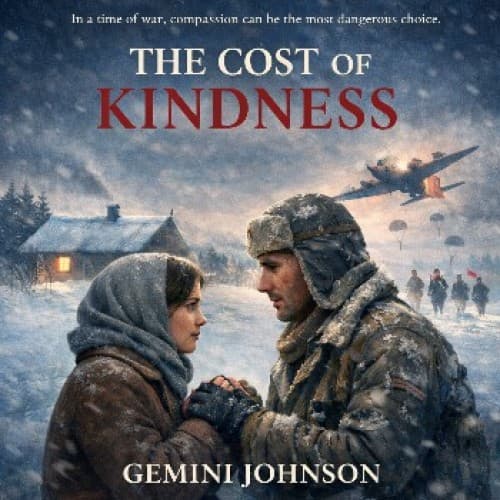

By February the cottage had learned him.
Not in the sentimental way a person might later tell it, but in the plain accumulation of small adjustments. His boots—borrowed from Yelena’s father and lined with wool cut from an old coat—stayed by the door now beside hers instead of under the bench where she had first shoved them. His cup had a place on the shelf. The extra spoon he had carved, clumsy but serviceable, hung from a nail near the stove. The narrow cot by the wall no longer looked like an improvised sickbed but like what it had become: where he slept.
The room still belonged to Yelena in every visible way. Her shawls hung from the pegs. Her mother’s old basin sat under the table. Her father’s tools lined the shelf above the woodbox. The patched curtain on the window was one she had sewn from flour sacks before Austin arrived. Nothing about the place forgot her claim on it.
But the cottage no longer held only one life.
Austin noticed this one morning when he rose before she did, stirred the coals into a new flame, and stood for a moment in the dimness waiting for the kettle to begin its quiet complaint. Outside, the sky was still black-blue, the snow hard as iron. He could hear one of the goats shifting and the faint restless cluck of the chickens before dawn. Behind him Yelena breathed evenly from the narrow bed in the loft space above, where she had moved back once his fever had broken and he no longer seemed likely to die every night.
He set the kettle on and reached automatically for the pail.
Only then did he realize how thoughtless the motion was, how much like habit.
For several seconds he stood there with the pail in hand, listening to the small sounds of the waking farm, and felt the shape of his own life altering under him in a way he did not know how to name.
Then Yelena’s voice came sleep-thick from the loft.
“No.”
He looked up. “Good morning to you too.”
She peered down over the edge, braid mussed loose over one shoulder, blanket wrapped around her like a shawl. Even half asleep she had heard the pail. “Ice,” she said, tapping two fingers against her thigh to indicate his healing leg. “Fall. Idiot.”
He leaned one shoulder against the wall and looked back at her. “I’m stronger.”
She considered that, then nodded once. “Still idiot.”
He laughed under his breath, and she disappeared again to dress.
That was how most mornings began now: with one of them objecting to the other.
It had become its own language.
The worst of his wounds were healing, but healing in winter was an untidy business.
The gash along his side closed more slowly than either of them liked. It no longer wept through the bandages each day, but if he overreached with the axe or twisted too quickly carrying wood, the scar reddened and pulled. The injury in his thigh knitted enough for him to walk without the obvious limp he had in the first weeks, though after a long day on the packed snow his muscles tightened until the old ache returned. He was thin from fever and from the flight before it, his face sharper than he remembered it being, the hollows under his cheekbones deepening in the mirror-bright window after dark.
Yelena inspected him with the same stern practicality she brought to split fence rails and temperamental goats.
No romance in it. No softness either, except the kind that hid inside competence.
Every few evenings she had him sit in the chair by the stove, lift the borrowed shirt, and hold still while she unwound the dressing at his side. She worked in silence except for the occasional instruction—turn, hold, wait—and Austin obeyed because he had long since understood that protest only wasted breath. The alcohol still stung. The ointment still smelled of herbs and fat. Her fingers were always cold at first touch and warmed as she worked.
One night, while she was packing fresh cloth against the scar, he said, “You missed your calling.”
She glanced up. “What?”
“Nurse. Medic. Doctor, maybe.”
She snorted softly, misunderstanding the last word but catching enough to know he was making some sort of compliment. “No.”
“Why not?”
She tied off the bandage with a little more force than was strictly necessary. “Goats,” she said, as if that settled the matter.
He smiled. “An excellent answer.”
When she finished, she reached past him for the shirt lying over the chair back. Her sleeve brushed his shoulder. The contact lasted no more than a second, but by now such things no longer made either of them start. They simply happened. An elbow at the stove, a hand at the small of the back when someone slipped on melted snow near the door, knees knocking under the table because the room was too small to prevent it.
Their bond, if it could be called that, had not grown from confessions or grand moments. It had grown from being cold in the same room. From dividing the last potato without discussing fairness. From carrying the same pail between them when the ice on the path made one set of feet uncertain. From seeing the other at their least guarded: him feverish, humiliated by weakness, waking from nightmares he could not always remember; her bone-tired after the evening chores, scarf slipping, face gray with smoke and fatigue, too weary even to pretend she was not.
Survival sanded people down. There was not much room left for performance after a while.
As the days passed, Austin learned the farm not as Yelena had learned it—through years and inheritance and the memory of other hands—but enough to be useful.
The goats came first because they were impossible to ignore.
There were six of them: the brown doe that had led Yelena to him in the birch grove, two white sisters with twisted little horns and a talent for shouldering open anything not latched properly, an elderly gray nanny who moved stiffly but head-butted with surprising vigor, and two young ones born the previous spring who still had more foolishness than sense. Yelena knew each animal by sound before sight. Austin at first could tell them only by color and disposition.
“This one,” he said one afternoon, pointing to the brown doe as it chewed determinedly on the frayed end of his scarf, “is a menace.”
Yelena, crouched in the straw checking a hoof for rot, did not look up. “Mila.”
“Mila?” He eyed the goat. “That can’t be right. That sounds affectionate.”
“Is name.”
“It ought to be Bandit.”
She sat back on her heels and considered the animal, which had by then gotten half his scarf in its mouth. “Bandit,” she repeated carefully in English, trying the strange shape of the word. Then she nodded. “Da. Good.”
So the brown goat became Bandit in their shared language, though Yelena still called her Mila when irritated.
The chickens were less distinct and more treacherous underfoot. Austin learned quickly not to step backward in the yard without looking. He learned how to scatter grain low and wide so the strongest hens did not rush the weakest from the feed. He learned that eggs gathered in deep cold held a ghost of warmth if taken early enough, and that Yelena always set the smallest aside first because they could be stretched into soup without being missed.
He learned the woodpile next.
At first she let him split only kindling while she worked the heavier rounds. He argued, not out of pride alone but because it offended him to watch a seventeen-year-old girl raise a full axe over her shoulder while he shaved slivers from pine. She listened to exactly none of it. The first time he stole the axe while she was inside fetching the basket, she came back to find him leaning on it, pale from the effort and one log barely opened.
She stood in the doorway looking at the scene.
“I did it,” he said, which sounded idiotic even to him.
“You did half,” she replied.
Then she took the axe from him, split the log cleanly in two with one hard stroke, and handed him the pieces to stack.
Humiliation would have been cleaner if he had not admired her for it.
Still, she relented by degrees. Once he could swing without reopening the wound, she let him take the smaller rounds. He learned the grain of their wood, the way frozen knots could turn a clean strike, the peculiar satisfaction of a log giving under steel. The work left his shoulders burning and his palms lined with blisters under the calluses, but he welcomed the ache. It was proof of substance returning to him.
Some days, when the weather held clear and the air snapped bright enough to hurt the lungs, they worked outside side by side in near silence. Yelena at the axe or the fence. Austin carrying split wood, checking the snares at the edge of the trees, hauling water in two pails now instead of one. Their breath smoked white. Snow squealed under their boots. Crows watched from the birches as if disappointed no one had died lately.
By the time they came in, cheeks raw from wind and mittens stiff with melt, the cottage felt almost tropical by comparison though the frost still thickened in the corners of the window.
Those returns inside began to matter to him more than he intended.
The shock of warmth. The smell of damp wool and ash. Yelena stooping to feed the stove while he unwrapped his scarf. The ordinary privacy of it. Not safety exactly—he had stopped trusting that word—but reprieve.
In another life he might have called it domestic. Here it was only the opposite of the war.
They learned each other’s histories in fragments no larger than what necessity and language would bear.
Sometimes Austin tried to tell stories because silence, though easier now, still sat heavy on him during the long evenings. He spoke more slowly than felt natural, stripping sentences down to pieces he thought she could understand.
“Ohio,” he said one night, drawing a rough shape with his fingertip in spilled flour on the table. “Farm. Corn. Pigs.”
Yelena leaned in, chin on her fist, following the movement of his finger. “Many pigs?”
“So many pigs,” he said solemnly. “Too many.”
This she understood in tone if not in vocabulary. Her mouth twitched.
He drew a tiny square for the house. Two smaller shapes beside it. “Mama. Sisters.”
She pointed to each shape and made him repeat the words until she had them.
Then she took the flour from him and drew a rectangle with a peaked roof and a little box for the stove. “Here,” she said. “Mama. Papa. Me.”
She added two stick goats outside.
He nodded, smiling. “An accurate census.”
“What?”
“Nothing. Good.” He pointed to the drawn goats. “Bandit?”
This time she laughed outright.
Sometimes the stories were not meant as stories at all. He would mention his father repairing wagon wheels in the mud and realize by the way she stilled over her mending that she was picturing it as if he had said church or harvest. She would mention her mother boiling linens during the fever year and say it with such flatness that only later, lying awake on his cot, would he understand the depth of what must sit beneath the words.
Once, while patching one of his socks with thread so fine it hardly looked strong enough to hold, she said, in careful halting English, “Before war… many people.”
He looked up from sharpening the small knife. “In the village?”
She nodded. “Children. Men. Women. Summer…” She searched for the word, made a little dancing gesture with her fingers in the air. “Music.”
The image hit him harder than any of the explicit losses had done. Music in this yard. Children where now only chickens scratched. Men mending things instead of disappearing into trucks and trains. A life crowded enough that a lone stranger in the woods would have become everyone’s problem instead of one girl’s.
He found himself asking, “What happened?”
She understood enough. Her shoulders lifted and fell. “War.”
That was all.
What answer could compete with it?
The language barrier became less wall than weather: still there, always affecting movement, but no longer preventing it.
Austin’s Russian improved because Yelena refused to simplify more than necessary. If he pointed vaguely at the salt, she named it and waited until he repeated it. If he asked with gestures where she was going, she answered with the actual word—well, shed, trapline, widow, wood—and made him catch up. She corrected his pronunciation without mercy and with mixed success.
One evening he pointed to the bucket of goat milk cooling near the stove and said confidently, “Molotko.”
Yelena, slicing onions, stopped dead. Then she turned very slowly and stared at him.
“What?”
She set down the knife and repeated carefully, “Mo-lo-ko.”
He frowned. “That’s what I said.”
“No.” She stepped closer, one finger raised like a schoolmistress. “Mo-lo-ko.”
He tried again. “Moloko.”
“Da.” Her finger lowered. “Before, you say hammer.”
He blinked. “I did not.”
She grabbed the wooden mallet from under the bench, held it up, and said, with maddening clarity, “Molotok.”
It took him a second. Then he groaned. “So I asked for a bucket of hammer.”
She folded her arms, victorious.
“And you didn’t stop me?”
“You talk many stupid things.”
That one needed no translation. He laughed until his side twinged, and she shook her head in theatrical disappointment before going back to the onions.
For her part, English came more slowly but lodged firmly once it did. She liked nouns best. Table. Window. Spoon. Bread. Weather. She had little use for the softer edges of the language, the filler that made ordinary speech flow. Austin would ask, “How are you?” and she would answer “Tired,” because what else was the phrase for?
Sometimes he taught her things for amusement more than necessity. Snowdrift. Porch. Orchard. Tin roof. Cornfield. She would repeat them under her breath as she worked, feeling out the foreignness.
Sometimes she surprised him by remembering everything.
He had once muttered, in half a daze from pain, that the kettle screamed like a church widow. Days later, when the lid rattled and steam whistled from the spout, Yelena glanced up and said carefully, “Widow kettle.”
He laughed so hard he had to sit down.
But the deepest understanding between them remained outside language altogether.
A tightening of her mouth when patrols might be on the road.
The look he got in his eyes if the wind rose at dusk and he found himself listening too hard for engines.
The way she always counted the hens twice if one failed to come in at dark.
The way he scanned the edge of the trees before crossing the yard, not because he expected anyone to be there, but because the habit had become part of his bones.
War taught recognitions of its own.
There were bad days.
The bond between them would mean nothing if everything softened too easily. Winter was too long, the room too small, the stakes too real for that.
Austin had one such day after trying to mend the outer fence beyond the goat pen.
The posts there had begun to shift under the freeze-thaw, and Yelena wanted them reinforced before the brown doe made another escape attempt. Austin insisted on helping. The work required stooping in deep snow, levering old wood upright, hammering crosspieces while balancing badly on packed ice. By the time they came inside his wound had started to pull hard under the bandage. He said nothing because pride is a more faithful injury than flesh.
At supper he barely ate.
Yelena watched him over the rim of her bowl. “Pain.”
It was not a question.
He shook his head.
She set down the spoon. “Liar.”
He should have laughed. Instead he snapped, “I said I’m fine.”
The English came too fast for her to catch all of it, but the tone hit cleanly enough.
She went very still.
The silence that followed was not the easy kind they had grown used to. It was a live thing, edged and waiting. Austin stared at the table, anger turning at once to shame. He had not meant to use his voice like that, had not even known the irritation had built so high in him. It was not truly about the fence or the bandage or the weakness. It was the old humiliating fury of dependence, surfacing at the wrong target because Yelena was near and safe enough to receive it.
Which made it uglier, not better.
Yelena stood, took both bowls, and turned toward the stove.
The movement—not dramatic, not wounded, simply practical—made him feel worse than if she had shouted back.
“Yelena,” he said.
She did not turn.
He forced himself upright despite the pull in his side and crossed the room slowly. Not because he meant to loom over her. There was no room in the cottage not to loom if you were a man his size and she was washing bowls at the stove.
“Sorry,” he said, touching his own chest, then inclining his head.
She scrubbed once more at the bowl before setting it down. “I know.”
The flatness of it undid him.
“I don’t—” He stopped, restarted more simply. “Pain. Angry. Not you.”
She looked at him then, face unreadable, dishcloth in one hand. “Da,” she said after a moment. “I know.”
He let out a breath.
Then, because she was not interested in letting him off entirely, she reached past him for the clean bandage cloth and added, “Still idiot.”
Relief came so abruptly he nearly laughed.
That night she changed his dressing with extra care and no extra gentleness. Their peace, restored, felt stronger for having bent without breaking.
Yelena had her own bad days, though hers were quieter.
Once a storm set in from the north and trapped them inside for two days while snow drove over the yard in white sheets. There was no proper work to be done beyond feeding the stove, checking that the animals still had enough hay, and keeping the door from freezing at the frame. Yelena grew restless in a way Austin had not seen before. She moved from task to task too quickly. Rewound thread already wound. Swept corners that were not dirty. Opened the grain sack twice to count what she already knew was left. By evening she had spoken almost nothing for hours.
Austin watched her from the stool by the stove.
“Come sit,” he said at last.
She ignored him.
“Yelena.”
“No.”
He looked toward the window where nothing could be seen but blown white. “Can’t milk the blizzard.”
She shot him a glare. The words probably did not all land, but enough of them did.
Then, unexpectedly, she sat. Not beside him, but across the table. Arms folded. Mouth set.
He did not try to pry. Instead he picked up the half-finished wooden spoon he had been carving and went back to work. After some time she reached for one of the socks needing mending and threaded the needle.
They worked like that in silence until her shoulders eased.
Only later, when she was banking the stove for the night, did she say, almost too softly to catch, “When storm… no road.”
He looked up.
“No road,” she repeated, then made a small helpless gesture with one hand. “No one.”
He understood.
The isolation that protected her also closed around her. In clear weather there were tracks, signs, the possibility of movement. In storms the world vanished entirely. If the roof came down, if she cut herself badly, if wolves came bold from hunger, if soldiers chose that day to stop—the snow would swallow evidence before help could think of the direction.
He had felt alone in the forest. She lived with another kind of alone, daily and without witness.
“Not no one,” he said.
She frowned at the double negative, then looked at him and understood the intended meaning anyway.
For a moment she only stood there with one hand on the stove handle.
Then she nodded once and said nothing more.
It was enough.
The weather softened slightly toward the end of February, though “softened” in that country only meant the cold no longer seemed eager to kill a man through wool. Some afternoons the sun held long enough to turn the snow surface to crust, and at the eaves a slow deliberate dripping began. Yelena noticed these things as practical markers: roof runoff, heavier paths to the well, slick ruts in the yard. Austin noticed them because they hinted at time moving forward.
Forward toward what, he did not yet know.
Leaving had not become a subject between them, but its outline now stood somewhere in the room with them. He could feel it whenever he tested his weight and found the leg stronger, whenever he took the pails alone from the well, whenever he split a full stack of wood without reopening the wound. The very skills that made him useful also made him less justifiable as a patient. And usefulness, once regained, carried obligation with it.
He tried not to think too far ahead.
So did Yelena, he suspected.
Instead they kept to the demands at hand.
One afternoon they went together to the trapline beyond the birches.
Yelena usually checked it alone, moving fast through the trees with the confidence of someone who knew every fallen branch by memory. This time she allowed Austin because his walking had grown steadier and because the last two checks had yielded rabbits enough to justify an extra pair of hands. The woods beyond the farm looked different when entered upright and healthy enough to notice them. Denser. More various. The birch bark peeled in pale curls. Spruce needles gave off a sharp resin smell where branches had broken under snow. Animal tracks stitched the drifts—fox, hare, something larger he could not identify.
“Wolf?” he asked, pointing to a broad print half filled with powder.
Yelena crouched beside it. “Old.” She touched the edge where the shape had softened. “Yesterday. Maybe.”
He looked into the trees with a soldier’s reflex, then laughed at himself. “Good to know.”
She had set three snares along a low run between brush and a fallen trunk. Two were empty. The third held a rabbit already dead, fur clean and white except for the blood at its neck. Yelena killed the motionless thing a second time with one efficient twist, then handed it to him by the hind legs.
“Dinner,” she said.
He took it. “I’ll tell it you said thank you.”
She glanced over her shoulder. “Tell rabbit?”
He nodded gravely. “Only polite.”
She shook her head and moved to reset the snare.
On the way back they walked close because the path through the trees narrowed. Once Austin slipped on a buried branch and caught himself against her shoulder. She staggered, then planted both feet and shoved him back upright with a muttered curse in Russian.
“Thank you,” he said.
“Big idiot,” she replied automatically.
But she did not pull away at once.
For one suspended moment they stood there in the birches, the rabbit hanging from Austin’s hand, both of them breathing hard little clouds into the cold.
Then she stepped free and kept walking.
The contact had meant nothing and something. That was becoming common between them.
At night Austin dreamed less often of the crash and more often of home, which he did not entirely trust as improvement.
In one dream his mother stood at the kitchen sink, sleeves rolled, while outside the windows snow lay shoulder-deep against the porch steps. He came in wearing the borrowed peasant shirt, and she turned as if this were the most natural thing in the world. Only when she opened her mouth, Yelena’s voice came out asking whether the goats had been watered.
He woke to the real cottage dim around him and laughed once under his breath at the absurdity.
From the loft Yelena’s sleepy voice said, “What?”
“Nothing,” he answered.
She was silent a moment. Then: “Bad dream?”
“Strange dream.”
“Better.”
He thought about that. “Yes,” he said finally. “Better.”
And that was true.
The war had taken enough from both of them that the fact of strange dreams replacing terrible ones felt almost like blessing.
By the time the moon thinned again and the month neared turning, the pattern of their shared life had become so ordinary within the cottage that the extraordinary fact of it sometimes vanished for hours at a time.
An American airman in hiding on an isolated Russian farm.
A seventeen-year-old girl sheltering him with no protection but distance, routine, and luck.
When Austin remembered the sentence whole, it struck him as impossible. Yet there they would be: Yelena cursing softly over a torn mitten, him trying to patch the hinge on the goat shed door; she measuring grain, him peeling potatoes too thick; both of them pausing at the same instant to listen when a distant engine growled on the road and passed without turning into the yard.
It was in those moments that the bond between them showed itself most plainly.
Not tenderness, not exactly. Not the softness of love stories. Something more stripped down than that. A reliance forged not from choosing the other in an open world, but from finding the world narrowed until the other person became part of how you crossed it.
He knew the weight of the pails now because he had watched her carry them every dawn.
She knew the rhythm of his bad nights by the way his breathing changed before he woke.
He knew which of her silences meant anger and which meant exhaustion.
She knew how much of his talk was for information and how much was to keep loneliness from thickening in the room.
He had begun taking the outer chores in the dark because she hated going beyond the shed before daylight.
She had begun leaving the knife and his papers on the table some evenings without putting them back on the high shelf.
Each act said the same thing in a different form:
I know your shape in this life.
I know what you can bear today.
I know what to watch for.
Neither would have called that love. Neither, perhaps, would have called it friendship in the ordinary sense. It was something winter made possible because winter demanded witness and labor before affection. Something war sharpened because war stripped the unnecessary away.
One evening, after a day of hauling water and repairing the chicken run, Austin sat by the stove rubbing warmth back into his hands while Yelena kneaded dough with both fists.
The room smelled of yeast, damp wool, and smoke.
Without looking up, she said in English, “Tomorrow… wood. More.”
He nodded. “More.”
A pause.
Then she added, “You strong now.”
The words were simple. The meaning under them was not.
He looked at her hands in the dough, the flour dust on her sleeves, the set of her shoulders.
“Yes,” he said after a moment. “Mostly.”
She nodded as if confirming something to herself.
He wanted to ask what came next. Wanted, perhaps, to ask whether she wanted him to stay a little longer or feared he already had. Wanted to know how many days a life like this could remain suspended before history found it again.
Instead he said, “I’ll get up early.”
This made sense within the grammar of the cottage, and so she accepted it.
“Da.”
Outside, the wind moved lightly through the birches. Inside, the dough rose by the stove, and the two of them went on with the ordinary work that had become, without either naming it, the truest thing between them.