


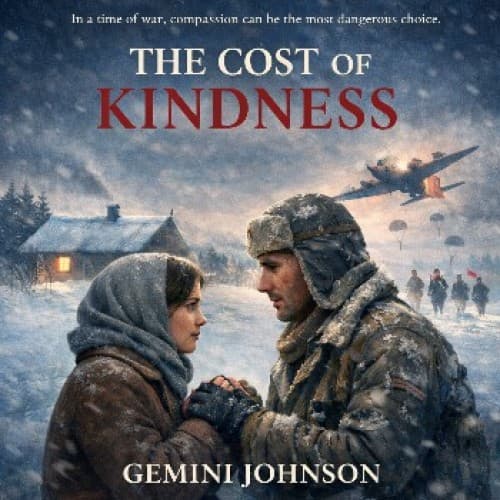

After the soldiers came, the cottage did not change at once.
That was the cruelest part.
The stove still needed feeding in the morning. The goats still complained before dawn. Snow still fell, softened, crusted, and melted at the edges of the yard. Yelena still swept the floor with the same stiff broom, still measured oats by hand, still folded cloths to dry by the stove. Austin still hauled water, split wood, checked the fence, and took his place at the table in the evenings with sore hands and damp boots.
The sameness might have been comforting if not for what sat beneath it.
The lie had made everything visible.
Before, Austin’s presence in the cottage had felt like an interruption that weather might extend indefinitely. Now every object connected to him seemed to carry a weight of consequence. His cup on the shelf. The knife marks on the repaired stool. The larger prints his boots left across the threshold when snow melted off them. Even the little wooden goat on the windowsill seemed suddenly dangerous, not because anyone would understand what it meant, but because Yelena and Austin did. It had been carved by a man who should not exist in this house.
Yelena moved through the days with the same steady hands, but Austin noticed how often she listened now.
Any engine on the road drew her head up. Any dog barking in the distance paused her in the middle of whatever she was doing. If the wind carried voices strangely from somewhere beyond the trees, she went still without seeming to. Her face did not change much, yet he had come to know the minute shifts in it too well to miss them. She no longer relaxed entirely, not even by the stove at night.
Austin could not blame her. He blamed himself instead, because blame had to settle somewhere.
On the third day after the search, he came in from the shed carrying a split rail and found her standing by the window, not looking out so much as listening through the frost-clouded glass. Her hand rested on the sill beside the little wooden goat. The room was warm. The road beyond the trees was empty. Still she stood like a person expecting the world to return in violence at any moment.
He set the rail down quietly.
“Yelena.”
She turned.
He had used her name often enough by now that the sound of it no longer startled either of them. But she recognized something in his face at once. He saw her understand before he had spoken.
“No,” she said.
He had not yet formed the words in Russian. He switched to English out of reflex, then checked himself and started again with care.
“I go,” he said, touching his chest. Then he pointed beyond the door, toward the road, toward anywhere that was not here. “Soon.”
She stared at him.
“No.”
This time not refusal exactly. More like a denial of fact, as if the thing he had said simply could not fit in the room with them.
He crossed slowly to the table. “Soldiers come once, they come again.”
She looked away first. To the stove. To the pail by the door. To anything but him.
“Maybe no.”
“Maybe yes.”
The words were blunt, their simplicity making them harder rather than easier.
She picked up the knife lying on the table and began slicing a potato that did not need slicing yet. The cuts came too fast, uneven.
Austin stood watching her hands. “Yelena.”
“No.” She set the knife down hard enough to nick the board. “No go.”
The force of it hit him unexpectedly. Not because she wanted him to stay as such. He had known, in some quiet corner of himself, that his leaving would matter to her. But hearing it said aloud in that bare, broken English made the thing feel solid in a way he had managed to avoid.
He leaned one hand against the table. “If I stay, they find me.”
She shook her head. “No.”
“They almost did.”
Her jaw tightened. He had seen that expression when she was angry at goats, at weather, at a snapped bucket handle. This was different. Anger reaching for somewhere to land and finding no decent place.
He tried again, more gently. “You saved me. Enough.”
At that she looked up.
The anger went out of her face, leaving something worse. Not grief. Not yet. Something like offense, as if he had reduced the last weeks to a debt tallied and nearly paid.
“Enough?” she said.
It was the longest word she had spoken in English all day, and she put into it everything she could not say in either language.
Austin felt the rebuke cleanly.
“No,” he said. “Not enough. I mean—” He stopped, raked a hand over his face, and began again with less pride. “I owe you life. But if I stay, I take yours.”
That she understood.
He saw it settle behind her eyes with the force of an old truth newly made impossible to ignore. The search had turned his presence from danger in theory to danger in practice. Each day after that was no longer shelter. It was gambling with her.
She sat down abruptly on the bench as if her knees had weakened under the thought.
The knife remained on the table between them. Outside, one of the goats bleated from the shed. The ordinary sound made the room seem cruel in its normalcy.
Austin pulled out the chair opposite her and sat.
For a long moment they did not speak.
He looked at her hands. Red at the knuckles. A new split near the thumb. Hands that had cleaned his blood, changed his bandages, hauled him upright when he could not stand. Hands that had lied for him to armed men.
When he finally spoke, his voice came out quieter than he intended.
“I should have gone sooner.”
She did not answer.
He had thought the same thing often in the last days, though the thought accused him more easily than it guided him. There had never been a clean moment to leave. Not while he was feverish. Not while he could barely cross the room. Not during the blizzard. Not before he knew how far the roads lay or what patrols moved through them. But the truth remained: his life had taken root here long enough to endanger hers.
Yelena’s eyes had dropped to the tabletop. “Roads bad,” she said at last.
It was not argument. Only fact.
“Yes.”
“Snow deep.”
“Yes.”
“You still hurt.” She touched her own side where his wound lay beneath the shirt. “Leg too.”
He almost smiled at the inventory. “Less.”
She gave him a look that dismissed his optimism on principle.
Then, after a pause: “Where go?”
He exhaled.
That was harder.
He had turned the question over in his own mind nightly without finding comfort in any answer. South, perhaps, toward larger roads, rail lines, someone in uniform who might know where American liaison officers moved through Soviet channels. West was a confusion of fronts and shifting lines. East meant only more distance. He knew names of places from maps and orders, but maps were one thing and a wounded man on foot in peasant clothes was another entirely.
Still, uncertainty was no excuse to remain.
He pointed vaguely southwest, because some direction had to be named. “Road. Town. Then soldiers.” He searched for the Russian. “Amerikanskiye. Maybe.”
She frowned. “Maybe.”
“Maybe.”
The word sat between them like a cracked board over deep water.
Yelena rose without warning and took the basin to the stove, though it did not need moving. Austin watched her back, the set of her shoulders under the worn dress. Her stillness had always been one of the things he trusted most. Now it seemed to him only another form of endurance.
By evening they had said no more about it.
But the decision had entered the cottage and could not be put out again.
The next days became a preparation neither named as such.
Austin mended what he could.
He spent a morning reinforcing the latch on the goat pen because Bandit had learned to nose it loose when hay ran low. He repaired the broken second rung of the ladder to the loft. He tightened the hinge on the grain chest so it would not sag open under weight. He split more wood than they could need in one week and stacked it under the lean-to in careful rows against the damp. When Yelena protested that enough was enough, he only shook his head and kept working.
These were not gifts. They were poor substitutions for presence. He knew that. But his hands needed to leave behind something useful or he thought he might go mad with the inadequacy of simply walking away.
Yelena prepared in her own fashion.
She dried extra bread by the stove and stored it in cloth. She rendered down the last of the rabbit fat and sealed it in a little tin. She fetched from somewhere in the loft an old wool scarf of her father’s, coarser but warmer than the one Austin had been using. She did all this without comment and without looking directly at him while doing it.
One night, after supper, she brought his papers down from the shelf.
They had remained hidden under the mattress since the search, but now she placed them on the table one by one with the careful respect of someone returning a man his identity. The folded documents. The dog tags. The photograph. The pistol, cleaned and wrapped. The knife.
Austin stared at them.
For weeks these things had been almost abstract. Remnants of another life left on a shelf while this smaller, harsher one swallowed his days. Seeing them all together again made departure seem abruptly real.
He touched the photograph first.
Yelena stood across from him, hands braced on the table’s edge. “Take.”
He looked up. “I will.”
The pistol came next. He checked it out of habit. The action worked. A little oil smell clung to it.
“You cleaned it.”
She shrugged, almost annoyed to be noticed for it. “Dust.”
He laughed softly. “Of course.”
Then his hand rested on the tags.
He had not worn them since the crash. Had nearly forgotten how cold metal felt against the skin. For a moment he only held them in his palm. Yelena watched his face, perhaps understanding the object mattered even if the stamped words on it did not.
“Home,” she said, touching the tags with one finger.
He nodded. “Something like that.”
She went to the stove and stirred the pot though there was nothing in it but hot water for washing. The movement gave him the privacy to slip the tags over his head. They settled against his chest beneath the shirt, their weight at once strange and familiar.
It felt less like reclaiming himself than like remembering who he had been before the forest.
The weather broke just enough to make leaving possible and miserable at once.
Snow no longer came every day, but the thaw had not truly begun either. The yard was a confusion of crust and slush, hard in the mornings, treacherous by afternoon. Ruts reopened in the road. Ice glazed the shaded parts of the path to the well. Water dripped from the eaves, then froze again in long clear daggers by dusk.
Austin chose the morning because it would be cold enough for firm footing and because he had already delayed two days beyond what he told himself was honorable.
He did not sleep much the night before.
The cottage held all its usual sounds: Yelena moving in the loft, the stove settling, one goat knocking lightly against the wall in its sleep. Yet everything had the quality of finality to him. The spoon hanging by the stove. The patched curtain. The wool sock drying on the chair back. He found himself committing them to memory in absurd detail, as if remembering could serve any purpose once he crossed the yard.
At dawn he rose quietly and dressed in the sheepskin coat, the felt boots, the scarf Yelena had set out folded on the bench. He tucked the pistol away under the coat, slid the knife into his boot, checked his papers again though there was no reason to. The cot behind him looked suddenly too narrow to have contained so much of his life.
When he turned, Yelena was already awake.
She stood near the stove feeding in kindling, her face made pale by the early light through the window. She had not braided her hair yet. It fell in a dark rope over one shoulder. For a moment neither of them spoke.
Then she held out a cloth bundle.
Food. Bread, a wedge of cheese, the little tin of fat, wrapped tight and tied with string.
He took it carefully. “Thank you.”
She nodded once. “Road long.”
He wanted to say more. Wanted to say that he would remember this place until memory failed him, that no debt in his life would exceed what he owed her, that if the world were decent he would someday repay her in ways neither of them could yet imagine. But all of that would have been selfish. Grand speeches belong to people who can afford them. They could not.
So he said the truth in the smallest possible shape.
“I wish…” He stopped, searched for a simpler route. “I wish not this.”
Her gaze flicked to him, held, then dropped to the stove again. “Da.”
He stood with the bundle in one hand and the useless fullness in his chest becoming hard to bear.
At last he moved toward the door.
The boards under his boots creaked in the usual places. The latch lifted in his hand. Cold touched the crack at the frame. He turned back then, because leaving without looking once more at her seemed impossible.
Yelena had not moved.
She stood where she was, one hand resting on the stove handle, the other hanging at her side. The cottage behind her glowed dim and ordinary: the table, the shelf, the little goat on the windowsill. Her face was composed to the point of severity, but he saw the strain in the way she held her mouth.
“Yelena,” he said.
She looked at him.
In the weeks they had spent under this roof, they had learned each other’s ways around pain and hunger and silence, but not how to end such a thing. There were no customs for it. No words in common broad enough to carry it.
He took one step back toward her, not all the way, only enough to close part of the distance. Then, with care that felt absurdly formal, he touched two fingers to his chest and inclined his head.
A soldier’s thanks. A son’s thanks. A man’s acknowledgment of a life owed.
Her throat moved as she swallowed. She nodded once in return.
That was all.
Austin opened the door and stepped out into the cold.
The yard looked different from this side of departure. Smaller. More vulnerable. Smoke went up from the chimney in a gray narrow thread. The birches beyond the fence were black against the morning snow. One of the goats called softly from the shed.
He pulled the scarf tighter and started toward the road.
Behind him the door remained open for exactly three heartbeats.
Then it closed.
Yelena stood with her hand still on the latch long after the sound of his steps had gone.
She did not go to the window.
She did not watch him cross the yard, or pass the birches, or vanish into the line where road and trees met. Watching would have turned departure into a thing with shape and sequence. A thing she might remember later too clearly. Better the closed door. Better the sound ending without witness.
The cottage altered at once.
Not dramatically. No wave of grief. No collapse. Simply subtraction.
One cup on the shelf too many.
One pair of boots gone from the door.
One cot no longer occupied.
One absence at the table that changed the whole balance of the room.
The stove ticked as the new log caught. Water in the kettle began to murmur. Outside, Bandit knocked against the pen gate, impatient for feed.
Yelena moved because movement was what remained.
She set out one bowl instead of two.
She folded the extra blanket and put it back in the chest.
She lifted the spoon he had carved and stood for a moment with it in her hand before hanging it again on the nail by the stove.
Only when she turned from the wall did she see that one tear had fallen onto the back of her knuckles.
She wiped it away at once.
There was work to do. There would always be work to do.
But for the first time since she had hauled a half-dead stranger from the snow, the cottage felt not only isolated, but empty.