


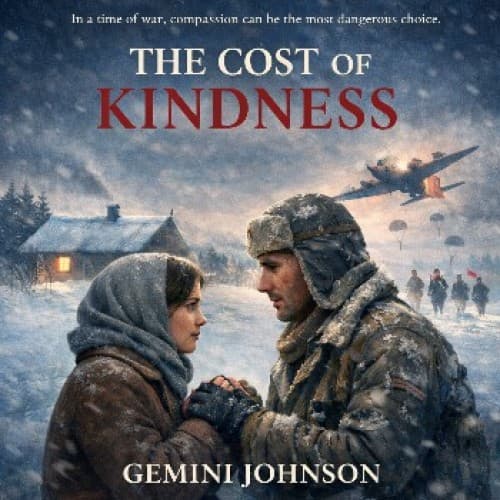

Austin woke to pain and the smell of smoke.
For several seconds he could not tell whether he had survived the wreck or simply carried its sensations with him into death. Heat pressed softly against one side of his body. His mouth tasted of iron and stale broth. Something hard supported the back of his head. Somewhere close by a log shifted in a stove with a hollow pop.
He opened his eyes.
The ceiling above him was low and crossed with rough wooden beams darkened by years of smoke. Light filtered through frost-clouded window glass in a dull blue strip. He turned his head and at once wished he had not. Pain tore along his side in a white, blinding line. He sucked in a breath between his teeth and lay still again, waiting for the room to stop tilting.
Not dead, then.
The realization came without comfort.
He remembered the snow. The clearing. Smoke rising through trees. Then fragments—warm liquid at his lips, a face in firelight, a young woman’s voice speaking a language he did not know well enough to follow. Safe, she had said. Or he had imagined it.
He lifted one hand from under the blanket and found it wrapped in a woolen glove with the fingertips cut away—someone else’s, not his. The blanket itself was thick and rough, smelling faintly of smoke, straw, and old wool. His own clothes were gone. In their place he wore a loose linen shirt, badly mended at one cuff, and beneath the blanket a pair of homespun drawers.
He let his head roll just enough to see the room.
It was small. A single main room with the stove at one end, a square table beneath the window, a shelf with crockery, hooks along the wall holding coats, dried herbs, and tools. Near the door sat a pair of felt boots caked with thawing snow. A goat bleated somewhere outside, answered by another farther off. The whole place smelled of wood smoke, damp wool, cabbage, and something sour but clean beneath it—lye soap, maybe.
A cottage. A farm cottage, by the look of it.
And seated at the table with a basket at her feet was the girl.
She wore the same shawl he half-remembered from the night before, though in daylight he could see it was more patched than woven. Dark hair had been braided this morning and wrapped at the back of her head, but the work had already started to come loose around her temples. Her dress was simple, homespun and faded, the cuffs darkened by use. She was peeling potatoes with quick, efficient motions, head bent, shoulders still and composed in a way that made him think of someone far older than she looked.
Seventeen, maybe. Eighteen at the most.
She sensed him watching and looked up at once.
Her face gave away little. Not surprise, not relief. Only attention.
“You wake,” she said.
Her English was rough but intelligible.
Austin swallowed and found his throat raw. “Looks that way.”
She set the knife down and came to the bed. Up close he could see what he had missed by firelight: not prettiness, though she had that in the ordinary way of healthy youth, but severity. A narrow, serious face weathered too early by cold and hard work. Hands red and chapped, with the small splits around the knuckles that came from washing and hauling water in winter. A person made practical by circumstances before she should have been.
She touched the back of her hand to his forehead.
No fuss. Just checking.
“Less hot,” she murmured to herself.
Then, more loudly, “Drink.”
She held a mug to him. Water this time, slightly warm. He tried to lever himself up and failed after an inch.
Her expression did not change. She slid one arm behind his shoulders as though this were merely another task in a long list of tasks and lifted enough for him to drink. Her strength surprised him. Not because she was large—she was not—but because there was no wasted motion in her. Everything she did seemed practiced by necessity.
He drank greedily until she pulled the mug back.
“No more,” she said.
“I appreciate the hospitality,” he muttered.
She frowned. “What?”
He let out a breath that almost became a laugh and regretted it immediately when his side protested. “Nothing. Thank you.”
That much she understood, or perhaps only the tone, because she dipped her head once and set the mug aside.
He looked toward the shelf above the stove and saw his pistol there, his knife beside it. Not stolen. Simply removed.
A sensible precaution.
“My things?” he asked, gesturing weakly.
She followed his gaze. “Safe.”
Again that word.
He nodded.
For a moment neither said anything. The silence in the room was not awkward exactly, but dense. He had woken in Soviet territory in a stranger’s cottage, half dead and unarmed, being tended by a farm girl who could barely speak his language and who had, for reasons he could not begin to understand, chosen not to turn him in. There ought to have been questions. There ought to have been suspicion. There ought, probably, to have been fear.
There was instead only her, standing beside the bed waiting to see if he would faint again.
He tried the most obvious thing first. “Austin.”
She pointed at him without quite smiling. “Da. Austin.”
Then to herself. “Yelena.”
This time he got her name closer. “Yeh-len-a.”
She corrected him immediately, sharper on the second syllable. “Ye-le-na.”
“Yelena.”
A faint softening crossed her face. Not a smile. But the nearest thing to one.
“Da.”
He lay back, exhausted already by the small exchange. “Well,” he said to the ceiling, “that’s one mystery solved.”
She caught only one word. “Mystery?”
He closed his eyes. “Never mind.”
The next days passed in fragments of fever, sleep, and the ordinary sounds of the cottage settling around him.
Morning announced itself first through chores. Always chores. The scrape of the door. The thud of boots on the plank floor. The gust of cold as Yelena went out before dawn wrapped in shawls and old coats, then returned with milk pails, wood, or eggs gathered against her apron. Chickens protested outside the wall near his bed. Goats stamped and snorted in the little lean-to or shed attached behind the main room. Once he woke to the wet sound of something being chopped and opened his eyes to see a rabbit hanging over a basin while Yelena worked a knife under its skin with methodical attention.
He would drift off again to the rhythm of it all.
When the fever was worst, English and memory came apart from each other. He woke once convinced he was back in the transport, hearing Bishop shout over engine noise. Another time he thought he saw his mother standing by the stove in her apron, though the figure turned and was Yelena carrying a bowl. He muttered nonsense, he knew that much by the strain on his throat afterward and the watchfulness in Yelena’s face when he surfaced.
On the fourth night he came fully awake into darkness and panic.
The room was black except for a reddish pulse from the stove door. Sweat chilled his neck. In the dream—if it had been a dream—the aircraft was still burning and Novak was pounding on the fuselage from inside, calling Austin’s name in a voice already gone muffled by smoke.
He jerked upright before his body could object and the movement tore the wound open enough that a bolt of pain ran through him. He bit back a cry, failed, and heard himself make a raw sound that was more animal than human.
At once there was movement in the dark.
A chair scraped. A lamp was struck. Yellow light bloomed low and uncertain.
Yelena was beside him almost before he understood she had been sleeping there at all, curled in the chair with a blanket over her legs. Her braid had come half undone. Her eyes were wide from sudden waking but not frightened.
“Quiet,” she said, and then, searching for words, “Bad dream.”
He was breathing too fast to answer.
She fetched the water and held it while he drank. Then she sat on the edge of the bed and pressed a cool cloth to the back of his neck until the pounding in his chest eased.
“Sorry,” he said at last, ashamed in the way a man is ashamed to be seen weak by anyone, let alone a stranger.
She frowned, not understanding.
“For waking you.”
Still nothing.
He made a little sleeping gesture with both hands under his cheek and then pointed to her, to the chair, and spread his own hand in apology.
Comprehension came. She shrugged as if to say it did not matter.
“Sleep,” she told him.
When she thought he had obeyed, she stayed sitting there a while longer, one hand resting lightly on the blanket near his wrist. Not touching him, exactly. Just near enough that he knew if the fever dragged him under again, someone was there to haul him back.
The realization struck him more deeply than he would have liked.
By the end of a week the fever broke.
Not dramatically. No sudden return from the dead. He simply woke one morning to find the world less distant and his thoughts no longer sliding away from him. The ache in his side remained sharp, but it belonged to the injury now rather than to some all-consuming sickness. Food held its taste again. The room stopped drifting in and out of shape. He could sit propped against the wall for short periods without feeling as if his bones were liquid.
Yelena marked the change without remarking on it.
She changed the bandage after breakfast, unwinding the cloth with careful fingers. Austin watched her face while she worked. Concentration brought a little crease between her brows. She leaned close to inspect the wound, then cleaned it with boiled water and vodka diluted just enough that it stung like hell anyway.
He hissed and grabbed the mattress ticking.
She glanced up. “Pain?”
“Only if I’m alive.”
She stared.
He gave up, panting a little from the effort of bearing it. “Yes. Pain.”
“Good.” She was already repacking the dressing. “Pain means not dead.”
He laughed despite himself, then winced because she was right.
That afternoon she brought him a bowl of kasha with goat’s milk and watched until he finished it.
When he handed the empty bowl back, he said, slowly, “Good.”
She understood. “Da.”
He pointed to the bowl, then to her. “Good.”
A pause.
Then, awkwardly, she pointed to the bowl and repeated, “Good.”
He nodded. “And—” He searched for a word simple enough to carry. He tapped his chest. “Thank you.”
This she had heard several times now. He could see her sifting through memory to connect sound and meaning. Finally she touched her own breastbone with two fingers and said, uncertainly, “Pozhaluysta.”
He blinked. “What does that mean?”
She shrugged. Then, slower, “It is… nothing. It is okay.”
“You’re welcome,” he guessed.
Her eyes lit with recognition. “Da. You welcome.”
He held up a hand. “No. You’re welcome. Means—” He pointed at her. “I say thank you. You say—you’re welcome.”
She took this in gravely, as if committing some technical fact to memory. “Your vel-come.”
“Close enough.”
She gave him a look that suggested she knew she had said it wrong and did not care.
Thus began the language between them.
It grew not by lessons but by repetition and need. Eat. Water. Hot. Cold. Sit. Sleep. Wood. Goat. Chicken. Pain. Bandage. Fire. Outside. Wait. Come. No. Yes.
Sometimes they pointed. Sometimes they acted things out. Sometimes one of them repeated a word until the other caught it, and both were so tired by then that the slightest mistake would tip them into laughter neither had intended. Once Austin spent nearly five minutes trying to explain spoon because he did not know the Russian word and she kept handing him a cup, then a bowl, then the ladle from the soup pot. Another time she wanted him to understand that the brown goat had a bad leg and mimed limping so earnestly across the floor that he nearly split his side laughing.
Her own laughter, when it came, startled him.
It was rare. Quick. Usually gone almost before it arrived. But it transformed her face entirely, stripping years from it.
He learned she did not waste words in Russian either. Or perhaps there was no one here to speak many to. The cottage held too much silence for that.
Once he could sit up for longer stretches, she allowed him his papers.
She brought them from the shelf wrapped in a clean cloth as though they, too, were recovering from illness.
The photograph had dried with a faint warp at one edge but survived. He stared at it longer than he meant to. His mother, standing stiffly because she always hated being photographed. Ruth and Evelyn on either side, trying not to grin. The porch behind them. Summer dresses. Trees in leaf.
When he looked up, Yelena was watching.
“Family,” he said, tapping the image.
She came closer. “Mama?”
He pointed. “Mama.”
Then to the girls. “Sisters.”
She repeated the word badly—“seesters”—and then, after a pause, touched the photograph at his mother’s shoulder. “Good?”
The question was simple enough. Alive? Well? Safe?
He considered lying for the sake of optimism, but lying seemed unnecessary here. “I don’t know.”
Her expression changed with immediate understanding. She nodded once, very slightly, and sat back on her heels. She did not ask more.
Later, without prompting, she pointed to the corner near the window where a small patch of wall was cleaner than the rest, as if something had once hung there. “Icon,” she said. “Before.”
He followed her gesture.
Then she pointed toward the yard, beyond the wall. “Mama.” A pause. Then to herself. “Papa.” Finally, after searching for the English: “War.”
He understood enough. Mother dead. Father gone to the front or lost to it.
“I’m sorry,” he said.
Again, the tone carried what the words might not. She lowered her eyes and began folding bandage cloth into neat squares, the conversation closed.
Strength returned in humiliating increments.
First he could swing his legs off the bed without blacking out. Then he could stand while Yelena steadied him by the elbow. The room swayed alarmingly the first time. His knees felt hollow. Sweat broke across his back under the borrowed shirt. He made it three steps to the table before the edges of his vision darkened and he had to sit.
Yelena said only, “Enough.”
He hated that she was right.
The next day he made it to the stove.
A day after that, to the door and back.
He had been a flyer, not an infantryman, but he had considered himself fit enough before the crash. Now a room the size of a kitchen was a campaign. His side pulled at every movement, and the scar on his thigh burned when he put too much weight on it. He found himself angry in odd, useless bursts—at the weakness, at the narrow bed, at the goat that kept poking its head in through the half-door to bleat at him while Yelena milked. The anger embarrassed him as soon as it flared. Yelena appeared to take none of it personally.
One morning, seeing him stare too long at the axe by the woodpile outside, she said, without looking up from kneading dough, “No.”
“I wasn’t planning to chop your whole forest down,” he muttered.
She did not understand the sentence. She understood the intention. “No,” she repeated more firmly, pointing at the bed, then at his side.
He opened his hands in surrender. “You are bossy.”
“What?”
He looked at her, deadpan. “Da.”
She narrowed her eyes as if certain she was being insulted. Which, in a way, she was. But the corner of her mouth twitched.
The next time she went out to haul water, he rose without permission and tried to carry in an armful of wood from the lean-to.
By the time she came back he had managed perhaps eight steps and stacked the logs in a lopsided pile by the stove. His breathing was ragged. One log had rolled and knocked over the broom.
Yelena set the pails down with a thump and stood looking at him.
He knew that look from schoolmasters and sergeants.
“I did it,” he said, which was not the defense he had intended but the only one his face could seem to manage.
“You stupid,” she replied.
Then she crossed the room, straightened the pile, and handed him the back of a chair before his legs gave out.
After that she let him help in smaller ways.
Shelling dried peas. Peeling potatoes. Holding cloth while she tore strips for bandages. Mending a broken handle on the grain scoop with nails and a little patience. He did these seated at the table, under her eye, like an overgrown child being trusted with tools only so long as he did not overreach.
He did not mind as much as he expected to.
Work, even useless work, made him feel less like a burden. And Yelena’s company, though spare, came easiest when they were side by side at some task. Speech was less necessary then. He learned her rhythms. She hummed under her breath sometimes without seeming to know she did it. She counted eggs almost soundlessly, lips moving. When thinking hard she pressed the tip of her tongue briefly to her upper lip. She never sat idle if she could help it. Even during the evening hour by the stove she mended, sorted beans, patched gloves, twisted rope, or sharpened tools.
It occurred to him after some time that she had probably spent months, perhaps years, like this with only animals and the occasional passing villager for company.
No wonder silence fit her so well.
The weather held them together as much as any moral choice.
Several times snow came in thick enough that even had Austin been well, leaving would have meant getting lost again before reaching anything useful. Once wind drove so hard across the clearing that powder hissed at the window all day and froze in the corners of the frame. The cottage creaked under it like a ship. Yelena stuffed rags under the door and along the sill and said one Russian word over and over as if cursing the storm by name.
“Metel?” Austin tried.
She looked up from the stove. “Metel. Blizzard.”
He repeated it. “Blizzard.”
“Da.”
There was satisfaction in exchanging even that much.
In the evenings, when chores were done and darkness pinned the world shut outside, they sat by the stove with the lamp turned low to save kerosene.
Austin carved sometimes with his knife, which she had finally returned to him once he could be trusted not to keel over while using it. Mostly he shaved useless curls from little pieces of wood until, gradually, shapes began to emerge: a spoon handle, the body of a bird, a tiny goat with uneven legs that made Yelena snort when he presented it to her.
“For your difficult friend,” he said, holding it up.
She took the carving, turned it over in her hand, and after a moment placed it carefully on the windowsill.
The honor of that tiny gesture touched him more than praise might have.
In return she taught him words by pointing. Window. Table. Spoon. Fire. Hand. Bread. Snow.
He taught her bread, spoon, chair, sorry, and hungry, though hungry she seemed to learn less from curiosity than from daily fact.
Food was always enough, but never so much that either of them forgot it could run short. Broth stretched farther than meat. Potatoes bulked out everything. Black bread was rationed by instinct even here, cut thin and chewed slowly. Once she brought in a rabbit from the traps and made a stew rich enough to scent the whole room. He watched her skim grease from the top and save it in a tin without comment.
She caught him looking and said, “Later.”
“Nothing wasted,” he said.
She understood enough of it to nod.
Nothing wasted. Not grease. Not cloth. Not wood ash. Not daylight. Not words.
The same might have been said of tenderness in that place. There was little room for it unless it served something. And yet it appeared anyway, disguised as practicality. The extra blanket she laid over his legs when the wind rose. The way he began lifting the heavier pails once he could manage the yard, so she would not have to make two trips. The cup of hot milk she set at his elbow without speaking when she noticed he had gone quiet from pain. The stool he repaired because one leg had been wobbling since before he arrived, though she had long since adapted to it.
Neither of them named such things.
They simply accumulated between them.
One afternoon, perhaps three weeks after he had first opened his eyes in the cottage, Austin stood long enough at the window to see the world beyond mere survival.
The clearing lay white and still under a pale wash of sun. Snow had drifted high against the fence. Beyond it the birches stood with their black scars and paper bark, and farther yet the pines marked the edge of the forest from which he had emerged as if spat out by winter itself. Thin smoke rose from the chimney and trailed low. A crow lifted from the shed roof and crossed the yard in silence.
“It’s beautiful,” he said before he could stop himself.
Yelena, sorting onions at the table, looked up. “What?”
He pointed out the window. “Beautiful.”
She followed his gaze and seemed genuinely puzzled by the statement. There was only the yard, the sheds, the fence, the same cold expanse she walked daily with buckets and feed and rope.
“Snow,” she said.
“Yes,” he answered. “Snow.”
She looked back at him as if trying to understand what a man had to go through before he saw snow and meant beauty instead of work. In the end she shook her head and went back to her onions.
But that night, when the wind dropped and the sky cleared enough to show stars, she opened the door after supper and stood looking out a little longer than was necessary.
Austin watched from the table and said nothing.
Trust, when it came, did not arrive in one moment.
It settled the way frost did: gradually, layer upon layer, until one day he realized he had stopped reaching automatically toward where the pistol should have been whenever the door opened. Realized, too, that she no longer watched his hands first whenever she set the knife near him or left the room.
She still barred the door at night.
She still kept his papers bundled and high on the shelf unless he asked for them.
She still did not tell him much about what lay beyond the clearing, about nearby villages or roads or patrols. Whether this was caution or merely the limits of shared language he could not tell. Likely both.
But once, when he woke from an afternoon sleep to find the cottage empty, there was no spike of alarm. Only the steady assurance that she would come back because this was her place and because she had, thus far, always come back.
She did, moments later, carrying a basket of eggs and a coil of wire.
Seeing him awake, she held up the basket. “Three.”
“Three eggs?”
“Da.”
He leaned toward it. “That’s almost a banquet.”
She frowned. “Ban…?”
He took one egg gently between thumb and forefinger, held it up like treasure, and said with exaggerated solemnity, “Very important.”
This she understood. A laugh escaped her, brief and bright, and for the second time since he had known her he thought with a pang how young she truly was under all the hardness.
It was perhaps because of that laugh, or because the day had been clearer than most, or because the room for one hour felt almost outside the war, that he said what he had been thinking for some time.
“You shouldn’t be alone out here.”
He said it softly, more to himself than to her.
But she heard the tone if not all the words.
“Alone,” she repeated, then nodded once. “Da.”
No self-pity. No elaboration. Simply fact.
He looked at the shelf with the bowls, the patched curtains, the little goat carving on the sill, the boots by the stove.
The cottage had held him together for weeks now. To her it was not refuge. It was labor, weather, and endurance. The difference in that struck him hard enough that he had to look away.
Outside, snow slid from the roof in a heavy muffled sheet.
Inside, Yelena cracked one of the precious eggs into a pan, and the smell of it filled the room like a promise too small to trust.