


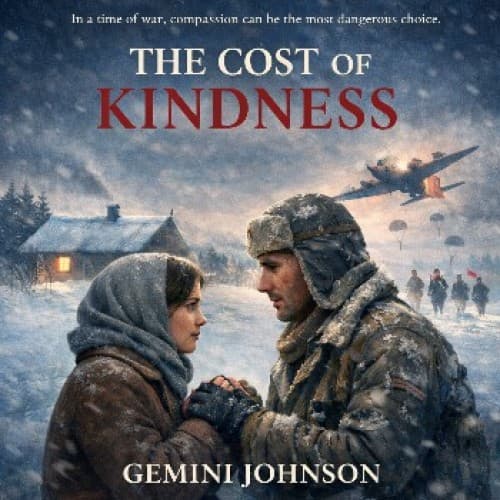

The cold in northern Russia was not the kind that merely numbed a man.
It judged him.
It measured the thinness of his coat, the wetness of his boots, the sharpness of the wind against the opening at his collar. It found every weakness and entered there first. Hands went before feet. Feet before the nose. The ears burned, then vanished. Thought itself slowed under it. The body became clumsy and resentful, and the mind—if a man was alone long enough—began to tell him lies. That he was warm when he was not. That he ought to sit down for a moment. That the snow would make a fine bed.
Second Lieutenant Austin Graves had seen cold before. Ohio had winters. The Army Air Forces had given him more than enough of them besides. He had flown through weather that made the wings shake and the engine note flatten into something ugly and unnatural. He had watched ice creep across a windshield in white fern patterns while men in headsets cursed and checked gauges with stiff hands. He had thought, more than once, that he understood cold.
He had not understood this.
This was something older and emptier.
It was late afternoon, though the light had already begun to fail in the forest. The trees stood close here—spruce and fir, rank on rank, their dark needles burdened with snow. What had once been a road, or perhaps merely a logging track, had disappeared beneath drifts and wind-packed ridges. Austin had lost it an hour ago. Maybe more. Time had become slippery since the landing. He could not keep his thoughts lined up long enough to count properly.
He stumbled over a root hidden under the snow and caught himself on one knee.
Pain flashed through his side so sharply it stole his breath.
For a moment he stayed there, bent over, one gloved hand pressed against the torn fabric below his ribs. The dressing he had tied there himself—if one could call it a dressing—was useless now. Blood had frozen into the cloth hours ago. Every step since had worked the wound open again. He could feel the wetness, hot at first and then chilling as soon as it met the air.
He swallowed against the taste of metal in the back of his mouth and forced himself upright.
The forest did not care.
Nothing in it shifted except the snow blown in thin veils across the ground. He listened for engines, for voices, for anything. All he heard was wind moving through the trees and, very far away, a low muttering that might have been artillery or thunder or only his own blood in his ears.
He had gone over the sequence so many times already that it had begun to lose shape.
The flight out of Fairbanks had been hard but manageable. The route westward and then onward through the Soviet transit chain had never been a thing any of the men liked speaking about plainly. The arrangement itself felt strange: American aircraft, American crews in stages, Soviet territory stretching out below them, official cooperation wrapped around an undercurrent of mutual suspicion. Austin had not been important enough to care much about politics. Important enough, however, to fly where he was told and keep his mouth shut.
By the time the weather turned, they had already been arguing over ice.
One engine had begun to run rough. Then another instrument had started acting up. Then visibility had gone to hell. There had been shouting in the cockpit, hard clipped orders, and the kind of silence that came afterward when everybody aboard knew they were past the point of good options.
He remembered the impact in pieces.
A violent skid.
Metal screaming.
The smell of fuel.
Someone behind him crying out once and then not again.
After that there was fire somewhere off to the left, and snow blowing in through torn metal, and men trying to drag themselves free while the world leaned at a wrong angle. He remembered unbuckling. Falling. Crawling. The sound of ammunition cooking off somewhere in the wreck. He remembered faces, though he could no longer be sure whether he had truly seen them or only carried them with him afterward. Bishop, with his front tooth chipped and always talking too loud. Ellis, who smoked like a chimney and wrote letters home in tiny careful script. Novak, who had sworn they would all get drunk together the next time they saw a real town.
Austin had shouted until his voice went ragged.
No answer had come back except the crackle of fire and the groan of cooling metal.
He had taken what he could in the confusion—a pistol, his knife, a canteen, some emergency rations, his gloves—and then the fire had spread enough that staying there meant dying quickly instead of slowly. The horizon had been gray. Snow had begun again. There had been tracks at first, though whether they were from a road or only dragged wreckage he no longer knew. He had chosen a direction because a man had to choose something.
That had been yesterday.
Or this morning.
Or all his life.
He took another step. Then another.
His left boot had rubbed raw at the heel until each stride felt like walking on exposed flesh. His shoulders ached from hunching against the wind. The world had narrowed until it consisted only of the next tree and the next patch of white ground beyond it. Once or twice he thought he saw movement among the branches—a figure, perhaps, or a line of fence posts—but when he blinked there was nothing there.
He was beginning to understand, with a distant kind of clarity, that he might die stupidly.
Not in the air, not cleanly, not in the hot violence of impact, but here—walking in circles through some nameless stretch of Soviet forest until he sat down for one minute too long and never stood again. His mother would get a letter months later if she got anything at all. It would say missing or presumed dead, and that would be the end of him in official terms. Twenty-two years reduced to a typed line and a signature.
He almost laughed, but it hurt too much.
He came into a clearing without realizing at first that the trees had thinned. The sky opened above him, gray-white and empty. Snow lay flatter here, interrupted by a line of low brush and what looked like the black humps of sheds or hayricks half buried at the far side. He squinted, willing the shapes to stay where they were.
Then his knees gave out.
He hit the ground hard enough that the breath left him in a grunt. Snow pushed up under his sleeves and collar in a freezing flood. For a second he lay flat on his back staring at the sky, unable to move. Flakes drifted down through the stillness, tiny and dry. One landed on his lashes and melted there.
This, his body told him, was better.
Rest.
Just for a minute.
He knew the trick in it. He had heard the warnings. Men who froze often felt comfort before the end, an easing, a softness. The body lying to itself so it could stop fighting.
With effort that seemed absurdly large for the task, he rolled onto one side and shoved a hand into his coat. His fingers fumbled against paper, against the little pencil he had kept tucked in a pocket ever since leaving home. He managed to drag both out, though the pencil slipped once and had to be clawed from the snow.
The paper had been folded and unfolded too many times. It was soft along the creases. He smoothed it on the snow with the heel of his palm and bent over it, breathing hard.
Mom,
He stopped there.
His hand shook so badly he could barely see the word. Ink would have frozen. The pencil barely marked. What was he meant to say now? That he was sorry? That he had done his best? That he had thought about home more in the last twelve hours than in the twelve months before them?
The Ohio farm rose in his mind with the cruel sharpness of fever memory. Mud in spring. Corn standing tall in late summer. His father bent over an axle with sleeves rolled. His mother at the stove with flour on her forearms. The kitchen windows steamed in winter. You could hear the screen door slap in the evening when his sisters came in from the yard. Ordinary things. Useless things to remember here.
His fingers slackened.
The pencil dropped from his hand and disappeared in the snow.
A smell reached him then.
At first he thought it was the wreck burning again, some delayed ribbon of smoke carried on the wind. But this was wrong for that. Softer. Familiar.
Wood smoke.
Not oil or fuel or the bitter chemical scent of burning metal. Oak, maybe, or pine. And beneath it, faint as a memory, another smell—vegetables, broth, something cooked low and long.
Austin lifted his head.
Beyond a stand of birches at the edge of the clearing, something trailed into the sky in a narrow gray line.
Smoke.
A chimney.
He stared at it as if staring hard enough might keep it from dissolving. Then he tried to push himself up and nearly blacked out from the effort. His vision tunneled. The trees darkened at the edges.
Warmth, he thought dimly.
Not safety. He was too worn for that word. Only warmth.
He got one knee under himself, then another, and managed perhaps three dragging steps before the world slid away.
The snow received him without comment.
Yelena Ivanovna Petrovna had been alone long enough to know the different sounds of the farm.
A goat’s cry when it was hungry was not the same as when it was caught. Chickens made one kind of noise for feed and another for a hawk overhead. Snow slid from the roof with a soft, heavy collapse. Water beginning to thaw in the bucket at dawn made a delicate cracking sound around the edges. The wind itself had moods. Coming from the east it whistled under the eaves. From the north it seemed to press flat against the walls and listen.
That afternoon, one of the goats was missing.
It was the smallest brown doe, stubborn and clever enough to nose loose any latch Yelena failed to tie properly. She had gone out after the midday feeding to fetch more split wood from the lean-to and found the pen door half-open and the little tracks wandering toward the birch grove. She stood for a moment in the yard with the armful of wood pressed against her hip and watched the wind lifting powder from the drifts.
“Idiot animal,” she muttered.
She set the wood inside, took the rope from its peg near the door, wrapped her scarf another turn around her neck, and headed into the trees.
The farm sat alone at the edge of what had once been a small settlement and was now, in truth, little more than scattered memory. Three cottages stood within walking distance if a person could call it that in winter, though only one was occupied with any regularity, and even that only by an old widow who lived with a grandson too young for the draft and too weak for useful work. Before the war there had been more people. Before the war there had been laughter now and then on the road, wagons in spring, men cursing over fences, children running with red noses in the first snow.
Now the road carried mostly soldiers and rumors.
Yelena had stopped expecting either to bring anything good.
She found the goat tracks easily. The animal had broken through the crust in a hopping, indecisive line and then circled twice among the birches where low twigs still poked through the snow. Yelena followed, boots sinking to the ankle, one mittened hand parting thin branches as she went. Her cheeks stung from the cold. A strand of hair worked free under her scarf and froze almost at once where her breath touched it.
The goat stood not twenty paces ahead, gnawing bark from a young sapling and looking entirely untroubled by the inconvenience it had caused.
Yelena opened her mouth to curse it.
Then she saw the shape in the snow beyond it.
At first it was only an interruption in the white, dark and awkwardly human. Her whole body went still. The rope slid from her shoulder into her hand.
There were bodies in winter. Less often now than the year before, but still. Stragglers. Men separated from units. Prisoners. Sometimes civilians who had taken the wrong road too late in the day. You learned to judge from a distance first. Uniform or coat? Boots worth stealing? Wolf sign nearby? Danger, always, before pity.
She approached slowly.
The man lay half on his side, one arm flung out, snow drifted across his shoulder and the back of his head. There was blood at his coat, dark and thick, and his face—when she crouched carefully near enough to see it—was pale under a crust of frost. A strange face. Foreign in a way that was not only language or haircut but the shape of the nose, the set of the jaw, the cloth of the uniform itself.
She noticed the patch on the sleeve next. Not Soviet. Not German either.
American.
The word came to her not because she had met one, but because she had seen photographs once in an old paper brought through the village by a railway man. Smiling airmen beside aircraft. Leather jackets. Clean faces. Men from some place so far away it might as well have been another century.
This one looked little like those photographs now.
His lips were blue at the edges. Frost had settled in his brows. But when she leaned in and set two fingers against the side of his throat, there it was: a pulse.
Weak. Threadlike.
Alive.
Yelena sat back on her heels.
The goat, forgotten, wandered off a few paces and began nosing at the snow again.
The forest around them was silent enough that she could hear the man’s breathing when the wind fell. Harsh, uneven, with a little catch in it. Not long for the world if he stayed where he was.
She looked toward the farm.
The cottage roof showed through the trees in a smudge of white. Smoke went up from the chimney, because she had banked the stove before coming out. Inside were her father’s tools, the two good blankets, the last of the dried mushrooms hanging by the stove, the little tin of ointment she had not yet used up. Inside was heat, such as it was. Safety, not exactly, but shelter.
She looked back at the man.
If she brought him in and anyone learned of it, she would be asked questions she could not answer safely. Why had she not reported him at once? How long had he been there? Had he spoken? What had he told her? A lone girl on a small farm was already expected to know when to keep her head down. War made that more necessary, not less.
If she left him, he would die.
That was plain enough too.
Yelena stood. She had never in her life felt dramatic about anything, and she felt none now. Only a hard, practical irritation, as if the war itself had chosen to drop one more burden in her path and expected her to carry it because there was no one else.
“Stay dead, then,” she said to the unconscious man, not because she meant it but because the anger gave her strength.
She turned and trudged back toward the farm for the sled.
Dragging it through the snow was bad enough. Getting him onto it was worse.
He was taller than her by nearly a head and solidly built even in his weakened state. Dead weight, her father used to say, was different from wood or sacks because it did not cooperate. This half-dead weight cooperated no better. Yelena hooked her hands under his shoulders and managed to lift him only an inch before her boots slipped. She fell backward into the snow with him partly across her knees and swore aloud.
The second attempt went better. She used the blanket from the sled as leverage, rolling him by degrees, gritting her teeth each time he groaned. Once he opened his eyes—a startling pale blue under the frost—and looked straight at her without seeing her.
Then they closed again.
By the time she had him arranged on the sled and the blanket pulled over him, she was panting hard enough to taste iron in her throat. She tied the rope around her wrist, braced both feet, and started back.
The sled fought her every step.
Snow packed under the runners. The path through the birches dipped and rose where roots lay hidden. Twice she had to stop and lean over with her hands on her thighs, breathing steam into the cold. The goat followed for half the distance, then lost interest and wandered off toward home on its own.
At the yard she paused only long enough to shove the cottage door open with her shoulder.
Warm air met her face in a weak but welcome rush.
Inside, the room looked exactly as she had left it: table by the window, stove breathing heat, boots drying upside down near the wall, a pot with yesterday’s cabbage water congealing into something gray on the back of the stove. The ordinary sight of it sharpened the strangeness of the man on her sled. Foreign cloth. Foreign boots. Foreign face. War dragged straight over her threshold.
She hauled him inside.
Snow melted off him in patches onto the plank floor. She kicked the door shut behind them and stood for a moment gathering herself, her hands on her hips, chest heaving. Then she fetched the kitchen knife.
Not to threaten him. He was hardly a threat in this state.
To cut him free of the frozen layers.
His outer coat came first, stiff with ice and blood. Then the rest by degrees, the knife sawing through cloth gone rigid with cold. She worked quickly because she knew enough to know that if he stayed wet he would not live through the evening. Under the torn outer layers his body was shockingly warm in places and cold in others. Fever and freezing at once. There was a wound at his side, jagged and ugly, not the neat little puncture of a bullet she had once seen in a soldier’s hand but a tearing injury with dark clotted blood all around it. Metal, perhaps. Shrapnel. Another cut crossed his thigh. Bruises flowered under the skin along his ribs.
He had scars too, older ones, silver and white near the shoulder and a thicker roped line near the knee.
She noticed these things because she was looking for what might kill him first.
The pistol she found at his hip went onto the shelf over the stove. The knife went beside it. In one breast pocket she found folded papers she could not read, a photograph gone damp at the edges, and the pencil she later set near the window to dry. The photograph she did not look at long. A woman and two girls standing in front of a porch. Family, likely. The sort of thing a man carried because he expected to be far from home longer than was decent.
She laid it back with his papers.
Water. Cloth. Spirits.
Her hands moved because if they stopped she would begin to think, and thinking would only ask questions that had no use yet.
She heated water until it steamed. She washed blood and dirt from the wound as gently as she could. He woke once during this and made a noise through clenched teeth, then drifted again. She had no proper medical kit, only remnants of what had been kept for her mother’s fever and a few supplies traded from passing soldiers in better times. Clean cloth. Needle. Thread. Ointment. A little vodka. A little lard. The sort of medicine country people made do with because there was nothing else.
The smell of the wound made her stomach tighten. Not rotten yet, but close enough that she knew infection would be the next battle if cold did not finish him first.
“Stupid,” she muttered, though whether at him or the war or herself she could not have said.
She packed the side wound. Bound it tight. Cleaned the cut on the thigh. Forced a little water between his lips when he stirred enough to swallow. Then she stripped the extra blanket from her own bed and spread both blankets over him where he lay on her father’s narrow cot near the stove.
Only after all that did she notice her hands were shaking.
The cottage had gone dark beyond the reach of the fire and the small lamp. Outside, the evening drew down with the blank certainty of winter. Chores still waited. Goats did not care whether a foreigner bled out in your bed. Chickens needed shutting in. Water would freeze if left.
Yelena stood looking at the man one moment longer.
Without the uniform he seemed younger somehow. Not a boy, no, but still young. Too young to look as worn as he did. His face in repose had a tiredness to it that no sleep would mend fully. One of his hands lay open on the blanket, palm up, fingers slightly curled. Broad hand. Workman’s hand as much as a pilot’s.
She looked away.
The farm first. Then whatever came next.
She pulled on her mittens again and went back into the cold.
By the time the chores were done, night had settled completely.
The stars were hidden. Snow thickened in the dark. The yard glowed faintly with what little light spilled from the cottage window. Yelena carried in the last bucket, kicked the snow from her boots, and shut the door with her hip.
Heat wrapped around her in a drafty, imperfect way that still felt almost luxurious after the yard.
The man had not moved much. His breathing was louder now in the quiet room, sometimes fast, sometimes shallow. Fever had reddened his cheeks. The hair at his temples was damp with sweat. Yelena took off her scarf and laid the back of her hand against his forehead.
Hot.
She set cabbage broth on the stove and added a little onion, the last carrot from the cellar, and more water than she wanted to. Enough to stretch it. Enough to make it smell better than it truly was. While it heated she sat on the stool by the bed with her sewing basket in her lap and mended one of her wool socks by lamplight, though she did not make much progress. Every few minutes her eyes went back to him.
Outside, wind worried the walls.
Inside, the foreigner muttered now and then in his sleep. The words meant nothing to her. Once he said something with such urgency that she looked up sharply, needle suspended in her hand, certain he must have woken. But his eyes stayed closed. The fever was talking for him.
When the broth was ready she poured some into a chipped bowl and waited for it to cool.
At last he made a different sound. A rough groan dragged from deep in the chest. His head turned on the pillow. One hand twitched at the blanket.
Yelena set the sewing aside.
She slid an arm behind his shoulders and lifted him carefully. He was heavier warm than cold. His head lolled briefly against her shoulder before he fought his way halfway back to consciousness with the stubbornness of the very ill.
His eyes opened.
For one wild instant he jerked, trying to come upright. Pain stopped him. So did weakness. His right hand went automatically toward his side where the pistol should have been. Found nothing.
His gaze fixed on Yelena.
Fear first. Confusion after. Then the rapid inventory of a soldier waking in an unknown room.
She held the bowl where he could smell it.
“Quiet,” she said. “Eat.”
He stared.
Then the smell reached him and overrode whatever else he had meant to do. His lips parted. She tipped the bowl slowly. He swallowed like a man remembering what food was. A little broth spilled down his chin. He drank again, slower now, eyes never leaving her face.
Close up, his irises really were that pale—washed-out blue, almost gray in the firelight. Strange eyes for such a tired face.
When the bowl was empty he sagged back against her arm.
“Safe,” she said, because it was the only English word she was sure of.
He blinked once. Looked around. The room must have told him enough: peasant cottage, no barracks, no officers, no immediate threat.
“Safe,” he repeated, his voice no more than a scrape.
Then, after a pause, he tapped his own chest weakly.
“Austin.”
His accent rounded the name strangely in her ears.
She understood the gesture. Tapped her own chest.
“Yelena.”
He tried it back and got it wrong.
Not badly. Just wrong enough that, under other circumstances, she might have smiled.
Instead she took the bowl from his hand and said, “Sleep.”
He did.
Yelena sat awake by the stove long after, listening to the foreigner breathe and the wind move over the roof, while the war waited outside the walls for morning.
That was the first night.
And by dawn, though she did not yet know it, the course of both their lives had already shifted.