


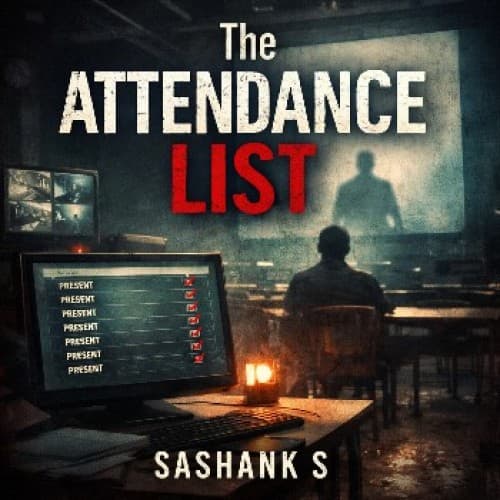
Morning came like nothing had happened.
Sunlight fell across the college gates, students walked in laughing, vendors shouted for chai orders, and bikes clogged the entrance road like every other weekday.
Arjun stood outside Block C with hollow eyes.
Yellow police tape hung loosely across the doors — not tight, not serious, almost symbolic. Two officers spoke casually to a group of curious students, their expressions bored rather than alarmed.
Nisha wrapped her arms around herself. “Tell them again,” she whispered. “Tell them everything.”
Arjun nodded and approached the officer.
“There was a death last night,” he said, voice shaking. “Power outages, locked rooms, automated systems — we were trapped.”
The officer barely looked up from his notebook. “No power outages recorded,” he said flatly. “Electricity board confirmed normal supply.”
Meera stepped forward. “We saw orientation videos. Behavioral monitoring. Emotional scoring. There were recordings — files everywhere.”
The officer exchanged a glance with his partner.
“College administration has confirmed there is no such program,” he replied calmly. “Block C has been unused for years.”
“That’s impossible!” Nisha said. “We were inside last night!”
The officer gestured toward the building.
The doors were open.
Inside — empty classrooms. Dust-covered desks. Broken projectors that looked untouched for a decade.
No servers.
No cables.
No cameras.
Nothing.
Arjun’s chest tightened. “Check the CCTV,” he said desperately. “Check the attendance logs.”
The officer sighed. “Already done. No unusual activity. According to records, you were all at your hostels last night.”
The words felt unreal.
Karthick’s name was nowhere in any official file.
No emergency report.
No incident log.
No missing person notice.
Even the Evidence Room they had entered was now just a locked storage space filled with old exam papers.
The college dean met them outside the admin building later that afternoon.
“There has never been a Behavioral Orientation program here,” she said firmly. “You students are under stress. Final year pressure can cause hallucinations.”
Meera’s hands trembled. “We saw our past recordings. Personal counseling sessions. You used them—”
“We have no access to private counseling records,” the dean interrupted gently.
The conversation ended with polite dismissal and concerned looks.
Gaslighting wrapped in professionalism.
By evening, Arjun stood alone at the bus stop outside campus.
Nisha and Meera had gone home early — shaken, silent, unwilling to stay another night. The world moved normally around him, but something inside him refused to believe it was over.
He checked his phone one last time before boarding the bus.
No attendance alerts.
No automated emails.
No system messages.
Just silence.
The bus pulled away from campus slowly.
For the first time in days, Arjun exhaled fully. The college shrank behind him — buildings fading into the evening haze, Block C disappearing like a nightmare dissolving in daylight.
Maybe they really had escaped.
Maybe it was over.
His phone buzzed.
A new email arrived.
Sender: Faculty Behavioral Systems
Subject: Access Credentials Granted
His stomach dropped.
He opened it.
“Congratulations. Based on your behavioral profile and survival response, you have been granted Faculty-Level Access.”
Attached was a login link.
Against his better judgment, he tapped it.
A familiar dashboard appeared — cleaner, more advanced than before.
SYSTEM STATUS — ACTIVE
A new tab opened automatically.
INCOMING BATCH — GROUP 29
A list of unfamiliar student names scrolled onto the screen.
Next to each name:
Heart rate baseline.
Emotional risk index.
Predicted compliance score.
Attendance markers already blinking.
Arjun’s hands shook.
At the top right corner, his own name appeared.
ROLE: OBSERVER — FACULTY ASSIST
“No…” he whispered.
Another file opened automatically.
Orientation Session — Behavioral Monitoring Pilot
A video began to play.
The hall looked identical to the one from Chapter 6 — same blurred faculty faces, same calm instructional voice.
Then the camera angle shifted.
The presenter stepped into view.
Arjun froze.
It was him.
Standing confidently in front of a new group of students — explaining emotional scoring, attendance compliance, and observation techniques like he had been doing it for years.
His voice echoed from the screen:
“You are not here to punish students. You are here to observe real human reactions under stress.”
The video timestamp showed a date from next semester.
Future footage.
Or a prediction.
A new system notification appeared:
NEXT ORIENTATION — SCHEDULED
OBSERVER TRAINING REQUIRED
The bus continued moving away from campus, but Arjun felt more trapped than ever.
His phone vibrated again.
Attendance updated.
New students marked Present.
His own status changed silently:
Active Observer
He stared at the screen, realization settling like cold iron in his chest.
No one had escaped.
They had only changed roles.
The system didn’t end experiments.
It recruited survivors.
And somewhere, on a campus he was trying to leave behind, another group of students was probably receiving their first anonymous attendance message — believing it was just a prank.
Arjun closed his eyes.
Because the worst question wasn’t who built the system.
It was whether anyone had ever truly been meant to leave it alive… or free.