


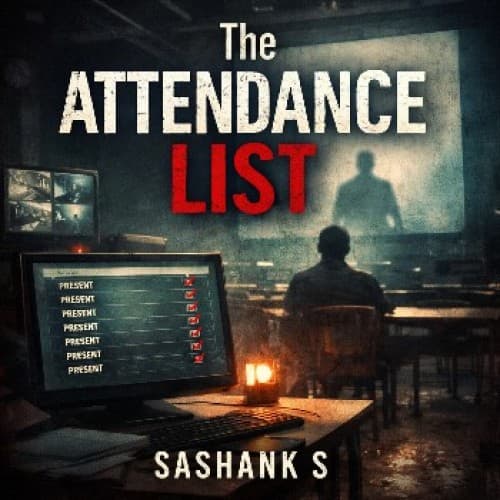
The projector turned on before anyone touched it.
A violent flicker cracked through the dark lecture hall — white light bursting against peeling green walls, dust dancing like ash in a burned-out world. The old academic block smelled of rust, damp paper, and something faintly medicinal… like antiseptic trying to hide rot.
“Did you—” Arjun started.
“No,” Meera whispered. “Don’t even ask.”
The projector’s fan screamed to life, spinning louder than it should for a machine this old. The screen unrolled slowly by itself, jerking halfway down before snapping into place with a metallic clack that echoed across the empty seats.
Their phones vibrated simultaneously.
Attendance Update:
Orientation Session — Behavioral Monitoring.
Status: Present
Nisha laughed — too loudly, too forced. “Great. Now we’re enrolled in ghost classes.”
The screen glitched.
Static.
Then a clean, official university logo faded in — one they recognized instantly. Same crest. Same colors. Same motto they saw every day on campus banners.
Except below it was a title none of them had ever heard before:
BEHAVIORAL MONITORING ORIENTATION — PILOT PROGRAM
The word Pilot blinked in dull red.
A woman’s voice began speaking — calm, instructional, emotionless.
“Welcome, participants. Your academic journey will include behavioral observation to enhance emotional resilience and decision-making under stress.”
Meera felt a chill run up her spine.
Participants.
Not students.
On the screen, clips of old classrooms flashed — years-old footage judging by the uniforms and hairstyles. Students laughing, arguing, crying… each clip overlaid with numbers that pulsed like heartbeats.
STRESS LEVEL: 62%
GUILT RESPONSE: HIGH
GROUP CONFORMITY INDEX: 78%
“Is this… real?” Nisha murmured.
Arjun pointed toward the bottom corner of the video.
Official university timestamps.
Real server watermarks.
This wasn’t a fake YouTube video. It was archived institutional footage.
The tape continued.
“Subjects will be monitored across academic, social, and emotional environments. Data will be collected via campus systems to identify behavioral patterns.”
Subjects.
The word landed like a punch.
Faces of faculty members appeared briefly — but each face was blurred. Not naturally. Artificially. Deliberately obscured.
“Why blur professors?” Meera asked softly.
“Because someone doesn’t want them recognized,” Arjun replied.
The video cut to a slide titled:
EMOTIONAL STRESS SCORING SYSTEM
Charts filled the screen — heart rate spikes, sleep cycle graphs, messaging patterns, movement heat maps across campus buildings.
Meera’s throat tightened.
“Movement tracking…” she whispered. “They knew where students went.”
Another slide appeared.
DATA SOURCES:
• Campus WiFi Signals
• Attendance Logs
• Counseling Records
• Anonymous Reporting Channels
Nisha took a step back.
“Counseling records?” she said. “That’s illegal. That’s private.”
The projector flickered again.
The tone of the video shifted.
Instead of diagrams, a live classroom appeared — dim lighting, a circle of chairs. A counseling session. Students speaking one by one, their voices raw, exposed.
The camera zoomed slowly toward one student sitting hunched forward, hands shaking.
Meera’s breath stopped.
“No…” she whispered.
The screen sharpened.
It was Karthick — the quiet one in their group. The one who barely spoke about anything personal. The one who always joked things off whenever conversations got serious.
On the screen, he looked younger. Broken.
“I feel like I’m constantly being watched,” Past Karthick said, voice trembling. “Like mistakes don’t disappear here… they just get recorded somewhere.”
The group turned toward the real Karthick standing beside them.
His face drained of color.
“I never agreed for this to be public,” he whispered.
The video continued — instructors’ voices layered over his session.
“Subject exhibits high guilt retention.”
“Group pressure triggers emotional regression.”
“Recommend controlled stress scenarios.”
Controlled.
Stress.
Scenarios.
The projector hummed louder, almost angrily.
Karthick staggered forward toward the screen.
“Stop it,” he said, voice cracking. “Turn it off.”
But there was no remote. No keyboard. No visible controls.
The tape shifted again.
New slide.
LONG-TERM MONITORING RESULTS
Photos appeared — campus festivals, late-night study sessions, disciplinary hearings. Faces blurred except for a small group… their group.
Images from first year.
Second year.
Moments they thought were random.
Arguments they forgot.
Even that ragging incident they had buried under jokes and silence.
Meera’s heart pounded.
“They were watching us for years,” she said.
The projector emitted a high-pitched whine.
The video glitched into a live feed.
Not old footage.
Now.
The five of them standing in the hall — seen from a camera mounted high above the door.
Nisha turned instinctively.
There was no camera there.
Yet on screen, their movements were mirrored perfectly.
A red overlay appeared over each of them.
LIVE STRESS SCORE:
Arjun — 91%
Meera — 87%
Nisha— 76%
Karthick — 96%
Below the numbers flashed a message:
PHASE 6 ACTIVE — SUBJECT RESPONSE EVALUATION
“Phase 6?” Arjun whispered. “We’re… in a phase?”
The projector’s voice returned — softer now, almost conversational.
“Longitudinal observation confirms sustained behavioral consistency. Emotional responses remain predictable.”
Predictable.
That word echoed like an insult.
The screen changed one final time.
A timeline appeared — starting years ago, long before tonight’s attendance messages began.
Checkpoints labeled:
ORIENTATION
DATA COLLECTION
GROUP STRESS TESTING
MEMORY CONFLICT PHASE
ABSENCE RESPONSE PHASE
And now…
ACTIVE OBSERVATION — CURRENT SESSION
Meera’s phone buzzed.
Notification:
Thank you for your continued participation since Year 1.
Her hands shook so badly she almost dropped it.
“They’ve been watching us from the start,” she said. “Every fight. Every mistake. Every—”
The projector abruptly shut off.
Darkness swallowed the hall.
For a moment, no one breathed.
Then the attendance portal refreshed on all their phones.
A new file appeared automatically:
Orientation Completed — Group 17
Underneath it, a chilling note:
Emotional baseline confirmed. Next evaluation phase scheduled.
The doors at the back of the hall unlocked with a slow metallic click.
No one moved toward them.
Because for the first time that night, the truth felt heavier than the fear.
They weren’t just trapped in a haunted building.
They had been observed.
Measured.
Studied.
Long before they ever walked into Block C.