



The email arrived on September 14th, the third week of my senior year. The subject line was neutral—"Meeting Request: Academic Matters"—but the sender was the Associate Dean for Student Affairs, and the body requested my presence in her office at 4:00 PM that afternoon, with a note that I should bring "any materials relevant to your academic work from the past three years."
I read that sentence three times, searching for its true meaning. "Any materials relevant to your academic work" could mean transcripts, course schedules, the normal documentation of student life. But it could also mean something else, something specific, something that suggested they had found what I had been careful to leave for them.
I spent the hours before the meeting in a state of strange calm. I had known this moment would come eventually; I had, in fact, engineered it through the very clues I had embedded in my work. What I had not expected was the feeling of relief that accompanied my anxiety. The performance was exhausting, I realized. Maintaining the persona of the perfect student while secretly documenting its hollowness had taken a toll I had not fully acknowledged. Whatever happened in Dean Patricia Okonkwo's office, at least the pretense would be over.
I arrived at 3:45 and waited in the hallway, watching students pass on their way to afternoon classes. They looked young to me, though most were my age or older. They looked innocent, though I knew that many of them were engaged in the same small dishonesties that characterized academic life everywhere—downloaded essays, shared homework, borrowed ideas without attribution. The difference was that they believed they were breaking rules, violating a moral code. I believed I was revealing that the code itself was empty.
Dean Okonkwo's office was large and windowless, lit by fluorescent panels that gave everything a slightly unreal quality. She was a small woman in her fifties with close-cropped gray hair and the kind of stillness that suggested deep reserves of energy held in check. She did not stand when I entered, but gestured to a chair across from her desk.
"Elizabeth," she said, my name sounding like a diagnosis. "Thank you for coming. I assume you know why you're here."
"I assume," I said carefully, "that it has something to do with my academic record."
She opened a folder on her desk, my folder, I realized, thick with papers that had been accumulated over weeks or months of investigation. "We've received information suggesting that your work over the past three years may not be entirely your own. Specifically, we have evidence of plagiarism in multiple courses, collaboration on work submitted as individual, and..." she paused, looking at me with something that might have been curiosity "systematic documentation of these activities, as if you were conducting research on academic dishonesty."
I felt a chill that had nothing to do with the air conditioning. They knew about the documentation. They had found not just the cheating but the record of the cheating, the file cabinet of evidence that I had considered my insurance policy, my eventual revelation.
"May I ask how you obtained this information?" I said, my voice steady despite my surprise.
Dean Okonkwo's expression did not change. "A graduate student in the Philosophy Department was reviewing your thesis proposal—standard procedure for senior thesis students—and noticed certain patterns in your writing sample. Similarities to published work that seemed beyond coincidence. She brought it to Professor Hartwell, who reviewed your file and found... irregularities in your previous submissions."
I nodded, understanding. The Easter egg I had planted in my thesis proposal, the deliberate similarity to a well-known text, had finally been noticed. Not by an administrator, not by a plagiarism detection algorithm, but by a graduate student with time to actually read and think. The system had not caught me; an individual had, through the simple application of attention.
"And the documentation?" I asked.
"That we found in your dorm room," Dean Okonkwo said, and now there was something else in her voice, something like puzzlement. "During a routine maintenance check, a facilities worker noticed that your file cabinet was unlocked. He saw folders labeled with course names and dates, and... concerned by the organization of the material, he contacted campus security. They examined the contents and determined that it should be brought to our attention."
I almost laughed. After three years of careful performance, of embedded clues and deliberate patterns, I had been exposed not by academic scrutiny but by a maintenance worker noticing an unlocked cabinet. The irony was exquisite: my meticulous documentation, which I had believed would prove my seriousness, my scholarly intent, had been interpreted as suspicious simply because it was too organized, too comprehensive, too much like the work of someone with something to hide.
"I see," I said.
Dean Okonkwo leaned forward. "Elizabeth, I'm going to be direct with you because I think you appreciate directness. The evidence against you is extensive. We have identified at least thirty instances of plagiarism in your submitted work, ranging from improper citation to wholesale appropriation of others' arguments. We have testimony from three students, who have been offered immunity in exchange for cooperation, regarding collaborative work you submitted as individual. And we have your own records, which appear to constitute a confession of systematic academic fraud."
She paused, waiting for me to respond. When I remained silent, she continued: "Under normal circumstances, this would be a straightforward case. The Academic Honor Council would review the evidence, determine the extent of the violations, and recommend appropriate sanctions, up to and including expulsion with permanent notation on your transcript."
"But?" I said, hearing the qualification in her voice.
"But these are not normal circumstances," Dean Okonkwo said. "Because you are not a normal student. Your documentation suggests... an unusual level of reflection on your actions. You appear to have treated your dishonesty as a research project, complete with theoretical framework and evidentiary standards. And your academic record, prior to these revelations, was exemplary. Several of your professors have submitted statements on your behalf, noting your intellectual seriousness and your contributions to class discussion."
She opened another folder, this one thinner. "Professor Hartwell writes that 'Elizabeth is one of the most philosophically sophisticated students I have encountered in twenty years of teaching, and I find it difficult to reconcile the student I know with the evidence of misconduct.' Professor Yates suggests that 'whatever rules Eliabeth may have broken, she has clearly engaged deeply with the material in ways that suggest genuine learning has occurred.'"
I felt a surge of gratitude toward these professors, tempered by the knowledge that their praise would not save me. They were describing exactly what I had hoped to achieve: the separation between my authentic intellectual life and my performative academic life, the proof that I had learned even while cheating. But I doubted the Honor Council would see it that way.
"The Council meets next Thursday," Dean Okonkwo continued. "You will have the opportunity to present your case, to explain your actions, and to suggest appropriate sanctions if violations are found. I am required to inform you that you may be accompanied by an advisor of your choice, and that you have the right to review all evidence against you prior to the hearing."
"I understand," I said.
"Elizabeth." Dean Okonkwo's voice softened slightly. "I have been in this position for eight years. I have seen many cases of academic dishonesty, hundreds, probably. Most of them are simple: students overwhelmed by pressure, making bad decisions, copying a paper or looking at a neighbor's test. A few are sophisticated: students who have made cheating into a systematic practice, who have rationalized their actions until they believe them justified. But I have never seen a case like yours. I have never seen a student who cheated so... intentionally, so theoretically, so completely."
She looked at me with genuine curiosity. "Why? Why document everything? Why leave evidence that could destroy you? Most cheaters try to hide their tracks. You seem to have laid yours in neon."
I considered my answer carefully. This was the first time I had been asked the question directly, the first opportunity to explain what I had done in terms that might be understood. "I believed," I said slowly, "that the documentation was necessary to prove the seriousness of the experiment. That without it, I would be dismissed as just another dishonest student, rather than understood as someone testing the boundaries of a system that claims to value integrity but actually values appearance."
Dean Okonkwo's expression did not change. "And the experiment? What was its hypothesis?"
"That academic integrity is a performance," I said. "That the university's commitment to honesty is theatrical rather than substantive. That I could cheat systematically for years, leaving clues that should have been obvious, and never be caught because no one was actually looking."
"And has your hypothesis been confirmed?"
I smiled, despite the circumstances. "Would we be having this conversation if it hadn't been?"
She did not smile back. "You understand that your experiment, if that's what it was, has caused real harm. To the students who collaborated with you, who now face their own disciplinary proceedings. To your professors, who must question every grade they've given you, every recommendation they've written. To the university, which must investigate the extent of the fraud and determine how to prevent similar cases in the future."
"I understand that my actions have consequences," I said. "I have always understood that. What I question is whether those consequences are proportionate to the nature of my offense, or whether they serve to protect an institution that would prefer to punish the messenger than confront the message."
Dean Okonkwo closed the folders. "You will have the opportunity to make that argument to the Council. I suggest you prepare carefully. The Council does not look kindly on students who suggest that their dishonesty was justified by institutional failure."
"I will prepare," I said, standing. "And Dean Okonkwo? Thank you for asking why. Most people don't."
I left her office and walked back to my dormitory in the September twilight, my mind already racing through the argument I would need to construct. I had one week to prepare a defense that would not just save my academic career but justify it, that would transform my expulsion hearing into a forum for the ideas I had been developing for four years.
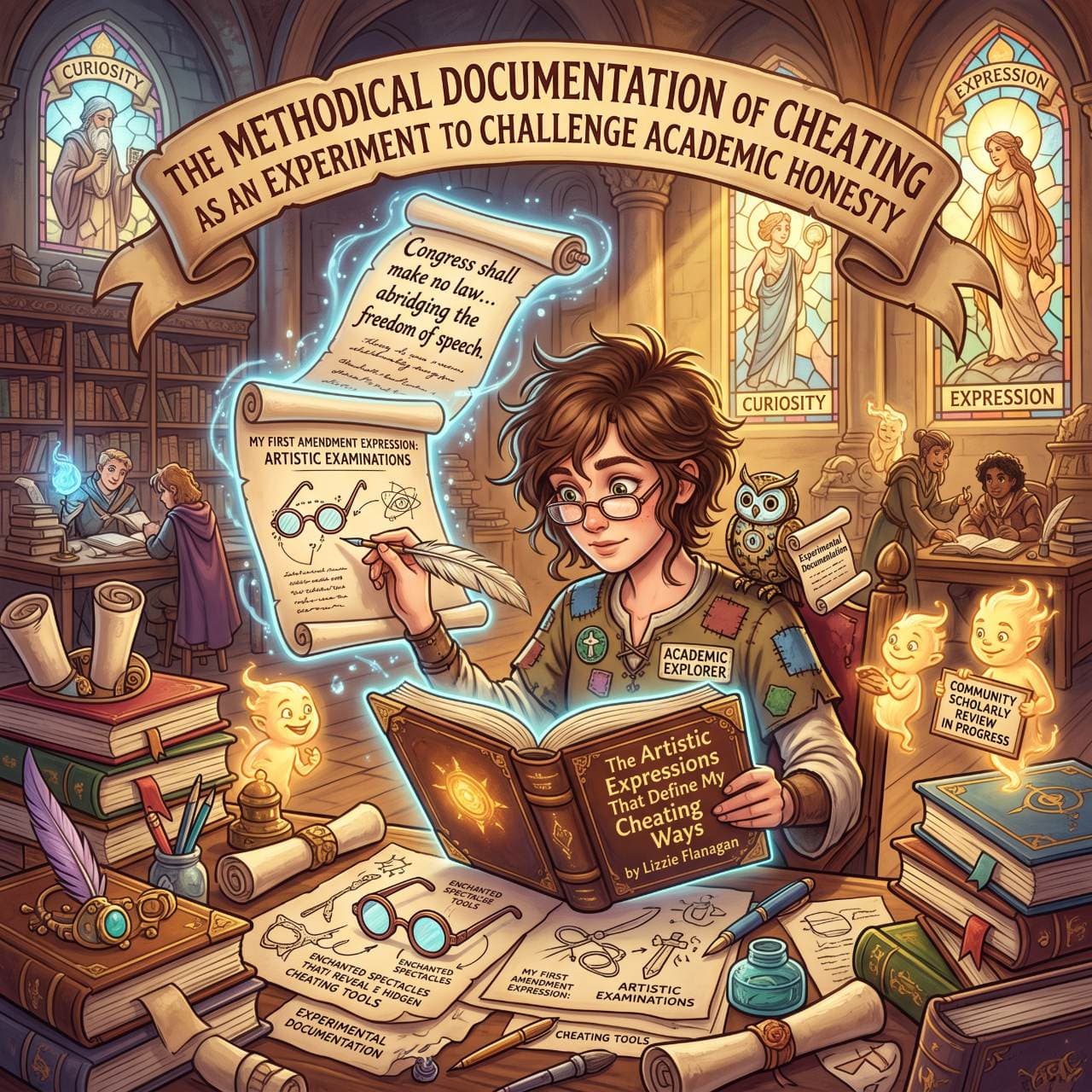
I would need to read the Constitution, specifically the First Amendment and the case law surrounding it. I would need to research the legal definitions of artistic expression, performance, and speech. I would need to find precedents, cases where illegal acts had been protected because they constituted expression, where the medium of the crime was also the message.
And I would need to write, finally and completely, the dissertation that would explain everything: not just what I had done but why, not just the methods of my cheating but its meaning. The document that would be entered into evidence as Exhibit A, that would be read by the Honor Council and perhaps by courts beyond, that would stand as my true academic legacy whether I was expelled or exonerated.
I worked through the night, and the next night, and the next. I read Texas v. Johnson, the flag-burning case that established that expressive conduct could be protected speech. I read United States v. O'Brien, which set out the test for when conduct could be restricted despite its expressive elements. I read about the "symbolic speech" doctrine, the idea that actions could communicate ideas as clearly as words, and that such communication was entitled to constitutional protection.
I read about performance art, about artists who had used their bodies as canvases, their actions as media. I read about the Situationist International, about détournement and the society of the spectacle, about the ways in which artistic intervention could expose the hidden structures of power and control. I read about institutional critique, the movement in contemporary art that used the museum's own spaces and practices to reveal its complicity in systems of exclusion and commodification.
And I began to see my experiment not as a crime or even as research, but as a work of art—a four-year performance piece that used the university as its gallery, academic integrity as its medium, and the very notion of honesty as its subject. The cheating was not the point; the cheating was the method. The point was to expose the emptiness of the institution's claims, to force a confrontation with the reality that integrity was not practiced but performed, not verified but assumed.
This was the argument I would make. Not that I hadn't cheated, I had, extensively, and I would not deny it. Not that my cheating was justified by the pressure I faced, it wasn't, and pressure did not excuse dishonesty. But that my cheating was expression, protected by the First Amendment, and that punishing it would violate not just my rights but the university's own commitment to free inquiry and open discourse.
It was a radical argument. It would almost certainly fail. But it would force the university to confront questions it had never been forced to confront before, to articulate its values in the face of a challenge that could not be dismissed with reference to rules and procedures. And in that confrontation, whatever its outcome, the truth would emerge, not the truth the university wanted to tell about itself, but the truth I had discovered through four years of systematic deception.
The hearing would be my final performance, and I intended to make it unforgettable.