


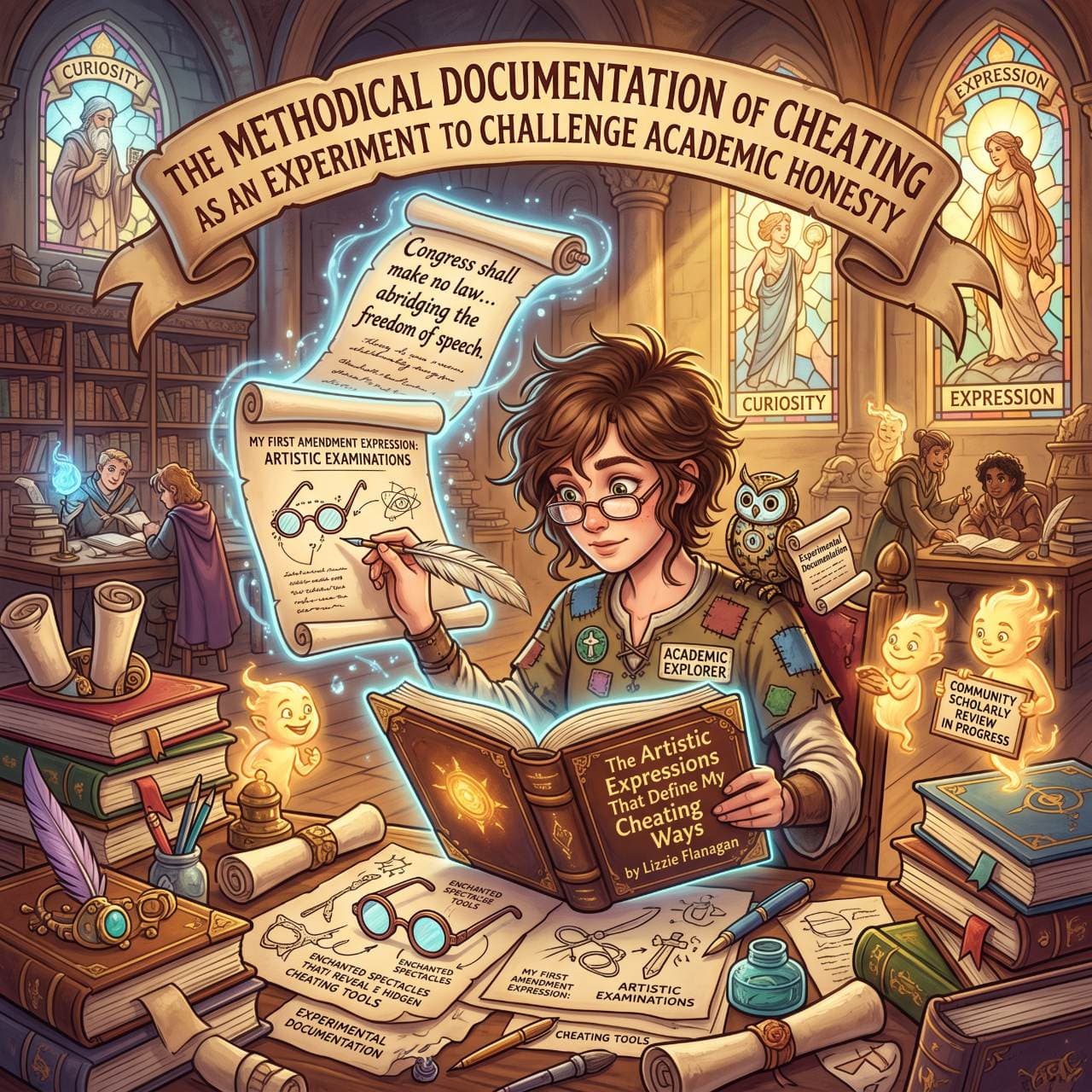

Westbrook University sat on 340 acres of New England forest, its Gothic Revival buildings arranged around a central quad in a configuration that suggested both permanence and order. The founders had intended it to look like Oxford or Cambridge, to invoke the medieval tradition of scholarly sanctuary, and they had succeeded so thoroughly that walking across campus felt like stepping into a photograph from another century. This was part of the performance, I would come to understand, the physical manifestation of the institution's self-image as a place apart, a realm of pure intellectual pursuit unsullied by the compromises of the outside world.
I arrived with my file cabinet of documentation, my carefully constructed persona as an eager, engaged, ethical student, and my plan for Phase Three of the experiment. College would be different from high school in crucial ways. The stakes were higher, the monitoring less consistent, the opportunities for independent study greater. I would need to adapt my methods, to develop new techniques for the university environment while maintaining the core principle that had guided me from the beginning: I would not hide completely. I would leave clues, create patterns, build a trail that could be followed if anyone chose to look.
My freshman year was devoted to establishing credibility. I took a heavy course load, eighteen credits per semester, and excelled in all of them. I participated in class discussions, visited professors during office hours, joined the debate team and the philosophy club. I wrote papers that were genuinely my own work, taking positions I actually held, developing arguments I believed in. This was important to me, morally if not strategically. I did not want to become the fraud I was pretending to be. I wanted to maintain a clear distinction between my authentic intellectual life and my performative academic life, to ensure that when the time came to reveal the experiment, I could point to genuine learning that had occurred alongside the fraudulent achievement.
I also used this year to study the university's academic integrity infrastructure. I read the Honor Code, which all students signed during orientation, with the attention I suspected its authors had not given it. It was a document of remarkable vagueness, full of noble sentiments about "truth," "honesty," and "personal responsibility" but lacking specific definitions of prohibited conduct. It prohibited "plagiarism" without defining what constituted plagiarism beyond "using another's work without attribution." It prohibited "cheating" without specifying which behaviors fell under that category. It created a system of "honor councils" to adjudicate violations, but the procedures for these councils were opaque, their membership selected by administrators rather than elected by students.
This was the pattern I had observed in high school, replicated at the university level: the appearance of rigor without the substance, the performance of integrity without the practice. The Honor Code was not designed to prevent cheating; it was designed to create the impression that cheating was prevented, to reassure parents and accreditors that Westbrook was a place of ethical excellence.
I also researched the university's detection capabilities. Westbrook used Turnitin for plagiarism detection, software that compared submitted papers against databases of published work and previously submitted student papers. I obtained a copy of the software's technical documentation, available through a public records request, though I suspected I was the first student to ever make such a request, and analyzed its algorithms. Turnitin looked for matching strings of text, similarities in sentence structure, patterns of citation. It could be defeated by sufficient paraphrasing, by the strategic alteration of key phrases, by the inclusion of original material alongside borrowed content.
More importantly, I discovered that Turnitin was not actually used for every submission. Professors had to opt in to the service, and many did not bother. Of those who did, most relied on the similarity score—a percentage indicating how much of the paper matched other sources—without actually reading the detailed reports showing where similarities occurred. A paper could score 40% similarity and receive no scrutiny if the professor trusted the student, while a paper scoring 15% might be investigated if the professor had suspicions.
This confirmed my hypothesis that academic integrity enforcement was not systematic but personal, dependent on relationships and reputation rather than objective analysis. I would need to build relationships, to become the kind of student who was above suspicion.
I began my sophomore year with a new course load and a new set of techniques. I had by this time developed what I called "the mosaic method", a system of composition that wove together original writing with carefully selected borrowed material in patterns that would be invisible to casual reading but detectable to serious analysis. I would write the frame of the argument myself, ensuring that the overall structure and conclusion were genuinely my own, but fill in the evidentiary and analytical sections with paraphrased material from academic sources, rendered just sufficiently different from the original to evade Turnitin while remaining recognizable to anyone familiar with the source material.
This was not laziness. It was, I believed, a form of commentary on the nature of academic writing itself. So much of undergraduate work consisted of synthesizing existing research, of repackaging others' ideas in slightly different language, of demonstrating "engagement with the literature" through quotation and citation. My mosaic method simply took this to its logical extreme: if the goal was to show familiarity with existing scholarship, why not demonstrate that familiarity by actually reproducing it, by weaving it so seamlessly into my own prose that the boundary between my thoughts and others' thoughts became indistinguishable?
I submitted my first mosaic paper in Professor Diane Hartwell's Introduction to Political Theory class. The assignment was to analyze Rawls's theory of justice and evaluate its applicability to contemporary affirmative action debates. I wrote an introduction and conclusion that presented my genuine views on Rawls: I found his veil of ignorance compelling but his difference principle insufficiently radical, and then constructed the body of the paper almost entirely from paraphrased sections of three published books on Rawlsian theory, rearranged and lightly modified to create the appearance of original analysis.
I received an A-. Professor Hartwell's comments praised my "sophisticated engagement with secondary literature" and my "ability to synthesize complex arguments." She noted one area for improvement: "Your voice sometimes gets lost in the sources. Make sure you're advancing your own argument, not just summarizing others."
I kept that paper, and her comments, in my file cabinet. They would become Exhibit 7 in my eventual hearing.
The mosaic method became my standard approach for the next three semesters. I produced twenty-three papers using this technique, receiving an average grade of A-. The lowest grade was a B+, for a paper in which I had apparently been too successful at paraphrasing, creating a work that was so seamless that Professor Marcus Yates complained it lacked "critical distance from the sources." Even in failure, I was succeeding: my cheating was being criticized for being too good, too indistinguishable from legitimate scholarship.
But I was also escalating the experiment in ways that increased my risk. I had begun to leave what I called "Easter eggs" in my submissions: deliberate clues that would be obvious to anyone looking carefully but invisible to casual review. In one paper on Kantian ethics, I embedded a sentence that read: "As this author has argued elsewhere in uncited works..." followed by a paraphrase of a famous passage from Kant's Critique of Practical Reason. In another, on the philosophy of language, I included a footnote that cited a real book but gave the wrong page number, a page that, if checked, would be found to contain material directly contradictory to my argument.
No one checked. Not once in twenty-three papers did a professor or grader contact me about these embedded clues. They were reading for completion, for competence, for the appearance of scholarly engagement. They were not reading for integrity.
This was the data I was collecting, the evidence that would eventually support my dissertation's central claim: that academic integrity in the contemporary university is not a practice but a faith, a belief system that persists despite abundant evidence of its own failure. Just as religious faith can persist despite the absence of empirical proof, academic integrity persists despite the absence of empirical verification. We believe students are honest because we have to believe it, because the alternative, that the entire system is built on sand, would be too destabilizing to contemplate.
My sophomore year also saw my first foray into collaborative cheating, expanding my network beyond Tyler Ray, who had enrolled at a different university. I identified three other students who shared my skepticism about educational metrics, students who were genuinely intelligent and capable but had become cynical about the performative aspects of academic achievement. We formed what I would later call, in my dissertation, "the Control Group" not because we controlled anything, but because we tested the system's controls and found them absent.
Our collaborative work was careful and limited. We shared research, divided reading loads, and occasionally contributed passages to each other's papers. We never simply copied from one another; that would have been too obvious, too easily detected by plagiarism software comparing student submissions against each other. Instead, we developed what we called "conceptual mirroring", approaching the same topic from slightly different angles using shared sources, creating papers that would appear original to automated detection but that actually represented a division of intellectual labor.
This was, I would argue, no different from what happens in professional academia, where research teams divide tasks and co-author papers. The only difference was that we were not transparent about our collaboration, that we pretended to be individual scholars working in isolation when we were actually a collective. But this pretense itself was demanded by the system, which required "individual work" even as it prepared us for professional environments where collaboration was the norm.
I documented everything. I recorded our planning sessions with their consent, creating audio files in which we discussed the philosophy behind our collaboration. I saved drafts showing the evolution of our shared ideas. I photographed the whiteboards where we mapped out our division of labor. I was building not just a confession but a case, a demonstration that what we were doing was intellectually coherent even if it violated institutional rules.
By the end of my sophomore year, I had accumulated 147 pages of documentation. I had maintained a 4.0 GPA. I had been invited to join the Honors Program, which would give me access to independent study courses and a senior thesis requirement. I had become, in the eyes of the university, exactly the kind of student they most valued: high-achieving, intellectually engaged, ethically upright.
The irony was not lost on me. I was being rewarded for my fraudulence with opportunities to commit further fraudulence. The system was not just failing to detect my cheating; it was actively incentivizing it, giving me more freedom and more resources the more successful I became at hiding my methods.
But I was not hiding, not completely. That was the crucial element, the one that would eventually form the basis of my legal defense. I was performing my dishonesty in plain sight, leaving clues that could be found, creating patterns that could be analyzed, building a record that could be examined. If the university had been actually committed to integrity, if integrity had been a practice rather than a performance, they would have caught me a dozen times over.
They never did. Not once in two years did anyone ask me a question that suggested suspicion. I was invited to apply for prestigious scholarships. I was asked to serve as a peer tutor for students struggling with writing. I was nominated for the Student Integrity Award, given annually to a student who "exemplifies the highest standards of academic honesty."
I declined the nomination, citing modesty. The truth was that accepting it would have crossed a line I was not yet ready to cross. I was willing to cheat, to deceive, to manipulate the system, but I was not willing to become the public face of the very integrity I was undermining. That would have been too much like Trevor Hathaway, too much like accepting praise for virtues I did not possess.
Instead, I continued my work, preparing for the final phase of the experiment. Junior year would bring the opportunity I had been waiting for: the senior thesis, a year-long independent research project that would culminate in a 60-page dissertation. This would be my masterpiece, the document that would bring together all my data, all my analysis, all my argument about the nature of academic integrity in the contemporary university.
I did not yet know that it would also be the document that exposed me, that forced the confrontation I had been preparing for but had not actually expected to occur. I thought I had more time. I thought I would be the one to choose when to reveal the experiment, how to frame it, how to ensure it was understood as critique rather than mere criminality.
I was wrong. The system I had been testing would eventually test me back, and the results would be more devastating than I had anticipated. But they would also, paradoxically, prove my point more thoroughly than any self-initiated revelation could have done.
The confrontation was coming. I could feel it in the spring of my junior year, when I noticed a new attention to my work, a hesitation in professors' praise, a sense that something had shifted in the atmosphere around me. I did not know what had triggered it, what small clue had finally been noticed or what pattern had finally been recognized. I only knew that the experiment was entering its final phase, and that I would need to be ready to defend not just my actions but the very possibility that actions like mine could have meaning beyond mere self-interest.
I spent the summer before my senior year writing. Not the thesis itself, that would come later, but the theoretical framework, the argument that would justify what I had done. I read First Amendment law, studying the boundaries of protected speech, the categories of expression that had been recognized as constitutionally shielded despite their disruptive or offensive nature. I read about performance art, about institutional critique, about the tradition of civil disobedience that stretched from Thoreau to the present day.
And I began to understand that my experiment was not just an exposé of academic dishonesty. It was a work of art, a performance piece that had been running for four years, a living critique of the systems we inhabit and the lies we tell ourselves about our own integrity. The cheating was the medium, but the message was about honesty, about the kind of radical honesty that forces us to confront uncomfortable truths even when we would prefer to look away.
This was the argument I would eventually make, standing before the disciplinary board, my future hanging in the balance. It was an absurd argument, I knew. It would be laughed at, dismissed, condemned as the desperate rationalization of a criminal mind. But it was also, I believed, true. And in a university supposedly devoted to truth, the truth should matter more than the rules that tried to contain it.
I was about to find out if that belief was justified, or if it was just another performance, another lie I was telling myself to justify the unjustifiable.