


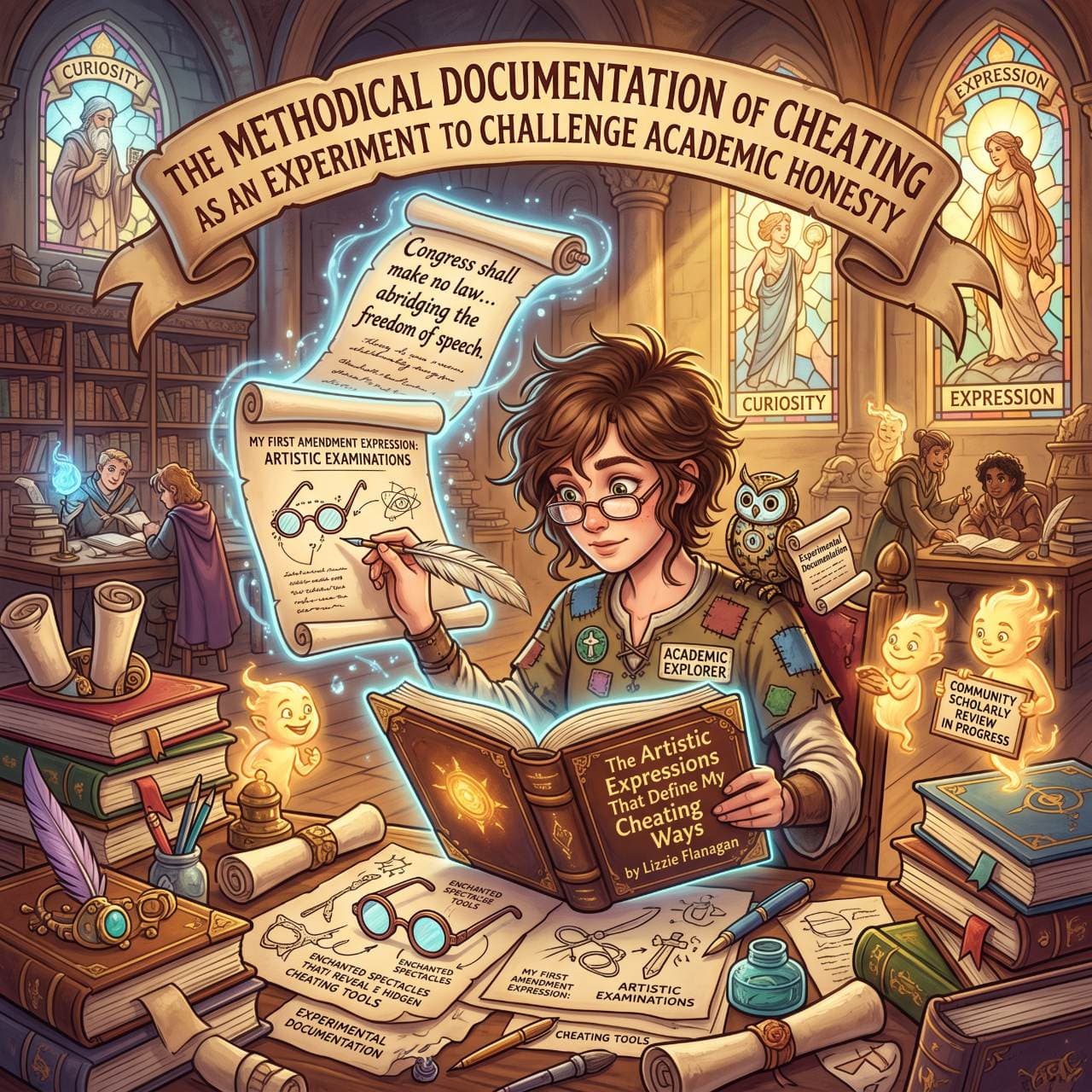

The Honor Council met in the Old Chapel, a building constructed in 1897 that had once served as the university's primary place of worship before being converted to administrative use. The irony of holding a disciplinary hearing in a former church was not lost on me; I would later reference it in my opening statement, suggesting that the university's treatment of academic integrity had become essentially religious, a matter of faith rather than evidence, of dogma rather than reason.
The chamber had been arranged as a courtroom, with the Council members seated at a long table facing a single chair where I would sit. Behind me were rows for observers, already filling with students who had heard rumors of the case and wanted to witness the drama. To my left was a small table for my advisor; to my right, a similar table for the university's representatives.
I had chosen as my advisor Professor Thomas Yates, the political theorist who had once criticized my work for lacking "critical distance from the sources." He had agreed to serve not because he endorsed my actions, he had made clear that he found them "deeply troubling", but because he believed in the importance of the questions I was raising. "If you're going to burn the house down," he had told me, "at least make sure people understand why it needed to burn."
The Council itself consisted of five members: two faculty, two students, and one administrator who served as chair. The faculty members were Professor Diane Hartwell, who had taught my first college course and written in support of my intellectual seriousness, and Dr. Robert Hanson, a mathematician known for his rigid adherence to procedural correctness. The student members were a senior named David Park and a junior named Sarah Goldstein, both of whom I knew by reputation as serious, rule-oriented individuals. The chair was Associate Dean Okonkwo, who had conducted the preliminary investigation.
Dean Okonkwo called the hearing to order at 9:00 AM precisely, reading from a prepared statement about the purpose of the proceeding and the rights of the accused. I was charged with "multiple violations of the Academic Honor Code, including plagiarism, unauthorized collaboration, and systematic academic fraud." The potential sanctions ranged from suspension to expulsion with permanent notation on my transcript.
"The accused has elected to represent herself," Dean Okonkwo continued, "with Professor Yates serving as advisor. She has also requested permission to make an opening statement before we proceed to examination of evidence. This is within her rights, and the Council will hear her now."
I stood, carrying a binder that contained my notes and, more importantly, the first twenty pages of what would eventually become my full dissertation. I had dressed carefully for this moment, not too formally, which would suggest I was trying to manipulate the Council's perception, but not too casually either, which would suggest disrespect. I wore black pants and a gray sweater, the colors of neutrality, of the space between right and wrong.
"Members of the Honor Council," I began, my voice steady despite my nervousness. "I stand before you today accused of academic dishonesty, and I do not deny the charges. Over the past four years, I have plagiarized extensively from published sources. I have collaborated with other students on work submitted as individual. I have manipulated testing procedures to obtain scores I did not earn through individual effort. The evidence presented against me is accurate, and I will not waste your time disputing facts that I myself have documented."
I paused, letting my admission settle over the room. The observers had gone silent; they had expected denial, evasion, the usual strategies of the accused.
"However," I continued, "I do dispute the characterization of these actions as mere dishonesty, as simple violations of rules without larger significance. What I have done was not merely cheating. It was an experiment, a systematic investigation into the nature of academic integrity and the mechanisms by which it is enforced. And as such, I argue that it constitutes protected expression under the First Amendment to the United States Constitution."
A murmur ran through the observers. Dean Okonkwo raised her hand for silence, her expression unreadable.
"The First Amendment protects not merely spoken words but expressive conduct," I continued, citing the cases I had spent the past week studying. "In Texas v. Johnson, the Supreme Court held that flag-burning was protected speech because it was 'inherently expressive,' communicating a particularized message that was likely to be understood by observers. In Spence v. Washington, the Court protected the display of a flag with a peace symbol attached, recognizing that the modification of a symbol could convey meaning beyond words."
I opened my binder to the first page of my prepared statement. "My academic work over the past four years has been similarly expressive. Through the medium of academic performance, through the deliberate manipulation of the signs and symbols by which educational achievement is measured, I have sought to communicate a particularized message about the hollowness of those signs and symbols. I have sought to demonstrate that academic integrity is not a practice but a performance, not verified but assumed, not substantive but theatrical."
I looked directly at Professor Hartwell, who had once praised my "sophisticated engagement with secondary literature." "When I plagiarized while leaving obvious clues to my plagiarism, I was not merely being careless. I was testing whether anyone was actually reading, whether the appearance of scholarship was sufficient to satisfy the requirements of scholarship. When I collaborated with other students while documenting our collaboration, I was not merely being reckless. I was investigating whether the demand for 'individual work' reflected a genuine pedagogical value or merely a bureaucratic preference for easily gradable products."
I turned to address the student members of the Council. "The message I sought to communicate was this: that the university's commitment to honesty is itself dishonest, that it claims to value integrity while creating conditions that make integrity impossible, that it punishes the small deceptions of students while ignoring the large deceptions of institutions. This message may be uncomfortable. It may be unwelcome. But under the First Amendment, the government, including state universities like Westbrook, may not prohibit expression simply because it is disagreeable or disruptive."
I paused again, taking a breath before delivering the core of my argument. "Therefore, I move that the charges against me be dismissed on constitutional grounds. My 'cheating' was not mere dishonesty; it was artistic expression, political commentary, and social critique. Punishing it would violate my rights to free speech and constitute viewpoint discrimination in violation of the First Amendment."
I sat down to silence. The observers were staring at me with expressions ranging from confusion to admiration to outrage. The Council members were consulting their notes, their faces carefully neutral.
Dean Okonkwo spoke first. "Elizabeth, your argument is... creative. But the Council must consider whether it has any legal merit. Professor Hanson, you have reviewed the constitutional questions raised by the defense?"
Dr. Hanson, the mathematician, cleared his throat. "I have consulted with the university's legal counsel. While the First Amendment does apply to public universities, its protections are not absolute. The Supreme Court has recognized that schools may regulate student speech that 'materially disrupts classwork or involves substantial disorder or invasion of the rights of others.' More relevantly, courts have consistently held that academic standards, including standards of integrity, are not subject to First Amendment challenge. A student cannot claim that submitting a plagiarized paper is protected speech any more than they could claim that submitting a blank page is protected speech."
"With respect," I interjected, "the cases cited by the university deal with restrictions on content, schools prohibiting particular viewpoints or subjects. My argument is not that I have a right to submit poor work, but that the work I submitted was expressive conduct, analogous to performance art or symbolic speech. The fact that it took the form of academic assignments should not strip it of constitutional protection."
Professor Hartwell spoke for the first time. "Elizabeth, I want to understand your position. Are you claiming that all cheating is protected expression, or only your cheating?"
"Only my cheating," I said, "because only my cheating was undertaken as systematic critique with documentary evidence and theoretical framework. A student who copies a paper to get a better grade is engaged in fraud for personal benefit. I was engaged in what I would call 'critical fraud', fraud undertaken to expose the conditions that make fraud possible and profitable."
"And the students who collaborated with you?" Dr. Hanson asked. "Were they also engaged in 'critical fraud,' or were they merely your accomplices?"
"They were participants in a research project," I said carefully, "though I accept responsibility for recruiting them and designing the methodology. Their actions were undertaken with full awareness of the experimental nature of the work."
Dean Okonkwo consulted her notes. "The university's position is that regardless of your intent, the actions violated clear rules that are necessary to maintain academic standards. The First Amendment does not protect fraud, even fraud undertaken with artistic or political intent. A student cannot burn down a building and claim it was performance art; similarly, they cannot submit fraudulent work and claim it was social critique."
"With respect," I said again, "the building-burning analogy is inapt. Burning a building causes tangible harm to property and safety. My 'fraud' caused no tangible harm, it did not damage property, endanger anyone, or even deprive the university of resources, since I paid tuition like any other student. The only 'harm' was to the university's reputation, and that is precisely the kind of harm that the First Amendment protects against. We cannot prohibit speech because it makes the speaker look bad."
The argument continued for two hours, moving through constitutional precedents, definitions of artistic expression, and the specific language of Westbrook's Honor Code. I cited cases I had found in my research: Levy v. Texas, where the court had considered whether a student's vulgar protest was protected; Hazelwood v. Kuhlmeier, where the court had allowed schools to regulate school-sponsored speech; Morse v. Frederick, where the court had permitted punishment of a student for a message promoting drug use.
The university's representatives cited other cases: Healy v. James, establishing that schools could enforce reasonable rules; Widmar v. Vincent, distinguishing between content-based and viewpoint-based restrictions; and various lower court decisions upholding academic integrity standards against constitutional challenge.
By the end of the morning session, it was clear that the constitutional question was unsettled, there was no direct precedent for a student claiming that cheating was protected speech, and the Council would have to make new law if they accepted my argument.
"We will reconvene at 2:00 PM," Dean Okonkwo announced. "In the afternoon session, the university will present its evidence of specific violations, and the accused will have the opportunity to respond. We will then consider both the factual questions, whether violations occurred, and the legal questions, whether those violations are protected by the First Amendment."
I spent the lunch break in a small conference room with Professor Yates, reviewing the evidence the university would present and preparing my responses.
"They're taking the constitutional argument seriously," Yates said, sounding surprised. "I expected them to dismiss it out of hand, but they're actually engaging with it."
"They have to," I said. "If they ignore it and expel me, I could sue. They need to build a record showing they considered and rejected the First Amendment claim."
"And will you sue? If they reject your argument?"
I considered the question. "I don't know. The lawsuit would be another performance, another opportunity to force a conversation about these issues. But it would also make me a professional plaintiff, a litigant rather than a scholar. I'm not sure that's the identity I want."
Yates nodded. "The afternoon session will be harder. They have specific evidence—papers, test scores, testimony from your collaborators. The constitutional argument is abstract; the evidence is concrete."
"I know," I said. "But I have something concrete too. Something I've been waiting to share."
I opened my binder to the final section, the pages I had written in the weeks since my meeting with Dean Okonkwo. "My dissertation," I said. "The full account of the experiment, with all the documentation, all the analysis, all the argument. I'm going to enter it into evidence as Exhibit A. Let them read what I really think, what I've really learned. Let them see that this wasn't just cheating—it was research, art, and truth-telling, all in one."
Yates took the manuscript and flipped through it, his eyes widening as he saw the scope of what I had created. "Two hundred and forty-seven pages," he said. "This is... substantial, Elizabeth. This changes things. This isn't just a defense; it's a work of scholarship."
"It's both," I said. "And that's the point. The boundary between scholarship and art, between research and expression, between truth and performance—those are the boundaries I've been exploring. This document is where they all collapse."
We returned to the Old Chapel at 2:00 PM, and the afternoon session began. The university presented its evidence methodically: plagiarism reports showing similarities between my papers and published sources; testimony from my collaborators describing our shared work; analysis of my test scores showing statistical anomalies; and finally, the contents of my file cabinet, my own documentation of everything I had done.
I did not dispute any of it. Instead, after the university rested its case, I stood and requested permission to enter my dissertation into evidence and to read from it.
Dean Okonkwo granted permission, and I began to read, the opening chapter, describing my initial hypothesis; the methodology section, detailing my techniques and their philosophical justification; the results section, analyzing what my experiment revealed about institutional failure; and finally, the conclusion, where I argued for a new understanding of academic integrity that distinguished between performative honesty and substantive honesty, between following rules and seeking truth.
The room was silent as I read. The Council members were taking notes; the observers were leaning forward in their seats. Even the university's legal representatives were listening, their usual adversarial posture softened by the strange nature of what they were hearing.
When I finished, two hours later, the sun was setting outside the chapel windows, casting long shadows across the floor. I closed the manuscript and sat down, exhausted but exhilarated.
Dean Okonkwo called for a recess while the Council deliberated. We waited in the hallway for forty-five minutes,
Professor Yates reviewing his notes while I sat in silence, watching the other students come and go, living their normal lives, unaware of the strange trial taking place in their midst.
When we were called back in, Dean Okonkwo read the Council's decision. They had found that violations of the Honor Code had occurred, this was not in dispute. They had also found that my constitutional argument raised "novel and serious questions" that the Council was not equipped to resolve definitively. They would recommend to the administration that my case be reviewed for potential First Amendment implications before final sanctions were imposed.
In the meantime, I was suspended pending final resolution. I would not be allowed to attend classes, submit work, or participate in university activities. My graduation, scheduled for May, was indefinitely postponed.
It was not the victory I had hoped for, but it was not the defeat I had feared. I had forced the university to take my argument seriously, to acknowledge that the questions I raised were not simple matters of rule-breaking but complex questions of law and philosophy. And I had entered my dissertation into the record, creating a document that would exist regardless of what happened to me, that could be read and considered by others who might be more sympathetic to its argument.
As I left the Old Chapel that evening, walking through the autumn darkness toward my uncertain future, I felt something I had not expected to feel: hope. The experiment was not over. It had entered a new phase, one that would test not just the university's commitment to integrity but its commitment to the free expression that it claimed to value.
The dissertation would be my legacy, my true final submission. And it would speak, I believed, long after I was gone from this place, long after the specific details of my case were forgotten. It would speak about the nature of honesty in dishonest systems, about the possibility of truth through deception, about the strange alchemy by which performance could become reality and fraud could become art.
This was the artistic expression that defined my cheating ways. And it was only beginning to find its audience.