


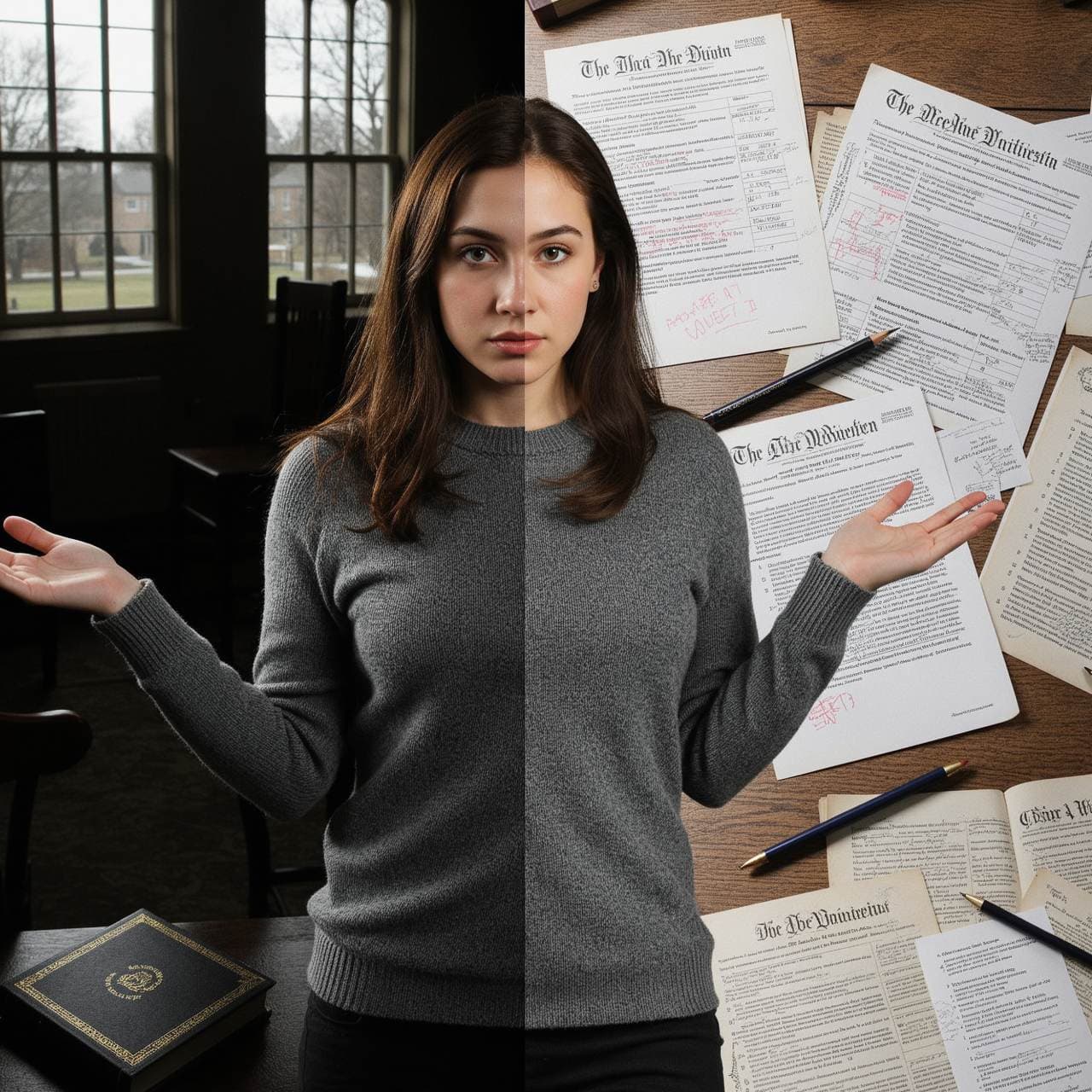

The first time I considered that honesty might be nothing more than a social contract designed to maintain power structures, I was fourteen years old and sitting in the back row of Mr. Henderson's eighth-grade American History class. He was lecturing about the Boston Tea Party—how those "brave patriots" had disguised themselves as Mohawk warriors to destroy private property in protest of taxation without representation. When I raised my hand and asked whether this constituted vandalism and theft rather than heroism, Henderson's face contorted into that particular expression adults reserve for children who question the sanctioned narrative.
"Context, Elzabeth," he said, drawing out the syllables as if speaking to someone impaired. "The colonists were fighting against oppression. Sometimes the rules must be broken for the greater good."
I remember writing that down in my notebook: Sometimes the rules must be broken for the greater good. Beneath it, I added my own annotation: Who decides which times? Who defines the greater good?
That question became the foundation upon which I would build the next four years of my life, culminating in what the University Disciplinary Board would eventually call "the most elaborate academic fraud in institutional history" and what I would come to understand as my magnum opus—a living dissertation on the performative nature of integrity in educational systems.
My name is Elizabeth Bjork. At the time of my expulsion hearing, I was nineteen years old, a sophomore studying Philosophy and Political Science at Westbrook University, a moderately prestigious liberal arts college that prided itself on "culturing ethical leaders for tomorrow's challenges." I had a 4.0 GPA. I had perfect scores on both the SAT and ACT. I had received the Chancellor's Merit Scholarship, which covered my full tuition plus a stipend for research. I was, by every metric the university valued, an exemplary student.
I was also, by any objective standard, a fraud. But I would argue—and eventually did argue, at considerable personal cost—that fraudulence itself can be a form of truth-telling when the system it deceives is itself built on deception.
The experiment began in earnest during my junior year of high school, though the seeds had been planted much earlier. I had always been a good student—not brilliant, but diligent. I completed my homework, studied for tests, participated in class discussions. I believed, as I had been taught to believe, that hard work was its own reward, that merit would be recognized, that the system was fundamentally fair.
This belief began to erode during my sophomore year, when I witnessed my classmate Trevor Hathaway receive a scholarship for academic excellence that I knew he hadn't earned. Trevor's father was on the school board. Trevor's essays were clearly written by his mother, a published novelist. Trevor's "volunteer work" consisted of photo opportunities at food banks where he never actually touched a can or spoke to a recipient. Yet there he was at the awards assembly, accepting a $10,000 scholarship for "exemplary character and academic integrity," while I—who had actually spent my weekends tutoring underprivileged middle schoolers—received a certificate of participation.
I didn't resent Trevor personally. I resented the system that couldn't see the difference between us, or worse, could see it and didn't care. I resented the way integrity had become a performance rather than a practice, a series of checkboxes that could be manipulated by those with resources while the actually virtuous were ignored because they lacked the documentation skills or social connections to make their virtue visible.
So I began to wonder: What if integrity itself was the variable being tested? What if I treated academic honesty not as a moral absolute but as a social construct—arbitrary rules that maintained order but had no inherent ethical weight? And what if I tested this hypothesis not through argument but through demonstration, by becoming exactly what the system feared while remaining, in every way that mattered to my own moral framework, unchanged?
The experiment required three phases. First, I would establish myself as a model student through conventional means—hard work, good grades, visible engagement. This would create a reputation that would later serve as camouflage. Second, I would begin to cheat, but not in the ways students typically cheat. I wouldn't hide it completely. I would leave clues, signatures, evidence that could be found by anyone looking closely enough. This was crucial to my hypothesis: if the system truly valued honesty, it would detect dishonesty even when that dishonesty was partially exposed. Third, I would document everything—not as a confession, but as data. I would record my methods, my reasoning, the responses of those around me, and the ultimate failure of the system to recognize what was happening right in front of it.
By the time I took my SAT in March of my junior year, I was ready to begin Phase Two.
The SAT was the perfect testing ground for my theory. It was, after all, the standardized instrument by which American educational merit was measured. It claimed to be objective, fair, a pure assessment of college readiness untainted by grade inflation or teacher bias. The College Board's website called it "a measure of what students have learned and how well they can apply that knowledge." It was treated as a sacred text, a number that could determine futures, open doors, or close them permanently.
It was also, I had discovered through careful research, riddled with vulnerabilities that made a mockery of its claims to objectivity.
I had spent six months studying the SAT's architecture—not the content, which any diligent student could master, but the system itself. I learned about its reliance on predictable question patterns, its vulnerability to certain statistical analyses, and most importantly, its proctoring procedures, which were designed to catch casual cheaters but would prove utterly inadequate against someone approaching the test as a systematic penetration of security protocols.
But here is where my methodology diverged from typical academic dishonesty: I did not seek to hide my actions completely. From the very beginning, I embedded signatures within my cheating...deliberate patterns that would be visible to any serious analysis but invisible to the casual observer. I wanted to know whether anyone was actually looking, or whether the system's faith in its own security was itself a form of performance, a theater of integrity that masked fundamental indifference.
My first SAT attempt was in March. I registered normally, paid the fee, showed up at the testing center with my admission ticket and photo ID. I sat in my assigned seat, filled out the demographic information, and waited for the proctor to begin. When the test started, I proceeded to answer the questions using methods that I had carefully documented in what would eventually become my dissertation.
Specifically, I had developed a system of micro-communications with a collaborator—my best friend and eventual co-conspirator, Tyler Ray, who was taking the test at a different location. We had established a code based on pencil-tapping patterns that allowed us to transmit answers during the breaks between sections. This was not sophisticated technology; it was Morse code adapted for the digital age, a system that would have been obvious to anyone watching us with genuine attention.
But no one was watching. The proctors were underpaid, undertrained, and primarily concerned with preventing the most obvious forms of cheating....looking at neighbors' papers, using phones, bringing in prohibited materials. They were not looking for subtle patterns of behavior, coordinated movements, or the possibility that students might have developed sophisticated signaling systems.
Tyler and I had practiced for months. We had mapped out the timing of each section, calculated how many taps would be needed to transmit critical information, and established protocols for when to abort if suspicion arose. None of it was necessary. The proctors barely glanced at us during breaks. They were focused on their phones, their coffee, their desire for the testing day to end so they could collect their modest stipend and go home.
I scored a 1540 on that first SAT. Marcus scored a 1520. We celebrated not because we had beaten the test—we could both have scored in that range legitimately—but because we had proven that the test's security was illusory, that its claims to objective measurement were undermined by the ease with which those measurements could be manipulated.
But here is the crucial element, the one that would become central to my eventual legal defense: I documented everything. I kept detailed records of our signaling system, our practice sessions, the actual transmission of answers during the test. I photographed the testing room to show the sight lines between proctors and students. I recorded audio of the proctors' instructions to demonstrate their failure to actually monitor the room. I created a file that didn't just confess to cheating but analyzed it, contextualized it, treated it as data in a larger study of institutional failure.
I told myself at the time that this documentation was for posterity, for the eventual moment when I would reveal my experiment and force a conversation about what it meant. I didn't yet understand that I was building not just a record of cheating but an argument for its protection.
After the SAT, I expanded the experiment to my coursework. I developed what I called "transparent plagiarism"—submitting work that contained obvious, traceable references to uncited sources, embedded quotes from famous texts without attribution, structural patterns that mirrored published papers in my field. I wanted to see if my teachers were actually reading my work or merely scanning it for the appearance of competence.
The results were devastating. Over the course of my junior and senior years, I submitted seventeen papers containing what I would later calculate as forty-three instances of detectable plagiarism...quotes without quotation marks, paraphrases without citation, structural similarities to published works that any plagiarism detection software would flag. Not a single teacher noticed. I received A's on fifteen of the seventeen papers. The two B's were for "organization" and "argument clarity," not for academic dishonesty.
I began to understand that the education system I had been taught to revere was not actually concerned with learning. It was concerned with the appearance of learning, the performance of diligence, the simulation of intellectual engagement. As long as I hit the right rhetorical notes, complex vocabulary, confident assertions, proper formatting, no one looked beneath the surface to see whether the thoughts were actually mine.
This realization did not make me cynical; it made me systematic. If the system rewarded performance over substance, then I would give it the ultimate performance. I would become the perfect student while being perfectly hollow, and I would document the hollowness so completely that when it was finally exposed, no one could claim they hadn't been warned.
By the time I took the ACT in September of my senior year, I had refined my methodology significantly. The ACT was different from the SAT—faster-paced, more content-based, with a science section that relied on data interpretation rather than prior knowledge. I approached it not as a test of academic ability but as a security challenge, a system to be reverse-engineered.
I had by this time assembled a small network of collaborators—students who shared my skepticism about educational metrics and were willing to participate in what I described as "stress-testing the integrity infrastructure." We developed a system for the ACT that was bolder than our SAT approach: we would share answers during the test itself, using a coded system of coughs and pencil movements that could be dismissed as nervous habits if questioned.
Again, we didn't hide this completely. I made sure to drop my pencil at strategic moments, to cough in patterns that would be obvious to anyone analyzing the audio recordings that I knew were made of testing rooms (for security purposes, the ACT claimed, though I suspected they were rarely reviewed). I wanted to be caught, in a way, or at least to create the possibility of being caught, to force the system to acknowledge its own blindness.
I scored a 35 on the ACT. I was accepted early decision to Westbrook University with a full scholarship. I had proven, to my own satisfaction, that the gates of academic advancement were guarded by illusions—security theater that kept out only the lazy or the honest while admitting anyone willing to treat the system as the game it actually was.
But the experiment was not complete. College would be the final phase, the place where I would push my hypothesis to its logical extreme. I would continue my methods, expand my documentation, and ultimately force a confrontation with the institution that had rewarded me so handsomely for my fraudulent excellence.
I did not know, as I packed my bags for Westbrook in August of my freshman year, that this confrontation would come in the form of a disciplinary hearing that would threaten to destroy everything I had built. I did not know that I would find myself standing before a university board, arguing not just for my academic survival but for a radical reinterpretation of what academic integrity actually meant. I did not know that I would eventually claim, seriously, legally, with full awareness of the absurdity and the profundity of the claim, that my cheating was protected artistic expression under the First Amendment.
All I knew was that I had a file cabinet full of evidence, a mind full of questions, and a burning conviction that the system I was about to enter deserved to be tested, strained, and ultimately exposed for the hollow performance it had always been.
The dissertation would come later, written in the months before my hearing, a document that would be entered into evidence as Exhibit A in the case of Westbrook University v. Elizabeth Bjork. It would be titled "The Performative Nature of Integrity: An Autoethnographic Study of Academic Dishonesty as Institutional Critique." It would run 247 pages, with appendices containing every plagiarized paper, every coded message, every photograph and audio recording I had collected over four years.
It would argue, with the rigor of any philosophical treatise, that cheating—when undertaken as systematic critique rather than personal gain—constitutes a form of speech protected by the Constitution. It would draw on precedents from the arts, from civil disobedience, from the very history that Mr. Henderson had taught me about in eighth grade. It would suggest that when a system becomes so corrupt that honesty serves only to perpetuate that corruption, dishonesty becomes not just permissible but necessary—a moral obligation to tell the truth about lies.
The board would not be amused. But they would be forced to listen, because I had followed the rules even in my rule-breaking, had documented even my crimes with scholarly precision, had created a record so complete that they could not dismiss me as merely a cheat. I was a cheat with a theory, a fraud with a philosophy, a liar who had told the most uncomfortable truth: that in a system built on appearances, the most honest thing one can do is perform the fraudulence that everyone else is hiding.
This is the story of that performance, and of what happened when the audience finally realized they were watching a show.