


Darren had stopped opening the letters.
There were perhaps forty envelopes beneath the letterbox, arranged by gravity rather than subject: Ledgerly, solicitors, police, Max, somebody calling themselves an Enforcement Something, another organisation whose name Darren had forgotten because organisations became difficult to distinguish once they wanted money from you. The pile had developed strata. Recent trouble lay on top of older trouble.
He had opened the original Ledgerly letter when he was still opening things. Sixteen pages of expensive indignation: breach of contract, breach of confidence, infringement of intellectual property rights, and enough subsidiary breaches to suggest that the English legal system had discovered fractals. He had read it, resealed it and, shortly afterwards, stopped opening his mail altogether.
That seemed fucking ages ago.
The letters had subsequently become shorter.
Darren remembered opening one—when? Three weeks ago? Two months?—and wondering whether Ledgerly’s solicitors had suffered a gas leak.
DARREN VALE MUST STOP. DARREN VALE HAS DONE WRONG. MONEY MUST BE PAID.
Something close to that.
He had laughed. Then he'd checked the letterhead because for several minutes he'd assumed it was a scam.
Apparently this was legal English now.
Max was involved somehow. Darren had ceased following the details. Something about reputational damage, professional misrepresentation, Darren having mentioned to somebody that he'd taken legal advice before launching the product. Which he fucking had. Max was a lawyer. Darren had asked him whether he could do something and Max had advised him not to do it. The fact that Darren had subsequently done it did not travel backwards through time and abolish the advice.
There had been police too.
Or investigators.
Possibly both.
The doorbell rang quite often.
Nobody had come through the door yet.
That was the important distinction.
Until somebody came through the door, Darren considered the matter pending.
Ever since Darren had made the mistake of opening Hamlet in that bookshop one more time...
He had tried not to think about it. Some observations did not reward verification. He had seen what he had seen; or, more precisely, he had seen what the world had permitted itself to become.
“To live or die?”
The most famous question in English had been compressed to four words.
Darren's product had launched. He remembered that clearly.
Its name was—
Darren frowned.
TradeTurbo Max?
No.
TradeMaster something. TradeMax Professional? There had been a logo. Blue, perhaps. He remembered spending an absurd amount of time on the kerning and almost none on the privacy policy, which in retrospect might have been an allocation error.
Hundreds of tradespeople had signed up within a month. The possibility engine worked magnificently. Of course it fucking did. Empty capacity became campaigns, campaigns became jobs, jobs generated reviews, reviews strengthened local visibility, customer histories informed future contact, the whole system feeding upon the informational exhaust of a business and converting it into money. Ledgerly had spent years recording what tradespeople had already done. Darren's software told them what to do next.
People loved it.
Then apparently they discovered how it knew what it knew.
That had been a surprisingly unpopular turn.
The application was still installed on his phone.
He had looked at it several days ago.
TRADESMAN APP
That was its name now.
Darren hadn't fucking called it Tradesman App.
He knew that.
He opened it.
Three buttons.
CUSTOMERS
JOBS
MONEY
He stared at them for nearly a minute.
The possibility engine had gone. Customer modelling, gone. Campaign intelligence, gone. Geographic targeting, margins, scheduling, rules, inference, review sequencing, all the magnificent machinery by which several hundred variables could be persuaded to tell a plumber that Tuesday afternoon was worth £640 if he stopped treating Tuesday afternoon as weather.
Gone.
CUSTOMERS. JOBS. MONEY.
Somewhere on the laptop was the repository.
He could check.
He hadn't.
The laptop was twelve feet away.
There were limits.
He put the phone face down. It had lost its manufacturer's name anyway. The casing now said:
PHONE
“Yeah,” Darren said. “I know what you fucking are.”
He didn't like shops anymore.
That was where things were worst.
The electronics shop had finished it for him. KEYBOARD had been funny. MOUSE had been funny. There were plausible explanations for both. Cheap own-brand stock. Minimal packaging. Reduced printing costs. Consumer research demonstrating that people buying a keyboard already possessed the conceptual sophistication necessary to recognise a keyboard.
Then Fastburgers had gone to one set meal.
One.
You walked in, paid and received it.
No menu.
No options.
Burger, fries, drink.
“What other meals have you got?”
“MEAL.”
“Yes. I can see the meal. What are the choices?”
“FOOD.”
He'd looked around for some indication that this was a promotion, a systems failure, a prank, perhaps an unusually ambitious piece of performance art about late capitalism.
Everybody else was eating.
He left.
After that he ordered everything online.
Then the delivery driver arrived.
The app gave his name as HUMAN BEING.
Darren assumed corrupted customer data.
“What’s your name?”
“HUMAN.”
“Your actual name.”
“HUMAN.”
“Surname?”
“BEING.”
The man had not smiled.
Darren had.
Initially.
“Human Being?”
“Yes.”
“Is everybody doing this now?”
The driver appeared not to understand the question.
Darren took the groceries and shut the door.
He hadn't ordered anything since.
He had enough food. That had become important.
Rice, pasta, beans, bottled water, tins. He had made a proper inventory originally, quantities, calories, expected duration, minimum protein requirements, contingency reserve. The spreadsheet remained on the laptop.
He wasn't opening the laptop.
There were twenty-three tins of soup in the kitchen.
Or twenty-two.
The labels said:
SOUP
No tomato. No chicken. No mushroom. No brand. No ingredients on the front. Just SOUP.
Darren had developed a primitive identification system involving weight, viscosity and the sound produced when shaken, which was how a man who had once constructed probabilistic behavioural models from several billion rows of consumer data found himself standing in his kitchen conducting forensic acoustics on lunch.
The bell rang.
Darren looked towards the hallway.
Again.
He put the soup down.
The pile of letters lay behind the door. Through the peephole there was nobody.
He waited.
Nothing.
He had considered disconnecting the bell but disliked the concession implicit in doing so. If Ledgerly wanted him, Ledgerly could ring. If the police wanted him, the police could ring. If Max wanted to explain how attending one lunch at Fastburgers had somehow transformed him into a casualty of international software crime, Max could ring until his fucking finger fell off.
Darren returned to the kitchen.
He stopped.
The tins were where he'd left them.
Twenty-three.
Perhaps twenty-two.
White labels.
TIN
Darren stared.
He picked one up.
TIN
Another.
TIN
All of them.
“No.”
He turned one around. Nutrition information remained, although abbreviated almost beyond usefulness. There was a barcode. Something had to be inside it. He shook it.
Liquid.
“Soup.”
The label said TIN.
“It's fucking soup.”
TIN
He put it down.
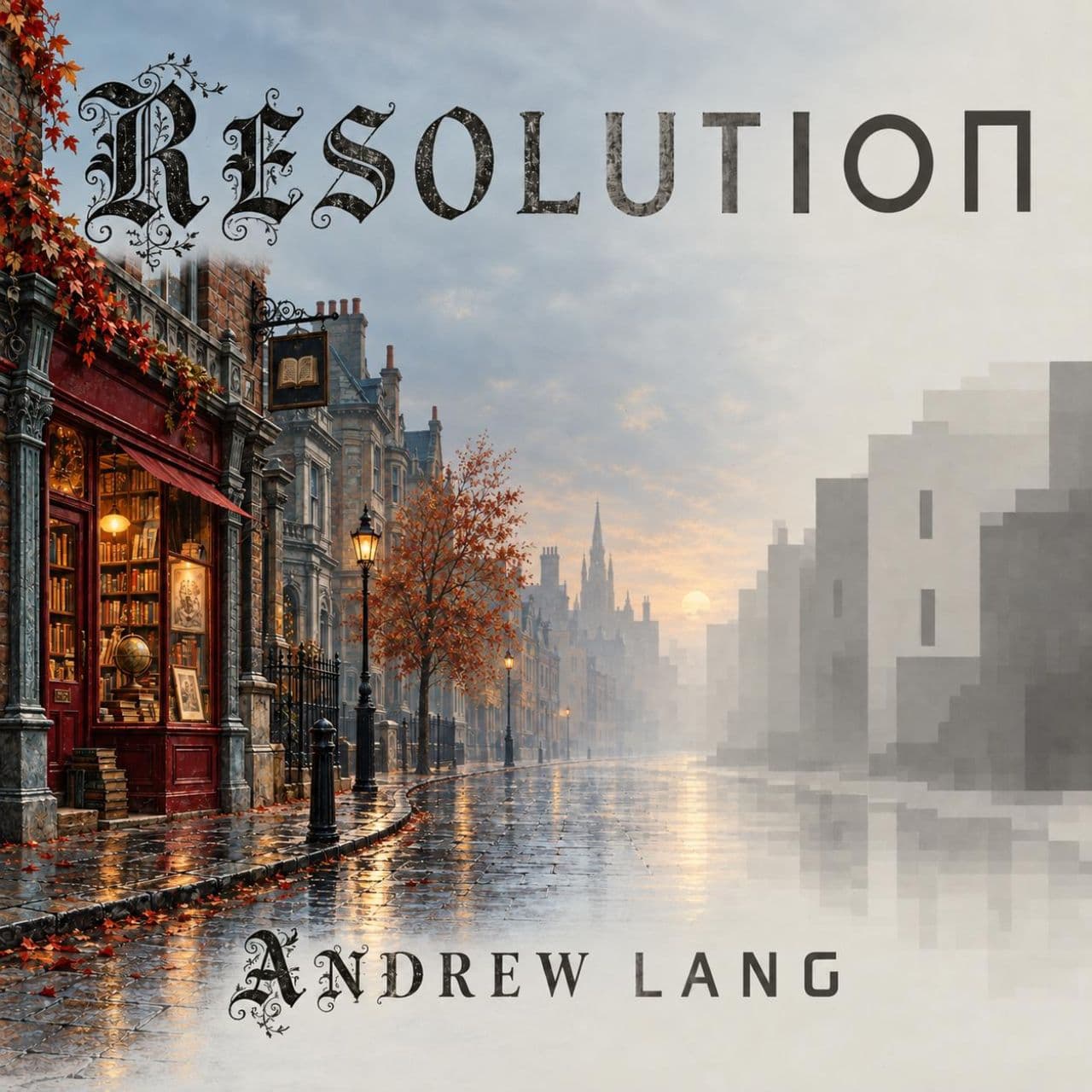
The world was losing its fucking resolution.
There. Fine. He'd said it.
Not branding. Not minimalism. Not corporate enshittification—no, he'd promised himself never to use that fucking word again. This was different. People and places and things were surrendering specificity. Reality still existed, but increasingly as category. Proper nouns collapsed into common nouns. Varieties became types, types became objects, objects became—
He stopped.
The Moon.
Why had that never bothered him?
The Moon was called the Moon.
The Sun was called the Sun.
Two of the most consequential objects available to human perception and civilisation had apparently looked at the naming problem and gone, yes, MOON, SUN, that'll fucking do.
Nobody found that frightening.
Perhaps because there was only one of each that mattered.
No distinction necessary.
Darren looked at the tins.
Perhaps the Moon and Sun had simply got there first.
The bell rang again.
He flinched.
That annoyed him more than the bell.
“Fuck off.”
Again.
He went into the hallway.
Nobody through the peephole.
“Who is it?”
Silence.
There was a new letter on the floor.
Darren could not remember hearing it come through.
No stamp. No letterhead visible. No return address.
One word.
PERSON
He didn't touch it.
The bell rang while he was standing beside it.
Darren jerked backwards.
“Who the fuck is there?”
Nothing.
He remained by the door for some time, listening. He could hear traffic outside, although even traffic had become difficult to trust. There seemed to be less of it. Fewer engines. Fewer horns. Or perhaps people had finally learned how to drive, in which case the collapse of informational reality had at least produced one measurable social benefit.
He nearly laughed.
Didn't.
He went back into the kitchen.
Something was wrong.
Not absent.
Wrong.
The tins were there. The kettle was there. Plates. Rice. Bottles. Cutlery. Toaster. Cupboards. Nothing had disappeared.
Darren stood in the doorway.
THING
On the tins.
“No.”
He picked up what had been soup.
THING
The word was perfectly accurate.
That was the horror of it.
Soup was a thing. A tin was a thing. A tin containing soup was a thing. The new description contained every previous description while preserving almost none of their information, as though language had discovered data compression and become violently ambitious.
Darren put it down.
“What's next?”
The kitchen declined to answer.
He was breathing quickly now.
“Because you can't simplify thing.”
His legs weakened. Darren slid down against the cupboard and sat on the floor. He drew his knees towards his chest.
The bell rang.
He stared towards the hallway.
Ledgerly.
Police.
Max.
Person.
It didn't matter.
Outside was where the next version lived.
The curtains had been closed for days. Darren no longer knew how many. He had food. He had water. Enough for weeks. Months if he rationed it. He could calculate the exact duration.
He wasn't opening the laptop.
He wasn't opening the phone.
He wasn't opening the door.
He certainly wasn't opening the fucking curtains.
The bell rang again.
Darren pressed his forehead against his knees.
“What comes after thing?”
Silence.
Then, because his mind had always been incapable of leaving a question unanswered, it supplied one.
There was only one way left to simplify it.