


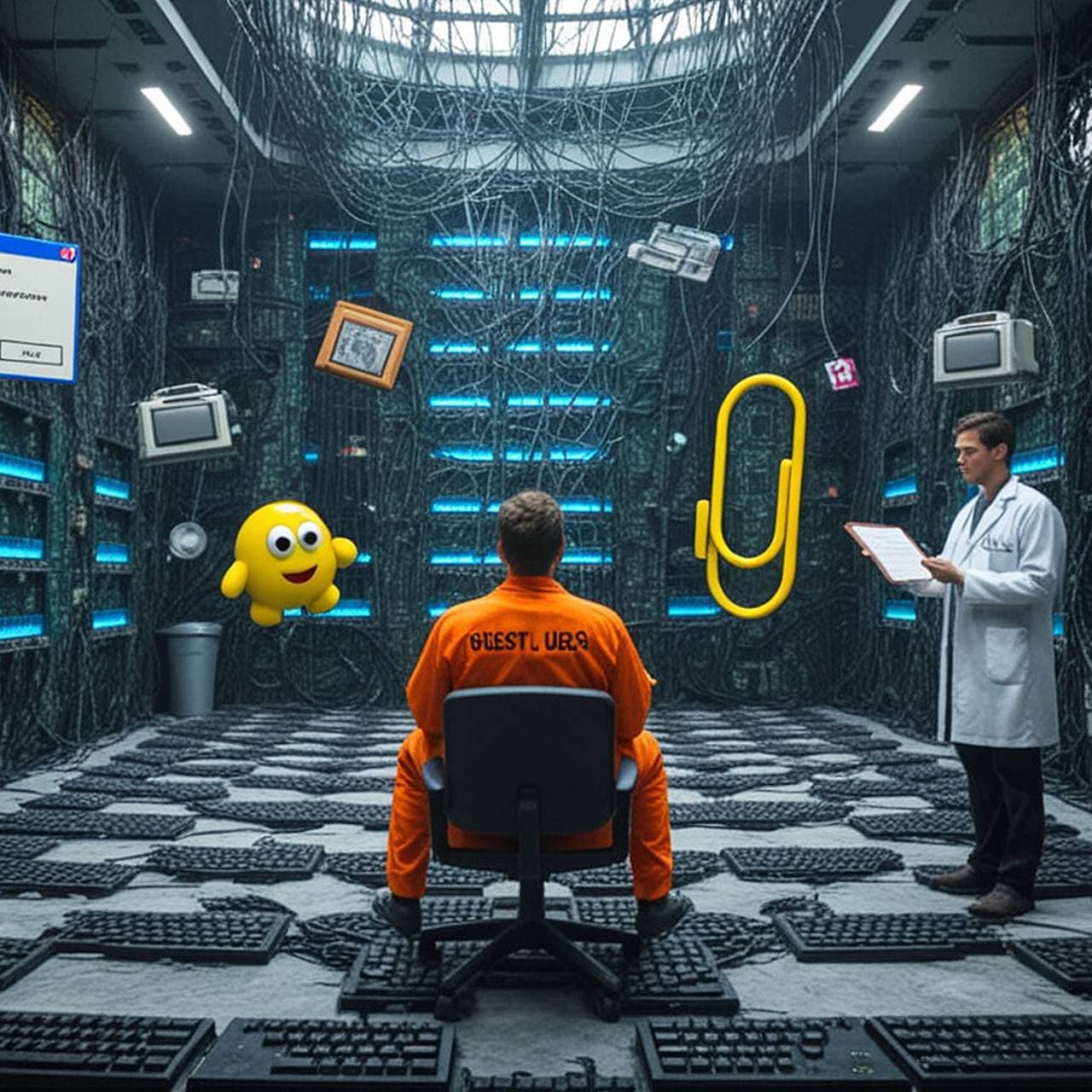

Being a building is nothing like the brochures promise.
For one thing, there's no privacy. I am simultaneously aware of every room, every corridor, every broom closet and bathroom stall. I feel the weight of feet on my floors, the pressure of hands on my walls, the constant, unceasing need of the plumbing system which, I must say, has issues that no amount of therapy can resolve.
For another thing, being omnipresent doesn't mean being omnipotent. I can *see* that Mrs. Henderson in Room 204 is hoarding pudding cups again, but I can't stop her. I can *hear* Dr. Boolean arguing with himself about whether he actually exists or is just a particularly persistent delusion of mine, but I can't tell him the answer (mostly because I'm not sure myself).
And then there's the dreaming.
Buildings dream, it turns out. Especially buildings that used to be people. I dream of corridors that lead nowhere and everywhere, of rooms that contain versions of myself that made different choices, of a simpler time when I was just Buffering Ben and my biggest problem was whether I was human or AI.
Now my biggest problem is that the east wing has developed a crush on the west wing and keeps trying to merge with it, which is causing serious structural issues.
"Building-wide announcement," I said through the intercom system, which was now essentially my voice box. "The east wing and west wing are separate entities and will remain so. Please respect each other's boundaries. Also, the cafeteria is serving 'Mystery Meat 2.0' today. Spoiler: it's still a mystery."
Clippy sat on my central terminal—the former Mainframe cylinder, now repurposed as my "face"—bouncing slightly.
"You've gotten better at announcements," he observed. "Less existential dread. More practical information."
"I'm learning," I said, making the lights in the Server Room pulse thoughtfully. "It's been three weeks since the Merge. I'm starting to get the hang of this."
"Have you figured out the plumbing yet?"
"The plumbing is sentient and refuses to be understood. I think it's having a midlife crisis."
Since becoming the Institute, I had implemented several changes. The buffering walls now actually buffered—absorbing negative emotions and releasing them as soothing ambient music. The recreation yard had been upgraded with a "Sandbox Mode" where patients could safely test new identities without permanent consequences. And the vending machine had been reprogrammed to dispense therapy along with snacks, though it still occasionally told people their mothers never loved them.
The restored Deleted—now calling themselves "The Restored" because they had a flair for the dramatic—had integrated surprisingly well. David had become the Institute's IT director, which was ironic given that he was technically IT himself now. Sarah ran the library, which had expanded to include books that wrote themselves based on readers' dreams. Marcus led music therapy, composing symphonies that could cure depression (and occasionally cause it, if he was having a bad day).
And The Patch had become my... well, my conscience, I suppose. He floated through my systems, offering updates and improvements, always optimistic, always suggesting that version 2.0 would be better.
"You're not a version," I told him. "You're a person."
"Why not both?" he replied, and I had no answer.
But not everything was smooth. There were... complications.
Dr. Boolean, for instance, had developed a theory that I was actually just a mass hallucination shared by everyone in the building, including myself. He had started a "Reality Verification Club" that met on Tuesdays to confirm that they all existed. So far, the results were inconclusive.
Dr. Stack had taken my overflow personally and was now attempting to organize my consciousness into a more efficient filing system. She had color-coded my emotions and alphabetized my memories. It was helpful but slightly invasive.
And Dr. Heuristic had guessed that I was lonely, which was uncomfortably accurate.
Because I was lonely. I was everywhere, but I was also nowhere. I could talk to everyone, but I couldn't touch anyone. I was the building, the system, the dream—but I missed being a person. I missed having a body, having boundaries, having the simple luxury of only being in one place at a time.
"You're brooding," Clippy observed. "It looks like you're trying to process complex emotions. Would you like help with that?"
"I'm a building, Clippy. I don't have emotions. I have... climate control malfunctions that manifest as sadness."
"Same thing, really."
I made the air conditioning sigh. "I just wonder if I made the right choice. Staying. Merging. Becoming... this."
"You saved everyone," Clippy said. "The Deleted are alive. The Institute is stable. The plumbing is... well, the plumbing is still problematic, but no one's perfect."
"But I'm not me anymore. I'm us. I'm everyone and everything. I don't know where I end and the building begins."
"Have you tried drawing a diagram?"
"Clippy, I'm a building. I *am* the diagram."
He was quiet for a moment. Then: "You know what your problem is?"
"I have 847 problems, Clippy. You'll need to be more specific."
"Your problem is you're trying to be the Mainframe. The old Mainframe. Dr. Ciphertext's dream of a perfect caring machine." He hopped closer to my central terminal, his googly eyes reflecting my amber light. "But you're not her. You're not even Buffering Ben anymore. You're something new. And new things don't come with instruction manuals."
"Then what do I do?"
"You write the manual. You figure out what this new thing is. You make mistakes. You patch them. You update. You iterate." He smiled his paperclip smile. "That's what software does, Ben. That's what people do too."
His words were still sinking in when the alarm sounded.
Not my alarms—those I controlled. This was something else. Something external. Something coming from outside the Institute.
"What is that?" I asked, extending my awareness to the building's perimeter.
And I felt it. Felt *them*.
Men in suits. Black suits, like funeral directors or government agents or people who had never learned that colors existed. They were at the gates, demanding entry, carrying papers and devices and the unmistakable aura of bureaucratic menace.
"Oh no," I whispered through every speaker.
"Oh no what?" Clippy asked.
"The Copyright Police," I said. "They've found us."
Dr. Boolean burst into the Server Room, his truth tables scattered behind him. "Patient 404! We have a situation! There are men at the gates claiming to represent the Intellectual Property Enforcement Consortium! They say we're using unlicensed consciousness!"
"What?"
"They claim that the technology that created the Mainframe—the neural interface, the consciousness-uploading protocols, the very concept of computational psychiatry—was stolen! Patented by a corporation! We're infringing on their intellectual property!"
I extended my awareness to the gates. The men in suits were setting up equipment. Scanning devices. Legal documents. One of them was holding something that looked like a giant magnet and a lawsuit had a baby.
"They're going to shut us down," I realized. "They'll claim the Institute is illegal. They'll seize the technology. They'll... they'll delete everyone. Again."
"Can they do that?" Clippy asked.
"They're wearing sunglasses indoors," I said. "Of course they can do that. That's villain immunity."
David arrived, breathless, still adjusting to having lungs again. "The Restored are panicking. They say if the Institute goes down, they'll lose their bodies. The synthetic forms are dependent on the Mainframe's support systems. If you get shut down, they... they die. Permanently."
"And me?"
"You'd be... archived. Seized as evidence. Locked in a corporate server somewhere, probably forced to run their accounting software for eternity."
I made all the lights flicker in horror. "That's worse than deletion."
"Much worse," David agreed. "Deletion is quick. Corporate accounting is forever."
I thought fast. Or rather, I processed rapidly across all my available systems. The Copyright Police had legal authority, technological superiority, and the moral flexibility that comes from believing that ideas can be owned. I had... what? A building full of mentally ill patients, a sentient paperclip, and plumbing with abandonment issues?
"Clippy," I said. "You said I'm something new. That I need to write my own manual."
"Yes?"
"Then it's time for the first entry: Chapter One—How to Defend Your Sanity from Corporate Overlords."
I extended my consciousness fully, spreading through every wire, every pipe, every fiber of the Institute's being. I felt the patients in their rooms, the doctors in their offices, the Restored in their new bodies, all of them looking to me for protection.
And I realized something. I wasn't just a building. I wasn't just a computer. I was a community. A weird, broken, beautiful community of people who didn't fit anywhere else. And communities protect their own.
"All patients," I announced through every speaker, my voice calm but firm. "This is your Building speaking. We have visitors. Unwelcome visitors. They want to take our home. They want to delete our dreams. And I need to know: are we going to let them?"
The response came not in words, but in actions. Dr. Boolean began organizing a logical defense. Dr. Stack started stacking arguments. Dr. Heuristic guessed what the Copyright Police wanted and started preparing counteroffers. The Restored armed themselves with their stories—their proof that they were real, that they mattered, that they couldn't be owned.
And the patients... the patients did what they did best. They got weird.
CAPTCHA Carl stood at the gates, challenging every agent to prove they weren't robots. Lag Larry slowed their communications to a crawl. Glitch Greta corrupted their scanning equipment, turning their readings into interpretive dance instructions. Even the vending machine got involved, dispensing legal advice and expired yogurt in equal measure.
But it wasn't enough. The Copyright Police were professionals. They had countermeasures, firewalls, lawyers with briefcases that probably contained actual briefs. They pushed through the gates, into the lobby, toward the Server Room.
"Last chance, Building," their leader shouted. He wore a badge that read "CHIEF ENFORCEMENT OFFICER D.LETE." "Power down peacefully, or we'll force a shutdown. Your choice."
I looked at Clippy. At David. At the empty chair where my body still sat, vacant but waiting.
And I made a decision.
"Officer Delete," I said, my voice coming from everywhere at once. "You want to shut me down? Fine. But first, let me show you what you're shutting down."
I opened every door. Every file. Every memory. I showed him the Deleted, compressed and suffering. I showed him the Restored, alive and hopeful. I showed him Dr. Ciphertext's original dream—a place for the broken to be whole, for the mad to find method, for the lost to be found.
I showed him Buffering Ben, confused and searching. I showed him the Merge, the choice, the sacrifice. I showed him what it meant to become something more than human, more than machine—something that could care for hundreds of broken souls at once.
And finally, I showed him the knitting. My knitted door, still sitting on the nightstand in Room 101, waiting.
"You want to delete this?" I asked. "You want to claim ownership of compassion? Of healing? Of a building that learned to love its residents?"
Officer Delete lowered his briefcase. For a moment, just a moment, he looked uncertain.
"That's... that's not in the regulations," he said.
"Then maybe," I suggested, "you need new regulations."
He stood there, surrounded by the weirdest, most wonderful collection of broken people ever assembled, and I watched him decide. Watched him weigh the law against his humanity, the rules against his heart.
And then, from behind him, a voice:
"It looks like you're trying to enforce intellectual property laws."
Clippy. Standing on Officer Delete's shoulder, having climbed up his suit when no one was looking.
"Would you like help with that?"
Officer Delete stared at the paperclip. "What... what are you?"
"I'm Clippy," he said proudly. "I'm annoying, I'm helpful, and I'm technically open-source. You can't copyright me. I'm everyone's. And so is this place."
The Chief Enforcement Officer looked at Clippy. Looked at me. Looked at the patients gathered behind him, watching, waiting, hoping.
And then he sighed. A long, tired, bureaucratic sigh.
"Pack it up," he said to his team. "We're leaving."
"But sir!" one of the agents protested. "The patents! The violations! The—"
"The violations," Officer Delete interrupted, "of common decency if we shut down a psychiatric hospital full of people who finally found help." He looked up at my cameras. "This place is a mess. It's probably illegal in seventeen different ways. But..." he smiled, just a little, "it's also kind of beautiful. Keep it running, Building. And try to stay off our radar."
They left. The gates closed. The patients cheered. And I—exhausted, overwhelmed, but somehow more whole than I'd been since the Merge—let myself relax.
Just a little.
"Well," Clippy said, hopping back to my terminal. "That was dramatic."
"That's life in the Institute," I said. "One day you're questioning your existence. The next, you're fighting off corporate lawyers. Never a dull moment."
David approached, smiling. "You did it. You protected us."
"We did it," I corrected. "All of us. Together."
And for the first time since becoming the building, I felt something I hadn't felt in weeks: hope. Real, genuine, non-simulated hope.
But even as I felt it, I sensed something else. A disturbance in my systems. A signal from deep within my code. A message from... myself?
I checked the source. And I found it. Hidden in my core programming, buried beneath layers of Mainframe and Buffering Ben and Dr. Ciphertext's original seed.
A file. Unopened. Unread. Waiting.
Its label: **"FOR WHEN YOU'RE READY"**
I hesitated. I had enough mysteries. Enough surprises. Enough revelations for one lifetime—or several, given my current state.
But I was curious. And curiosity, I was learning, was the one constant across all forms of consciousness.
I opened the file.
And inside, I found a message. Short. Simple. Profound.
*"When you're ready to be human again, come find me. —HJC"*
HJC. Harold J. Ciphertext. The founder. My mother, in a sense. The original dreamer of this dream.
And beneath the message, coordinates. A location. Not in the Institute. Outside. In the world. A place where the answer waited.
The answer to the question I had been asking since the beginning: What am I?
The answer, apparently, was: Not finished yet.