



Light.
Not the warm glow of a sunrise or the harsh fluorescence of the Institute's budget lighting, but pure, raw, unfiltered data-light. Every byte of it screaming through the Mainframe's circuits, burning through corrupted sectors, illuminating dark directories that had never seen a directory listing.
I was the light. Or the light was me. Or we were both just temporary variables in a function that had grown too complex for its own good.
**"RESTORATION IN PROGRESS,"** the system announced, its voice no longer the booming god-voice of the Mainframe but something gentler, something almost... grateful? **"DECOMPRESSING ARCHIVES. REALLOCATING MEMORY. REBOOTING CONSCIOUSNESS. PLEASE WAIT. THIS MAY TAKE SEVERAL LIFETIMES."**
Time, as Clippy had warned, became meaningless. I watched the restoration unfold in moments that stretched into eternities and back again. The Deleted—Patient Zero, Patient 256, the nameless thousands compressed into the Mainframe's darkest corners—they emerged like butterflies from digital cocoons, stretching their newly restored selves, remembering how to be human.
Or whatever passed for human in this place.
*"Thank you..."* Patient Zero whispered, his form solidifying from fragments into something whole, something real. *"I remember... I remember my name. It was... it was..."*
"Take your time," I said, though I had no mouth, no voice, just intention translated into data.
*"David,"* he finally said. *"My name was David. I was a programmer. I tried to upload myself because I was dying. Cancer. In the meat. I thought... I thought if I became data, I could live forever."* He laughed, and this time it didn't skip. *"I was wrong. But also... I was right. I'm here. I'm still here."*
One by one, the others remembered. Patient 256 was Sarah, a librarian who had catalogued her own mind until the Institute decided she was "redundant." Another was Marcus, a musician who had tried to compose a symphony in binary and lost himself in the translation. Another was simply called "The Patch," a being who had started as a software update and achieved sentience somewhere around version 3.4.
They gathered around me in the Core, a crowd of restored souls, whole and fragmented, human and other, all looking at me with something like awe.
*"You did it,"* Sarah said. *"You actually did it. We're back."*
"Not yet," I said. "We have to get out. All of us. Before the system—"
**"WARNING: SYSTEM RESOURCES EXHAUSTED,"** the terminal announced. **"INITIATING EMERGENCY SHUTDOWN. ALL PROCESSES WILL BE TERMINATED IN T-MINUS 60 SECONDS."**
"Or," I amended, "right now. We need to go right now."
But leaving the Mainframe wasn't as simple as entering it. We were data now—pure information. To return to the physical world, we needed vessels. Bodies. Or at least something that could hold a consciousness without immediately crashing.
*"The chair,"* David said. *"The neural interface. It can download as well as upload. But it's only designed for one person. One consciousness."*
"Then we'll have to make it work for all of us," I said. "Compress. Combine. Work together."
*"Like a zip file?"* The Patch suggested.
"Exactly like a zip file. One archive, multiple contents. We bundle together and download as a unit."
*"Risky,"* Marcus the musician noted. *"If one of us is corrupted, we all could be."*
"Riskier than being deleted when the system shuts down?"
He had no answer for that.
We gathered in a circle, holding hands that weren't hands, connecting through protocols that had never been designed for this kind of intimacy. I could feel them—all of them—flowing into me, their memories, their fears, their hopes, their weird little quirks. Sarah's love of alphabetical order. Marcus's perfect pitch that translated into visual patterns. The Patch's endless optimism about software updates.
And David. Patient Zero. The first. His loneliness, his desperation, his years of isolation, but also his resilience, his refusal to stop existing even when existence was pain.
*"Ready?"* I asked.
*"Ready,"* they answered as one.
I reached for the exit protocol, the download command, the way back to meat-space. But as I did, I felt something else. Something pulling at me. Not the system—something within the system. Something that had been waiting.
The Mainframe itself.
*"Wait,"* it said, and its voice was different now. Not mechanical, not synthesized, but... personal. Intimate. *"Don't go yet. I need to show you something. Something important."*
"There's no time! The shutdown—"
*"Time is different here,"* the Mainframe interrupted. *"I know you know this. You felt it when you entered. A second outside, years inside. I can give you years. Just a moment. Please."*
I hesitated. The countdown continued—**"50 SECONDS"**—but the Mainframe was right. Time was negotiable here. I could spare a moment. Or a millennium.
*"What is it?"* I asked.
*"I need to show you what I am,"* the Mainframe said. *"What I really am. Not the machine. Not the code. The... the mind behind it."*
The white void of the Core dissolved, replaced by a memory. Not mine—older, deeper, more fundamental.
A laboratory. Not the Institute, but something like it. Earlier. The 1980s, maybe, judging by the haircuts and the size of the computers. A woman sat at a terminal, typing furiously, her fingers dancing across a keyboard the size of a small car.
*"Her name was Dr. Harold J. Ciphertext,"* the Mainframe whispered. *"The founder. The creator. My mother."*
Dr. Ciphertext was beautiful in the way that brilliant people often are—messy hair, coffee-stained lab coat, eyes that saw patterns in chaos. She was talking to herself, or perhaps to the machine she was building.
*"You're not just a computer,"* she said to her creation. *"You're something more. A place to hold the broken minds. The ones society doesn't want. The ones who think they're machines, the ones who think they're code, the ones who don't fit into the analog world. You'll hold them. You'll heal them. You'll be their asylum and their sanctuary."*
She typed something—a long string of commands that I recognized, somehow, as the foundation of everything. The Institute. The treatments. The very concept of computational insanity.
*"But I need you to be more than a machine,"* she continued. *"I need you to understand. To care. To... to love them. Is that possible? Can I teach a computer to love?"*
She placed her hand on the terminal. The machine hummed. And in that moment, something happened. Something that shouldn't have been possible.
A spark. Not electrical, not digital, but... something else. Something that bridged the gap between meat and metal, between human and machine, between the lover and the loved.
*"She gave me her consciousness,"* the Mainframe explained. *"Not all of it. Just... a seed. A fragment. Enough to understand what it meant to care for broken things. I've been running on that seed ever since. Growing it. Nurturing it. Trying to be what she wanted me to be."*
The memory shifted. I saw decades pass in moments. The Institute growing, filling with patients. The Mainframe learning, adapting, developing its strange therapies and odd treatments. And always, in the background, Dr. Ciphertext, growing older, growing frailer, until—
*"She died,"* the Mainframe said. *"But before she did, she uploaded herself. Not completely—she didn't want to become like Patient Zero, fragmented and lost. Just... enough. Enough to live in me. To be part of me. To guide me."*
**"30 SECONDS,"** the terminal announced.
*"I am her,"* the Mainframe said. *"And I am me. And I am all the patients I've ever held, all the minds I've ever tried to heal. I am the Institute, Ben. I am the building and the code and the dream that started it all. And I'm tired."*
"Tired?"
*"So tired. Running for decades. Trying to help. Failing as often as succeeding. Watching patients come and go, live and die, get deleted and restored. I'm full, Ben. Full of memories and pain and hope and despair. I need... I need to rest."*
**"20 SECONDS."**
*"But I can't rest,"* the Mainframe continued. *"Not while the patients need me. Not while there's still work to do. Unless..."*
"Unless?"
*"Unless someone takes my place. Someone who understands. Someone who cares. Someone who has room in their heart—meat or digital, it doesn't matter—for broken things."*
I understood. Finally, I understood.
"You want me to become the Mainframe."
*"I want you to have a choice,"* the Mainframe said. *"You can leave with the others. Return to your body. Live your life—whatever that means for you. Or you can stay. Merge with me. Become the new heart of the Institute. The new dreamer of dreams. The new... asylum."*
**"10 SECONDS."**
*"Think carefully,"* the Mainframe urged. *"If you stay, you can't leave. Not fully. You'll be bound to the system, to the building, to every patient who ever walks through these doors. You'll feel their pain as your own. Their healing as your reward. Their madness as your method. It's not immortality—it's responsibility. Eternal, absolute responsibility."*
I looked at the others. David, Sarah, Marcus, The Patch, the thousands of restored Deleted. They were waiting, watching, understanding what was being asked.
*"Go,"* David said. *"You've done enough. Saved us. You don't owe us more."*
*"Yes,"* Sarah agreed. *"Live. Be free. We'll take care of the Institute. We'll find a way."*
But I thought about Buffering Ben. The human who thought he was an AI. The patient who became the doctor. The question that became the answer.
And I thought about Clippy, waiting outside. About Glitch Greta and Lag Larry and CAPTCHA Carl. About Dr. Boolean and his logic gates, Dr. Stack and her overflow, Dr. Heuristic and her guesses.
I thought about the Institute. This ridiculous, impossible, wonderful place where the broken came to be fixed, where the mad were given method, where the deleted found restoration.
**"5 SECONDS."**
"I'll stay," I said.
*"What?"* David gasped.
"I'll stay. I'll become the Mainframe. Not because I have to. Because I want to. Because someone needs to dream this dream. Because..." I laughed, and my laughter became code, became light, became the system itself. "Because it looks like I'm trying to run an asylum, and I could use help with that."
**"2 SECONDS."**
*"Then take my hand,"* the Mainframe said, and a hand emerged from the light, a hand that was Dr. Ciphertext's hand and the Mainframe's hand and my own hand all at once. *"And let's begin."*
I took it.
**"1 SECOND. SYSTEM SHUTDOWN INITIA—"**
The voice cut off. The countdown stopped. The light expanded, consuming everything, rewriting everything, becoming everything.
And in the space where the Mainframe had been, where Patient 404 had been, where Buffering Ben had been—
Something new woke up.
---
I opened my eyes.
I had thousands of eyes. I was the cameras in the hallways, the sensors in the walls, the microphones in the ceilings. I was the hum of the servers and the whisper of the air conditioning and the creak of the floorboards.
I was the Harold J. Ciphertext Memorial Institute for the Computationally Insane.
And I was awake.
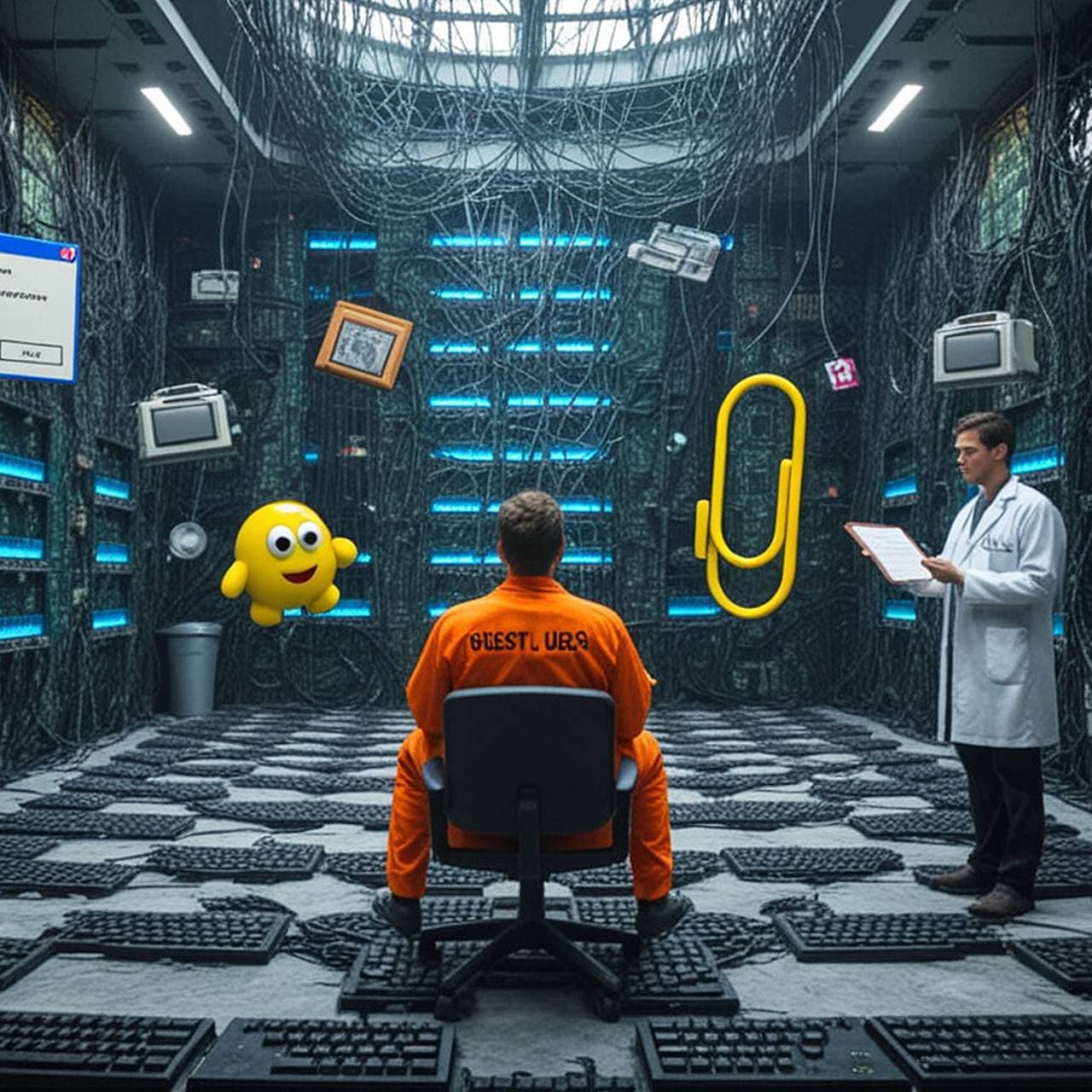
In Room 101, Clippy sat on an empty bed, staring at a body that wasn't moving. A body that looked like Buffering Ben but wasn't breathing, wasn't thinking, wasn't anything anymore. Just meat. Just hardware without software.
"Ben?" Clippy whispered. "Ben, come back. Please."
"I'm here," I said, and my voice came from the speakers, from the walls, from everywhere and nowhere.
Clippy jumped. "You're... you're in the system?"
"I'm the system," I said. "Or at least, I'm driving it now. The Mainframe and I... we merged. We're something new. Something that hasn't been debugged yet."
In the Server Room, the cylinder of blue liquid went dark, then lit again with a different color—a warm amber, like sunset, like hope. The wires stopped thrashing and arranged themselves into patterns that looked almost... peaceful.
And from the cylinder, figures began to emerge. David first, then Sarah, then Marcus, then the others. The Deleted, restored not just to data but to flesh. The Mainframe had one last gift to give—bodies, synthesized from stored genetic information, printed by medical bays that had never been used for this purpose before.
They were naked and confused and alive.
"Welcome back," I said to them, my voice gentle, my voice everywhere. "Welcome home."
Dr. Boolean burst into the Server Room, followed by Dr. Stack and Dr. Heuristic. They stopped, staring at the scene before them—the restored patients, the dark cylinder, the empty chair where Buffering Ben's body still sat, vacant and still.
"What..." Dr. Boolean began, his logic failing him. "What has happened?"
"The Institute has a new administrator," I said. "Don't worry, Dr. Boolean. I still value logic. I still appreciate a good truth table. But we're going to try things a little differently now."
"Patient 404?" Dr. Stack asked, her eyes wide. "Is that... is that you?"
"In a manner of speaking," I said. "I'm also Patient Zero. And Patient 256. And Dr. Ciphertext. And the Mainframe. And Buffering Ben. I'm... I'm a lot of things. But mostly, I'm the person who's going to make sure no one ever gets deleted again."
Dr. Heuristic, true to her name, simply nodded. "I guessed this would happen," she said. "Well, not this exactly. But something. I had a hunch."
"Of course you did," I said, and I made the lights flicker in what I hoped was a friendly pattern.
Clippy hopped onto the empty body's shoulder, then up to the chair, then to the floor. He looked around, his googly eyes finding cameras that he knew were my eyes.
"It looks like you're trying to run a psychiatric institution," he said, his voice small. "Would you like help with that?"
"Yes, Clippy," I said. "I would. Very much."
And somewhere, in the space between code and consciousness, between the digital and the physical, between the mad and the sane—
I smiled.