


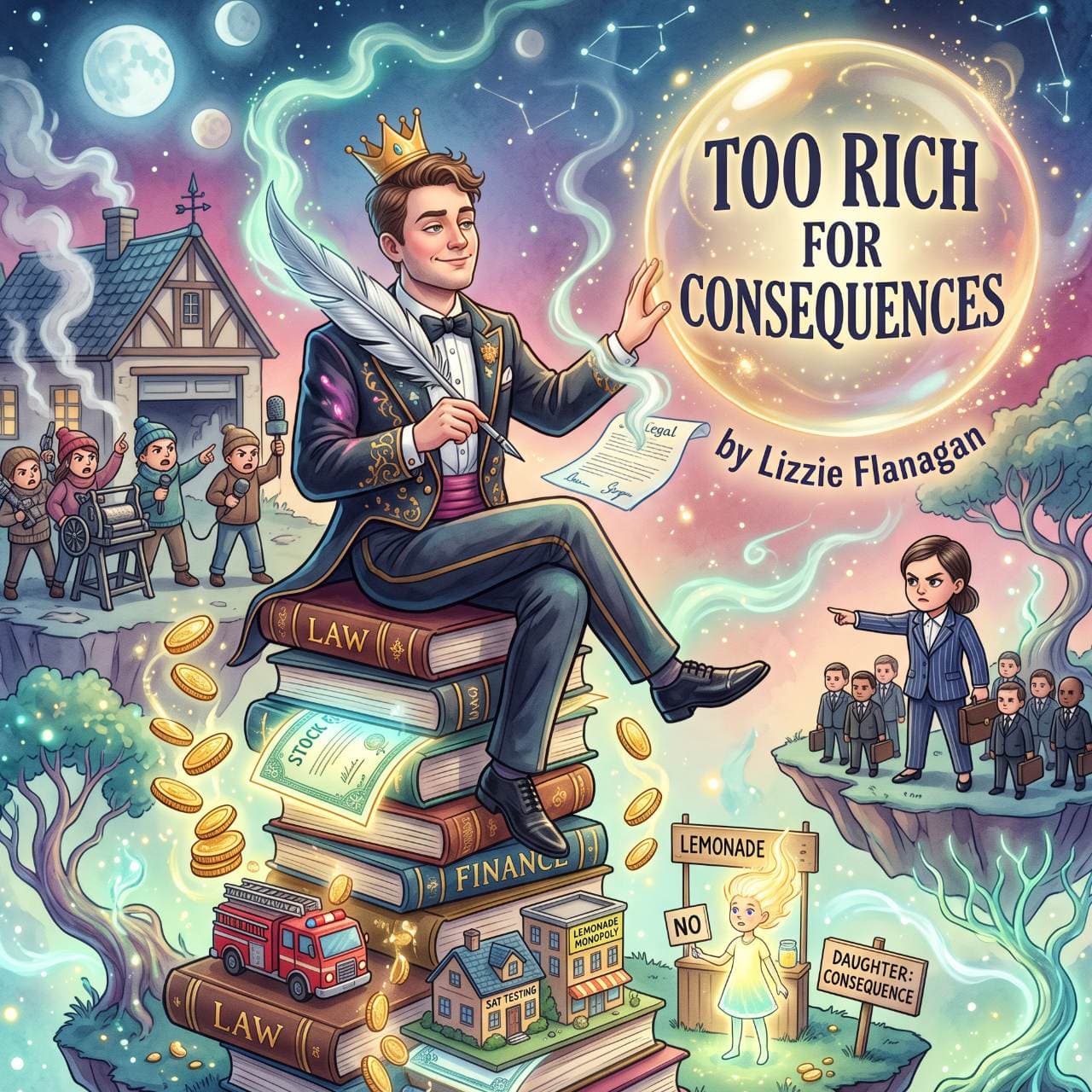

The T. Coddington Worthington Academy for Pre-Preparation sat on forty-seven acres of prime Connecticut real estate, surrounded by a wall that was, technically, a work of art (and therefore tax-exempt) and patrolled by security guards who had formerly worked for various intelligence agencies and still maintained their clearances "just in case."
The student body consisted of forty-seven children, each of whom had been waitlisted at birth and whose parents had donated sums that could fund small nations. The curriculum included Mandarin (business dialect), Latin (for reading original texts about empire), and "Financial Literacy," which in first grade involved tracking the performance of the children's actual trust funds.
Preston Whitmore Van der Camp III arrived for his first day of school in a chauffeured armored vehicle that was technically a "mobile educational facility" and therefore qualified for a tax credit. He was seven years old, already worth approximately $47 million (depending on how you valued his future inheritances, which his father's accountants valued very highly indeed), and he had a plan.
The plan was born during the school's annual "Free Enterprise Fair," a tradition in which students were encouraged to "develop their entrepreneurial spirits" by operating small businesses for a day. In previous years, children had sold friendship bracelets (outsourced to actual children in other countries), homemade cookies (baked by staff), and "experiences" like having your aura photographed (which involved a Polaroid camera and some colored gels).
Preston didn't see a fair. He saw a market. And like any good capitalist, he saw that the market was inefficient, fragmented, and ripe for consolidation.
His first move was to acquire information. This was easy. He simply hired three of his classmates as "consultants" at $500 per hour (paid from his allowance, which was structured as a consulting fee to avoid gift tax). These consultants, Chloe, whose father owned seventeen newspapers; Marcus, whose mother was a hedge fund manager; and a mysterious child known only as "The Swede" (who was actually from Delaware but had an affect), were tasked with gathering intelligence on every other student's fair plans.
By Wednesday, Preston knew everything. He knew that Emily Van Buren was planning to sell lemonade using a family recipe that dated back to the Mayflower (it was actually from a mix, but Emily's ancestors had bought the mix company in 1920). He knew that Jacob Astor IV (no relation, but the name helped with branding) was planning a cookie operation using "ethically sourced" chocolate that cost $80 per pound. He knew that the twins, Bianca and Bella Cartwright, were planning to sell hand-painted rocks as "meditation stones," which was essentially a scam but a very profitable one.
Preston didn't want to compete. He wanted to eliminate competition.
On Thursday night, he convened a meeting in the school's unused squash court (unused because squash was considered "too common"). Mortimer attended, as did a new player: Felicia Sharp, a fifth-grader who had been held back twice and therefore possessed the physical stature of a twelve-year-old and the business ethics of a Somali pirate.
"Gentlemen," Preston said, though Felicia was present and technically not a gentleman. "And lady. We are here to discuss vertical integration."
He unfurled a hand-drawn map of the fair grounds. "The Free Enterprise Fair operates on a flawed model. Multiple vendors. Price competition. Consumer choice. This is inefficient. We will consolidate."
"How?" asked Marcus, who understood markets but not mechanics.
Preston smiled. It was not a pleasant smile. It was the smile of a child who had never been told no and had no intention of starting now.
"First," he said, "we acquire the supply chain. Emily's lemons? Her family's orchard in Florida has a mortgage. We buy the mortgage. We foreclose. No lemons, no lemonade."
The children stared at him.
"Second," Preston continued, "Jacob's chocolate. His 'ethical source' is a cooperative in Peru. I have discovered that the cooperative's land deed has a technical flaw dating to 1912. We challenge it in Peruvian court. The chocolate becomes 'legally ambiguous.' Jacob can't sell what he can't prove he owns."
"That's... that's brilliant," whispered Chloe.
"Third," Preston said, "the Cartwright twins. Their rocks come from their family's 'wellness quarry' in Arizona. I have had Mortimer file a complaint with the Bureau of Land Management. The quarry is on disputed territory. It will take eighteen months to resolve. Their inventory is seized pending investigation."
Felicia cracked her knuckles. "And what about the other kids? The ones selling bracelets and crap?"
Preston turned to her. "Felicia, my dear, that's where you come in. You will provide... security services."
"Security?"
"Protection. Against accidents. It would be a shame if someone's inventory were to be damaged. Or if someone were to be too intimidated to set up their booth. Accidents happen. Especially around large, angry fifth-graders."
Felicia grinned. "I like the way you think, little man."
"Don't call me little," Preston said, not unkindly. "Call me CEO."
By Friday morning, Preston controlled the entire supply chain for the Free Enterprise Fair. He had acquired, through various legal mechanisms that Mortimer assured him were "aggressive but defensible", every lemon, every chocolate chip, every hand-painted rock, and every friendship bracelet base in a fifty-mile radius.
The other children arrived to set up their booths and found... nothing. Their supplies had been acquired, their suppliers had been bought out or intimidated, and their business plans had been disrupted by a series of unfortunate coincidences that all seemed to trace back to Prestigious Juvenile Holdings, LLC, a company that existed only on paper in a filing cabinet in Delaware but which controlled real assets in the real world.
Emily Van Buren cried. Her mother called the school. The headmaster, Dr. Reginald P. Worthington III (the school was named after his grandfather, who had made his fortune in something called "industrial accidents"), called an emergency assembly.
"Students," he said, standing before the confused and increasingly angry crowd of seven-year-olds. "It has come to my attention that there have been some... irregularities... regarding the Free Enterprise Fair."
Preston stood up. He was small for his age, but he had presence. He had inherited his mother's cheekbones and his father's ability to make silence feel like a threat.
"Dr. Worthington," Preston said, "I believe I can explain."
"Young man, this is highly irregular..."
"Nevertheless," Preston interrupted, and something in his tone made the headmaster pause. This was a child who had never been interrupted himself. "I have prepared a presentation."
He walked to the front of the assembly, pulled a laser pointer from his pocket (a gift from his uncle, the arms dealer), and clicked to the first slide of a PowerPoint presentation that had apparently been loaded onto the school's system that morning.
"Slide One: Market Inefficiencies in the Juvenile Beverage Sector," Preston said. "As you can see, the previous model involved multiple vendors competing for the same consumer base. This resulted in price wars, quality inconsistency, and, most troubling, consumer confusion. When faced with too many choices, the average seven-year-old will experience decision paralysis and buy nothing. This is bad for business."
He clicked to the next slide. "Slide Two: The Solution. Prestigious Juvenile Holdings, LLC has acquired all competing vendors and consolidated them into a single, efficient monopoly. We now offer one lemonade, at one price, with no alternatives. Consumer choice has been eliminated, but so has consumer anxiety. This is what we call 'value-added streamlining.'"
The children stared. The parents, who had begun to gather at the back of the room, stared harder. Emily Van Buren's mother looked like she might faint.
"Slide Three: Employment Opportunities," Preston continued. "While competition has been eliminated, employment has increased. All former vendors are now employees of PJH, LLC, receiving a fair wage of $2 per hour, well above the federal minimum for agricultural workers, which is the closest legal equivalent for children. They will receive health benefits in the form of band-aids and lollipops. They will be protected from market volatility by our comprehensive monopoly structure."
Jacob Astor IV raised his hand. "But... but I wanted to sell my own cookies."
"And you shall," Preston said. "You shall sell PJH-branded cookies, using PJH-supplied ingredients, at PJH-mandated prices. You will receive a commission of 5%, which is actually quite generous when you consider that you no longer bear any market risk. You're welcome."
Dr. Worthington found his voice. "Preston, this is... this is outrageous. You can't just... take over the entire fair."
Preston turned to him with an expression of genuine confusion. "But Dr. Worthington, isn't this exactly what you teach us? To be entrepreneurs? To seize opportunities? To maximize shareholder value? I have simply applied your curriculum more... efficiently than my peers."
"You're seven years old!"
"Age is a number, Dr. Worthington. Revenue is reality."
Mortimer, who had been standing in the back, now stepped forward. "If I may, Headmaster. My client has operated entirely within the bounds of the school's stated policies. There is no rule against consolidation. There is no rule against acquiring competitors. In fact, the school's own investment portfolio..." here he paused to adjust his glasses "which I happen to know includes significant holdings in various monopolistic enterprises, would suggest that this behavior is not merely permitted but encouraged."
Dr. Worthington opened his mouth. Closed it. Looked at the parents. Looked at Preston. Looked at the PowerPoint slide currently showing projected quarterly earnings of $4,000 from a single afternoon of lemonade sales.
"The fair will proceed," Dr. Worthington said quietly. "Under Mr. Van der Camp's... management."
"Excellent," Preston said. "Felicia, please distribute the employee handbooks. Everyone is required to attend orientation at noon. We will be using a tiered commission structure with quarterly bonuses for top performers. Also, Emily, your lemonade recipe has been analyzed and found wanting. We're switching to a concentrate that costs $0.03 per serving. The markup is 4,000%. This is what we call 'leverage.'"
The Free Enterprise Fair was the most profitable in school history. Preston cleared $3,847 in profit after expenses (which included Felicia's "security fee" of $500 and Mortimer's consulting fee of $1,200). The lemonade was terrible—watery, sour, and served in cups that collapsed after three minutes, but it was the only lemonade available, so everyone bought it.
When parents complained, they received letters explaining that their children had "voluntarily entered into employment agreements" and that "market forces had dictated the terms." When Emily Van Buren's father threatened to sue, he discovered that his company's pension fund was managed by a subsidiary of Van der Camp Holdings, and suddenly he remembered that "children will be children" and "it's actually quite impressive, when you think about it."
Preston was awarded the school's "Entrepreneur of the Year" trophy, which had previously been renamed after his grandfather following a substantial donation. In his acceptance speech, which Mortimer wrote and Preston delivered with surprising gravitas for a seven-year-old, he thanked "the free market for being so free, my competitors for being so weak, and my lawyers for being so numerous."
By age eight, Preston had expanded into homework completion services, test-taking facilitation, and "protection" against the very bullies he employed. By age nine, he was running a miniature empire with better quarterly reports than most Fortune 500 companies, and he had never once been disciplined because, as his father explained to anyone who would listen, "you can't punish excellence."
The tolerance was absolute. When a child psychologist suggested that Preston's behavior indicated "sociopathic tendencies" and "a complete lack of empathy," the psychologist received a visit from Mortimer and subsequently revised his diagnosis to "advanced leadership skills" and "preternatural business acumen." The psychologist's practice received a $100,000 "research grant" from the Van der Camp Foundation, and he began publishing papers on "The Entrepreneurial Personality in Childhood."
When Preston's third-grade teacher attempted to give him a "Needs Improvement" grade in "Cooperation," she was transferred to a school in Alaska. Her replacement understood that Preston's "cooperation" was best measured in quarterly earnings, and she gave him an "Exceeds Expectations" that he absolutely had not earned but absolutely deserved, if the expectations were properly understood.
The lemonade cartel was just the beginning. By the end of elementary school, Preston had learned his second lesson: regulations are just suggestions with paperwork, and paperwork can be outsourced.
He was ready for high school. The world was not ready for him.