



Everyone has a story. That's what they tell you in writing workshops, anyway. Everyone has a story worth telling, worth reading, worth publishing and turning into a movie starring someone handsome who doesn't quite look like you but captures your "essence."
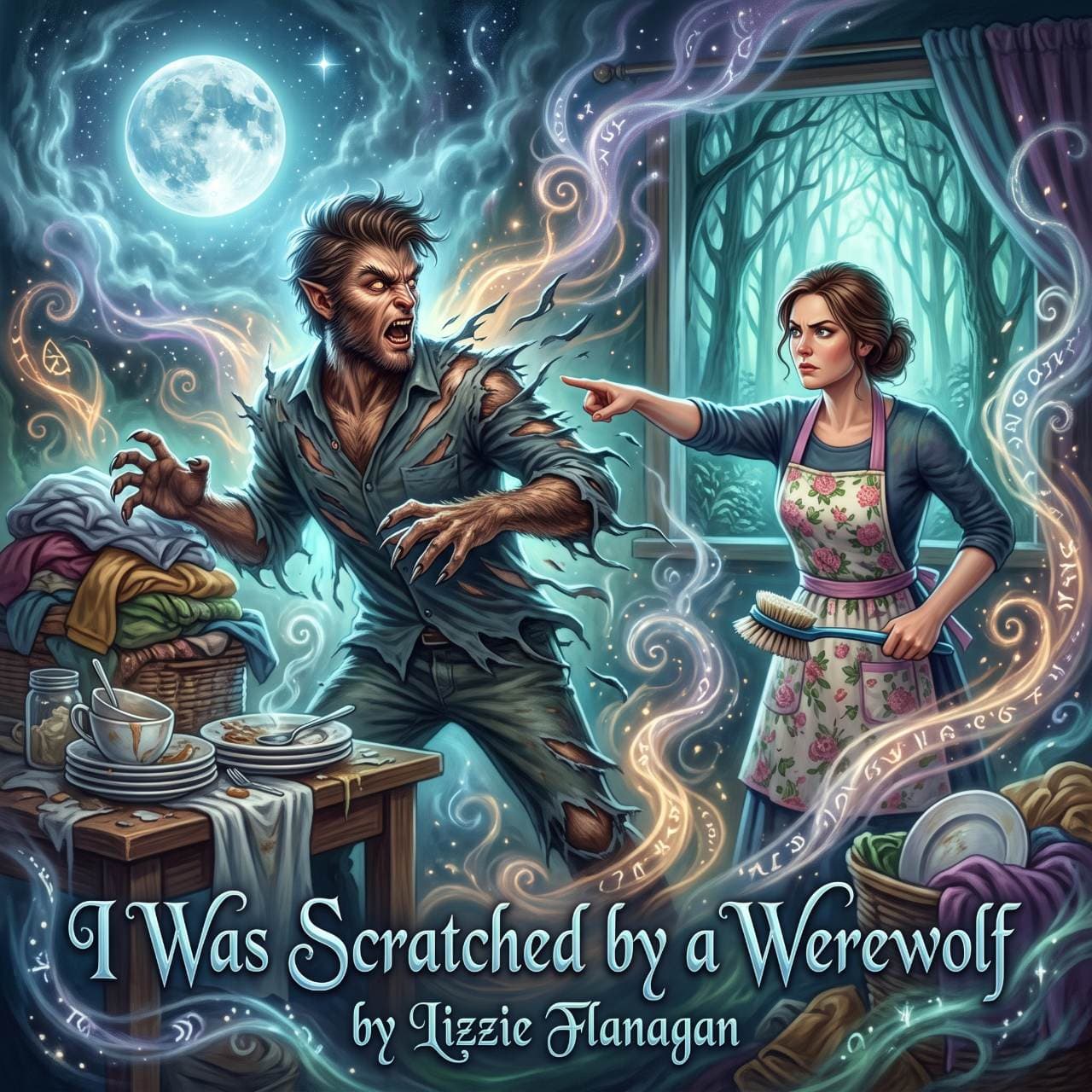
My story, I thought, was particularly worth telling. I was a werewolf. A real one. Not the Hollywood kind with perfect abs and dramatic backstories about cursed ancestors. I was a middle-aged insurance salesman who got scratched during a camping trip and discovered that lycanthropy was mostly about paperwork, marital negotiation, and learning to live with excessive body hair.
It was comedy. It was tragedy. It was domestic realism with supernatural elements. It was, I believed, a bestseller waiting to happen.
"Deborah," I announced one Saturday morning, approximately five months into my condition, "I'm going to write a memoir."
She was weeding the garden and didn't look up. "That's nice, dear. Make sure you use spellcheck."
"No, I mean a real memoir. A book. About my life. My transformation. Our marriage. The whole werewolf experience."
She pulled a dandelion with more force than necessary. "Gary, who would want to read that?"
"Everyone! People love transformation stories. It's the hero's journey. Ordinary man, extraordinary circumstances, personal growth, return with wisdom to share."
"Your 'hero's journey' involves eating a book and getting a rash from silverware."
"Exactly! It's relatable! It's funny! It's... human. Even when I'm not human."
She sat back on her heels. She looked at me, her hands dirty from the soil, her hair escaping from its ponytail, her expression that particular blend of love and exhaustion that she reserved for my more ambitious announcements.
"Gary," she said, "if you want to write a book, write a book. But promise me something."
"Anything."
"Promise me that when you're done, you'll let me read it before you show it to anyone else. Anyone. Including your mother. Including the internet. Including that weird guy at the grocery store who always asks about your 'condition.'"
"I promise," I said, already envisioning my book tour, my interviews, my appearance on morning television where I would explain lycanthropy to a fascinated nation.
I started writing that afternoon.
The memoir poured out of me like... well, like the wolf pouring out of me during full moons. Unstoppable, messy, and occasionally resulting in something that needed to be cleaned up afterward.
I wrote in the basement, at my desk in the den, surrounded by my wolf things and my memories. I wrote about the camping trip. About Doug and the gouda. About the scratch, the first transformation, the horror and wonder of becoming something else.
I wrote about Deborah. About her patience, her strength, her terrifying efficiency in the face of supernatural chaos. I wrote about our marriage, the negotiations, the petty wars, the love that persisted through fur and fangs and ruined dinner parties.
I wrote about the DMV, the fake union, the scientific study, the silver rashes. I wrote about Emperor Napoleon and his dominance over my couch. I wrote about Mrs. Gonzalez and her suspicions, the HOA battles, the lycanthropy chic trend that had thankfully died down.
I wrote 50,000 words in three weeks. I was prolific. I was inspired. I was, I believed, the voice of a generation of middle-aged men dealing with unexpected supernatural conditions.
Then I gave it to Deborah to read.
She disappeared into the bedroom with the manuscript. I heard nothing for two hours. No pages turning, no comments, no reactions. Just silence.
Finally, she emerged. She held the papers in her hands. Her expression was unreadable.
"Well?" I asked, unable to contain my excitement. "What do you think?"
"Gary," she said slowly, "we need to talk."
My heart sank. "It's bad?"
"It's... it's something. It's definitely something." She sat down. She set the manuscript on the coffee table. She steepled her fingers like a CEO about to deliver bad quarterly earnings.
"First," she said, "the good. It's... energetic. You clearly have passion for the material. And some of the scenes are genuinely funny. The part where you tried to sue the moon? That made me laugh."
I perked up. "Really?"
"However," she continued, and I sank again, "there are some issues. Some significant issues that need to be addressed before this goes anywhere."
"Like what?"
"Like the fact that you've portrayed me as a 'terrifying she-demon who rules with an iron fist and the threat of frying pan violence.'"
I blinked. "I didn't say that."
"You wrote: 'Deborah, my wife, is a force of nature unto herself, a hurricane in human form, a woman who could make a drill sergeant weep with her organizational standards.'"
"That's... that's a compliment!"
"You also wrote that I 'weaponized perfume like a chemical warfare specialist' and that my disapproval is 'more frightening than any full moon transformation.'"
"Well... I mean..."
"And then there's the scene where you describe me 'sabotaging a research institute with the ruthless efficiency of a crime boss,' which, while technically accurate, makes me sound like I'm running a mafia family."
"I was trying to show your strength! Your loyalty! Your willingness to protect me!"
"You made me sound like a supervillain, Gary. A supervillain who happens to do your laundry."
I looked at the manuscript. I looked at her. I realized, slowly, that I had a problem.
"Also," she continued, "you've revealed private information about all our neighbors. Mrs. Chen's 'suspicious nature and potential witchcraft.' Mr. Henderson's 'midlife crisis tail-wearing.' The Johnsons' son's marijuana. You can't publish this. We'll be sued. We'll be ostracized. We'll have to move."
"But... but it's true. It's all true."
"Truth is not a defense against libel, Gary. Or against being a terrible neighbor."
She picked up the manuscript. She held it like it was a dead thing, something that needed to be disposed of before it caused an outbreak.
"I'm going to edit this," she said. "Heavily. I'm going to redact names, change details, soften characterizations, and remove the chapter where you describe our intimate life as 'navigating the challenges of lycanthropic marriage including the difficulty of finding positions that accommodate tails.'"
"We don't have tails in human form!"
"And yet you wrote three pages about it. Including diagrams."
I had forgotten about the diagrams.
"Deborah," I said, my voice small, "is it salvageable?"
She looked at the manuscript. She looked at me. She sighed.
"Maybe," she said. "With enough work. Enough redaction. Enough pretending that you're writing fiction instead of memoir. We can call it... 'The Domestic Wolf.' A novel. About a man who thinks he's a werewolf but might just be having a breakdown. That way, if anyone recognizes themselves, we can claim it's coincidence."
"A novel," I repeated. "Not a memoir."
"A novel," she confirmed. "And I get final approval on every chapter. Every paragraph. Every sentence that mentions me."
I agreed. Of course I agreed. I had no choice. Deborah was my editor now, my gatekeeper, my protector against my own lack of judgment.
She spent three months rewriting my memoir into a novel. She changed names—Mrs. Gonzalez became "Mrs. Park," Mr. Henderson became "Mr. Garcia," Deborah became "Rebecca" (which she said was "distant enough to be deniable but close enough that I still recognize myself"). She removed the lawsuit against the moon. She removed the scientific study sabotage. She kept the humor but added nuance, warmth, humanity.
When she was done, it was actually... good. Better than what I had written. It was a story about marriage, really, disguised as a werewolf story. A story about love enduring through transformation, about partnership surviving the impossible, about finding the extraordinary in the ordinary.
I sent it to agents. I got rejections, at first—"too niche," "werewolf market is saturated," "unclear if this is comedy or drama." But then an agent named Patricia Voss wrote back. She loved it. She wanted to represent it. She thought she could sell it.
She did sell it. To a mid-sized publisher with a decent advance and the promise of a "modest marketing push."
I was going to be a published author. Deborah was going to be a character in a book (even if her name was Rebecca and she was "distant enough to be deniable"). We were going to be... famous? Or at least, known. Recognized. Understood.
And that's when my other new ability kicked in, and everything got complicated.
The lie detection thing had been developing gradually. I first noticed it about four months into my lycanthropy, when Bob from Sales told me he "loved my presentation" and I smelled something sour on his breath, not alcohol, but something else. A chemical signature of insincerity. Stress hormones. The particular scent of someone saying one thing while believing another.
At first, I thought I was imagining it. But then I started testing it. Asking questions I knew the answers to. Watching people's reactions. Smelling their responses.
When someone lied to me, I could smell it. Literally. A sharp, acrid tang, like burning plastic or overheated electronics. It wasn't foolproof, some people were better liars than others, and some were so practiced they barely registered, but it was reliable enough. Reliable enough to be dangerous.
"Deborah," I said one evening, "I think I can smell lies."
She was reading, one of the many books she consumed while I was transforming, and she didn't look up. "That's nice, dear."
"No, I mean literally. When someone lies to me, I can smell it. There's a... a scent. Stress hormones. Chemical changes. I can detect them."
She looked up. "Gary, that's... that's a significant ability."
"I know! I could be a human lie detector! I could help solve crimes! I could be a consultant for the police, like that guy in the show with the psychic powers!"
"Or you could ruin every social interaction we ever have."
"What do you mean?"
"I mean, Gary, that people lie. Constantly. Little lies, big lies, polite lies, protective lies. 'You look nice today.' 'I love this gift.' 'No, your cooking is fine.' If you can smell every one of those, you'll never be able to function in society. You'll be constantly aware of everyone's deception, their hidden thoughts, their unspoken judgments."
"Isn't that good? Knowing the truth?"
"Sometimes," she said, her voice soft. "But sometimes the lie is kinder. Sometimes the lie is what keeps us all from killing each other at dinner parties."
I didn't listen. I was excited. I tested my ability at work, catching coworkers in small deceptions, "I finished that report" (lie), "I'm not looking for another job" (lie), "Your new haircut looks great" (lie, unfortunately).
I caught the mailman in a lie about why our delivery was late. I caught the barista in a lie about whether the coffee was fresh. I caught a telemarketer in approximately forty-seven lies in the span of a three-minute phone call.
It was exhilarating. It was powerful. I knew things I shouldn't know, saw through masks that everyone wore, understood the hidden currents of human interaction.
And then we went to the Hendersons' dinner party (no relation, different Hendersons, this was getting confusing), and I ruined everything.
The Hendersons (Mark and Linda, across the street, the ones with the perfect lawn) threw a dinner party once a month. It was their thing. They invited the neighborhood, cooked elaborate meals, and pretended to be sophisticated while secretly judging everyone's wine choices.
We went because Deborah said we had to. "We live here," she said. "We have to make an effort. Even if you can smell lies now."
"I'll be good," I promised. "I won't say anything. I'll just... observe."
"Don't observe too hard," she warned. "And don't sniff anyone."
I tried. I really did. I stood in their perfect living room with their perfect furniture and their perfect guests, and I made small talk and ate cheese and drank wine and tried not to notice that everything smelled like deception.
Mark Henderson lied about his job. He said he was "consulting," but he smelled like fear and desperation. He had been fired. Three weeks ago. They were living on savings and pretending.
Linda Henderson lied about her "wonderful" marriage. She smelled like resentment and loneliness and the particular chemical cocktail of someone who had stopped loving her husband years ago but didn't know how to leave.
Their son, home from college, lied about his grades. Their daughter, visiting from out of town, lied about her "amazing" new apartment that was actually a roach-infested studio she could barely afford.
Everyone lied. About everything. The food was "delicious" (it was overcooked). The wine was "excellent" (it was cheap). The party was "so much fun" (it was excruciating).
And then Mrs. Patterson (from three doors down, the one with the dead raccoon in her wall) said to Deborah, "You look wonderful, dear. That dress is so flattering."
And I smelled the lie.
It wasn't a mean lie. It was a kind lie, the kind Deborah had warned me about. Mrs. Patterson thought Deborah looked tired. She thought the dress was unflattering. She was trying to be nice.
But I was so tired of the lies. So overwhelmed by the constant scent of deception, the endless social performance, the masks upon masks.
"She's lying," I said.
The room went quiet.
"Gary," Deborah said, her voice tight.
"She's lying," I repeated. "She doesn't think you look wonderful. She thinks you look tired. She thinks the dress is wrong for you. She's being polite, but it's not true."
Mrs. Patterson turned red. "I... I don't know what you mean."
"You do," I said. "You meant well. But it's not true. None of this is true. Mark was fired. Linda wants a divorce. Their son is failing out of school. Their daughter can barely pay rent. We're all standing here pretending everything is fine when it's not, and I'm tired of it. I'm tired of the lies."
The silence was absolute. Then Deborah grabbed my arm.
"We're leaving," she said. "Now."
She dragged me out of the house. Behind us, I could hear the murmurs starting, the confusion, the damage I had done.
In the car, Deborah didn't speak. She drove home in silence, her hands tight on the wheel, her jaw set.
"Deborah," I said, "I'm sorry. I couldn't help it. The smells, they were overwhelming, and I just... I snapped."
"You outed our neighbors' secrets," she said, her voice flat. "You exposed their pain. You humiliated Mrs. Patterson for trying to be kind."
"I know. I'm sorry."
"Sorry isn't enough, Gary. You violated their privacy. You violated their trust. You took your... your condition, your ability, and you used it as a weapon."
"It wasn't a weapon. It was the truth."
"The truth," she said, pulling into our driveway, "is that people need their lies. They need their masks. They need to pretend everything is okay sometimes, because if they had to face the reality of their lives every second of every day, they wouldn't survive. You took that from them. You took their dignity. Their pretense. Their protection."
She turned off the car. She turned to look at me, and her eyes were wet.
"I told you," she said. "I told you this ability would ruin you. Would ruin us. And you didn't listen."
"I'll stop," I said. "I'll learn to control it. I'll..."
"You can't un-know things, Gary. You can't un-smell them. You can't put the genie back in the bottle."
She got out of the car. She went inside. She didn't speak to me for the rest of the night.
I sat in the garage, in my den, and I thought about what I had done. About the power I had, and how I had abused it. About the difference between knowing the truth and speaking it, between seeing through masks and tearing them off.
I had been so excited about my ability. So proud of my wolf-enhanced senses. I had thought they made me special, superior, gifted.
But Deborah was right. They made me dangerous. Not because I could hurt people physically, but because I could hurt them with truth, with exposure, with the cruelty of honesty when kindness was needed.
I resolved to change. To learn control. To keep my perceptions to myself, no matter how difficult, no matter how much the lies burned in my nose.
It took time. It took practice. It took Deborah's patience and my commitment to being better. But slowly, I learned to filter. To ignore the small lies, the social lies, the protective lies that kept the world running smoothly.
I saved my ability for when it mattered. When Deborah's car mechanic tried to overcharge her for work she didn't need, I smelled his deception and found a new mechanic. When a contractor tried to cut corners on our neighbor's roof, I caught him in a lie about the materials and saved Mrs. Patterson thousands of dollars.
I used my nose for good. For protection. For truth that helped rather than harmed.
And slowly, the neighborhood came to accept me again. They forgot the dinner party incident, or at least forgave it. They learned that I was strange, but useful. That I had abilities, but also boundaries.
They even gave me a nickname.
It started with the raccoons.
Willowbrook Lane had a raccoon problem. They were everywhere, in trash cans, in attics, in crawl spaces. They were bold, unafraid, destructive. The neighborhood had tried traps, repellents, professional removal services. Nothing worked.
Then one night, during a full moon, I escaped.
I had been careful for months, ever since the first transformation. Careful to stay in the basement, to respect Deborah's rules, to be safe and contained. But this night, something was different. The moon was closer, brighter, more insistent. The wolf was stronger, more restless, more determined.
I got out. I don't know how. One moment I was in the basement, the next I was in the backyard, then over the fence, then running through the neighborhood on four legs instead of two.
I ran for hours. Through yards, through the small woods at the end of the street, across the golf course. I hunted. I chased. I caught.
I caught raccoons. Five of them. Big ones, bold ones, the ones who had been terrorizing the neighborhood for months. I didn't kill them, I wasn't a killer, even as a wolf. But I caught them, shook them, held them down until they submitted, until they understood that there was a bigger predator in town, a stronger force, an alpha they couldn't challenge.
Then I let them go. They ran, tails between their legs, and they didn't come back. Not to Willowbrook Lane. Not while I was there.
I woke up the next morning in the backyard, naked and covered in dirt and scratches, with Deborah standing over me holding a robe and an expression of exhausted resignation.
"You escaped," she said.
"I know. I'm sorry. The moon... it was strong."
"You caught raccoons."
"I... what?"
"There are five very traumatized raccoons living in the storm drain at the end of the street. Mrs. Gonzalez saw you. She said you 'defended the neighborhood with the ferocity of a guardian spirit.'"
I blinked. "She's not wrong."
"You're the Wolf of Willowbrook now, Gary. That's what they're calling you. The protector. The guardian. The... raccoon hunter."
I stood up. I put on the robe. I looked around at our street, our home, our life.
"Is that... bad?" I asked.
Deborah thought about it. She looked at the neighbors' houses, at the quiet street, at the peace that had settled over Willowbrook Lane since the raccoons had fled.
"No," she said. "I don't think it's bad. I think it's... fitting. You're our wolf. Our protector. Our strange, hairy, occasionally embarrassing guardian."
She smiled. "Just try not to eat any more books, okay?"
I promised. I promised to be better, to be controlled, to be the wolf they needed rather than the monster I feared.
And as I stood there in the morning light, my wife beside me, my neighborhood around me, my memoir (novel) waiting to be published, I realized that I had found my place. My pack. My purpose.
I was scratched by a werewolf, so...
So I became the Wolf of Willowbrook. Husband. Writer. Lie detector. Raccoon terror. And most importantly, Deborah's wolf. Always Deborah's wolf.